Strategy
Brand Equity in B2B: What It Is and How to Build It
Brand equity in B2B is the extra weight your name carries in a buying decision. Here is what it is made of, how to build it, what erodes it and how to check it.
Key takeaways
- Brand equity in B2B is the difference your name makes to how buyers respond: whether they shortlist you, believe your claims and accept your price.
- It has five components: awareness, associations, perceived quality and proof, trust in the company and its people, and loyalty.
- Most buyers are not in market at any given time, so equity is built by creating memories before the purchase, not during it.
- You build it by choosing a few associations, making experts visible, turning claims into proof and keeping every touchpoint consistent for years.
- It erodes through inconsistency, broken promises, habitual discounting and frequent repositioning.
Brand equity in B2B is the commercial advantage your name brings to a buying decision: the reason a buying group puts you on the shortlist, believes your claims and accepts your price when a lesser-known vendor offers similar features. It lives in the memory of buyers, their colleagues and the wider market, and it is built from five things: awareness, specific associations, proof of quality, trust in the people behind the product, and the advocacy of current customers.
Most technical founders I talk to treat brand equity as a consumer idea. They assume enterprise purchases are rational and get decided by feature lists, integrations and ROI models. Those matter. But when two products solve the same problem about equally well, the buying group tends to pick the one it already knows and trusts, because that choice is easier to defend internally.
That gap between a strong product and a thin reputation is most of the work we do at Sutro with technical B2B teams at commercial inflection points, such as moving upmarket, raising a round or preparing for an exit. I am also the founder and CEO of Ramotion, which has been in the industry since 2009. The pattern repeats: the product earns the meeting, and brand equity decides how much the buyer believes once they are in it.
This guide covers what B2B brand equity is, its five components, how to build it, what erodes it, and a checklist a leadership team can work through this quarter.
What brand equity means in B2B
Brand equity is the difference your name makes to how buyers respond to everything else you do. Kevin Lane Keller defined customer-based brand equity as the differential effect of brand knowledge on consumer response to the marketing of the brand. Put simply, if buyers react better to your offer than they would to the same offer from an unnamed vendor, you have positive equity. If they react worse, you have negative equity.
Keller split brand knowledge into two parts: awareness (can buyers recall and recognize you) and image (the set of associations they hold about you). Equity exists when buyers are familiar with the brand and hold favorable, strong and unique associations in memory. That definition works in B2B almost unchanged. What changes is who holds the memory.
In B2B, the memory sits with a buying group, not one shopper. An engineer, a security reviewer, a finance lead and an executive sponsor each hold a slightly different picture of you. The brand also attaches mostly to the company rather than to a single product, because buyers are judging whether you will still be there, still be competent and still be responsive in three years.
This guide assumes the basics; if you want them first, start with what B2B branding covers and why it matters.
Research on this is newer than you might expect. A 2025 systematic review of industrial brand equity covered 64 articles published between 2010 and 2023 and concluded that research in the B2B context is still recent, with many aspects underexplored. So treat any neat B2B equity model, including the one below, as a working tool rather than settled science.
Why brand equity matters in B2B buying
Brand equity matters in B2B because it lowers the personal risk of choosing you. People in a buying group are not only spending company money. They are putting their own judgment on the record, and a failed purchase follows them.
Bain's research on the B2B Elements of Value makes this explicit. Among the 40 elements it identifies is reputational assurance, a choice that does not jeopardize and may enhance the buyer's reputation at work. Others on the list include reduced anxiety, expertise and stability. None of those are features. All of them are things a buyer infers from your name before and during the sale.
Timing matters too. Professor John Dawes of the Ehrenberg-Bass Institute writes that up to 95% of business clients are not in the market for many goods and services at any one time, so most advertising reaches people who will not buy soon. In his view it works by building and refreshing memory links to the brand, and those links activate when a buyer does enter the market. Brand equity is the stock of those memories.
The commercial payoffs follow from that. A brand with equity is more likely to make the shortlist without a cold introduction. Its claims get less scrutiny. Procurement still negotiates, but with less leverage, because the buyer has already decided the safer option is worth something. Customers renew and refer more readily, because recommending a known name reflects well on them.
The five components of B2B brand equity
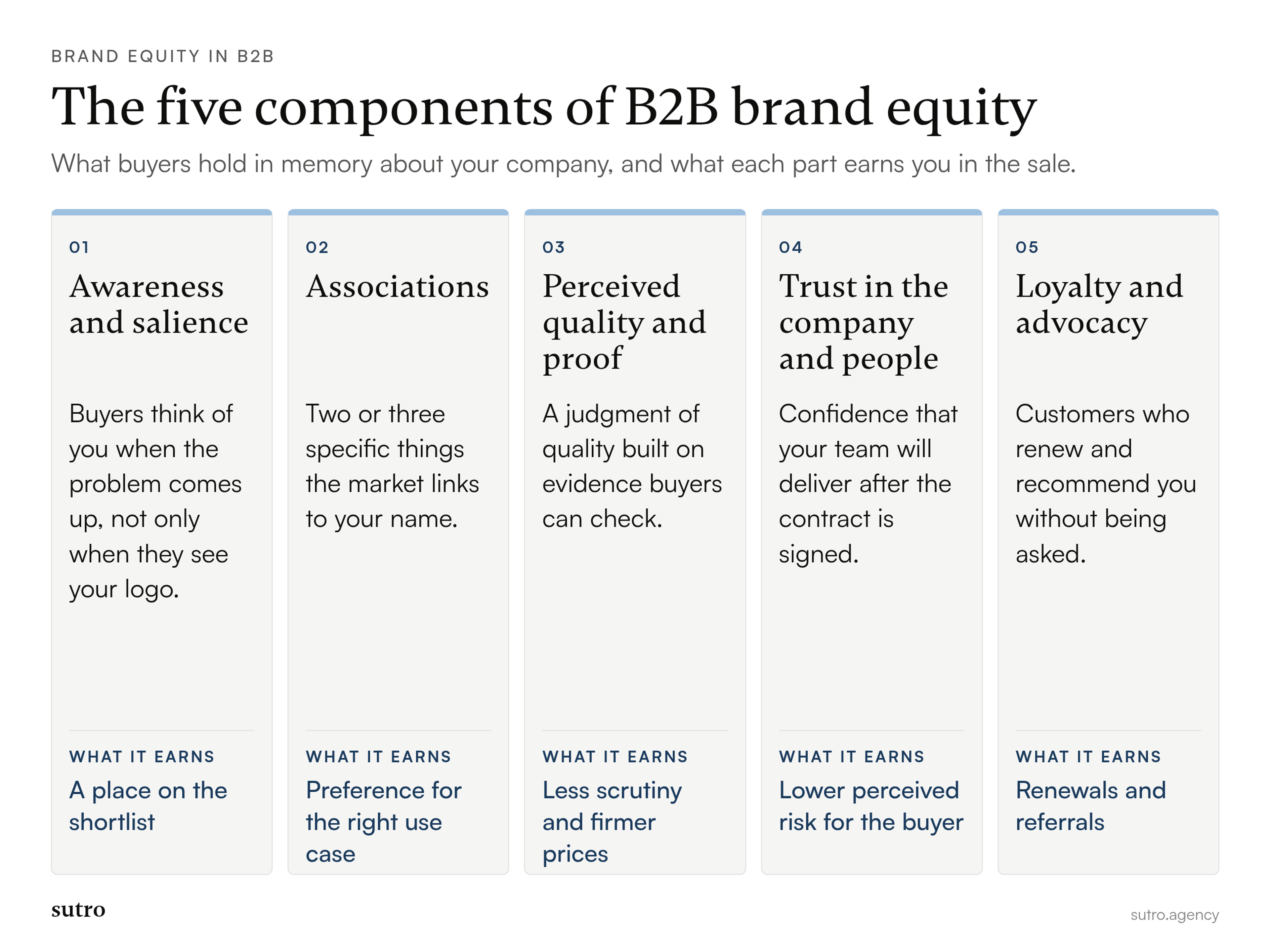
B2B brand equity has five components: awareness, associations, perceived quality, trust in the company and its people, and loyalty. The first four mirror the classic consumer models of brand equity. The fifth, trust, is the B2B adjustment, because buyers judge the seller, not just the product.
Awareness and salience
Awareness means buyers recall you when the problem comes up, not just recognize your logo when they see it. In B2B, salience is specific: the right people think of you in the right buying situation.
Associations
Associations are what buyers believe you stand for. Strong equity depends on a small number of specific, relevant associations, such as "the safe choice for regulated data" or "the fastest path to production for small platform teams." A long list of generic ones ("innovative," "scalable," "customer-centric") adds nothing, because every competitor holds the same list.
Perceived quality and proof
Perceived quality is the buyer's judgment of how good you are before they have used you. In technical markets it rests on things buyers can check: documentation, security practices, public benchmarks, reference customers, and how well your people answer hard questions.
Trust in the company and its people
Trust is the belief that the organization behind the product will deliver, stay stable and act in the buyer's interest. B2B purchases run through months of contact with sales engineers, implementation teams and support. Every one of those people adds to or draws from the corporate brand. This is where B2B equity differs most from consumer equity. In the B2B deals I have seen, the credibility of the seller often weighs more than the product brand itself.
Loyalty and advocacy
Loyalty is customers choosing you again, and advocacy is customers recommending you when nobody is paying them to. In B2B it shows up as renewals without heavy discounting, users who bring your product to their next employer, and customers willing to take a reference call.
Where B2B brand equity comes from
B2B brand equity comes from three sources: being known in the category before buyers need you, being clearly associated with one problem, and delivering what the brand promises.
Early presence is the strongest source. A buyer who first hears of you in a cold email starts at zero. A buyer who has read your engineering blog, heard your founder on a podcast and seen peers mention you in a community thread arrives with a picture already formed.
Focus is the second. Companies that try to stand for everything end up standing for nothing in particular. A narrow, clear association is easier to remember and easier to repeat.
Delivery is the third, and the one marketing controls least. Equity built by content and messaging is spent the moment a buyer's experience contradicts it. The proof has to be real, and the people who meet customers have to match what the brand says.
How to build B2B brand equity
You build B2B brand equity by choosing what you want to be known for, showing up before buyers need you, and making every touchpoint prove it, then holding that line for years. Equity is one outcome of the wider B2B brand strategy that sets where you compete. What follows is not a fixed sequence but the principles that build it: mental availability, consistency, proof and people.
Choose the associations you want to own
Pick two or three associations and drop the rest. They should be true today, matter to the people who sign, and be hard for a rival to claim honestly. This is a positioning decision, and it comes first. If it is not settled, work through how to define where a B2B brand competes and for whom before investing in reach.
Show up before buyers are in market
Most of your market is not buying right now, so build memory with them while they are not. Publish technical writing people use in their work, have a public point of view on problems in your category, and be present in the communities and events your buyers already attend. Tie every piece to the associations you chose, so each exposure reinforces the same memory.
Make your experts visible
In technical markets, people trust people who clearly know the work. Let your engineers, product leads and founders write and speak under their own names. Their credibility transfers to the company, and it gives buyers someone to judge besides a logo.
Turn claims into proof
A claim only adds equity when buyers can check it. Replace adjectives with evidence: published security documentation, reproducible benchmarks, named references who agreed to be named, and plain descriptions of how implementation actually goes. If you need a method for testing which claims are worth making, use a three-question test for every brand claim before you publish them.
Align every touchpoint
The website, the sales deck, the product, onboarding and support should all tell the same story in the same terms. A buyer who hears one promise from marketing and a different one from the sales engineer stops believing both. Give sales and customer teams the same language and proof marketing uses.
Stay consistent for years
Consistency is what turns exposure into memory. Teams get tired of their own message long before the market has absorbed it. Change the proof, the examples and the campaigns as often as you like; change the core associations only when the business itself changes.
How B2B brand equity erodes
B2B brand equity erodes through inconsistency, broken promises and discount-led selling. It takes years to build and only a few quarters of reactive decisions to damage.
Inconsistency is the most common cause. When the message, website and value proposition change every few quarters, buyers never form a clear association. The brand blurs into the category.
Broken promises do the deepest damage. If marketing promises a setup measured in minutes and the real integration takes an engineering quarter, the buyer remembers the gap, and technical communities share those stories quickly.
Habitual discounting teaches buyers that your list price is not real. Procurement learns to wait for the end of the quarter, and the brand starts to stand for a deal rather than for value. Once that association forms, it is hard to reverse.
Frequent repositioning is a quieter version of the same problem. Each new direction resets the memory you spent years building. Reposition when the market or the business has actually moved, not because the current message has become boring to you.
A B2B brand equity checklist by component
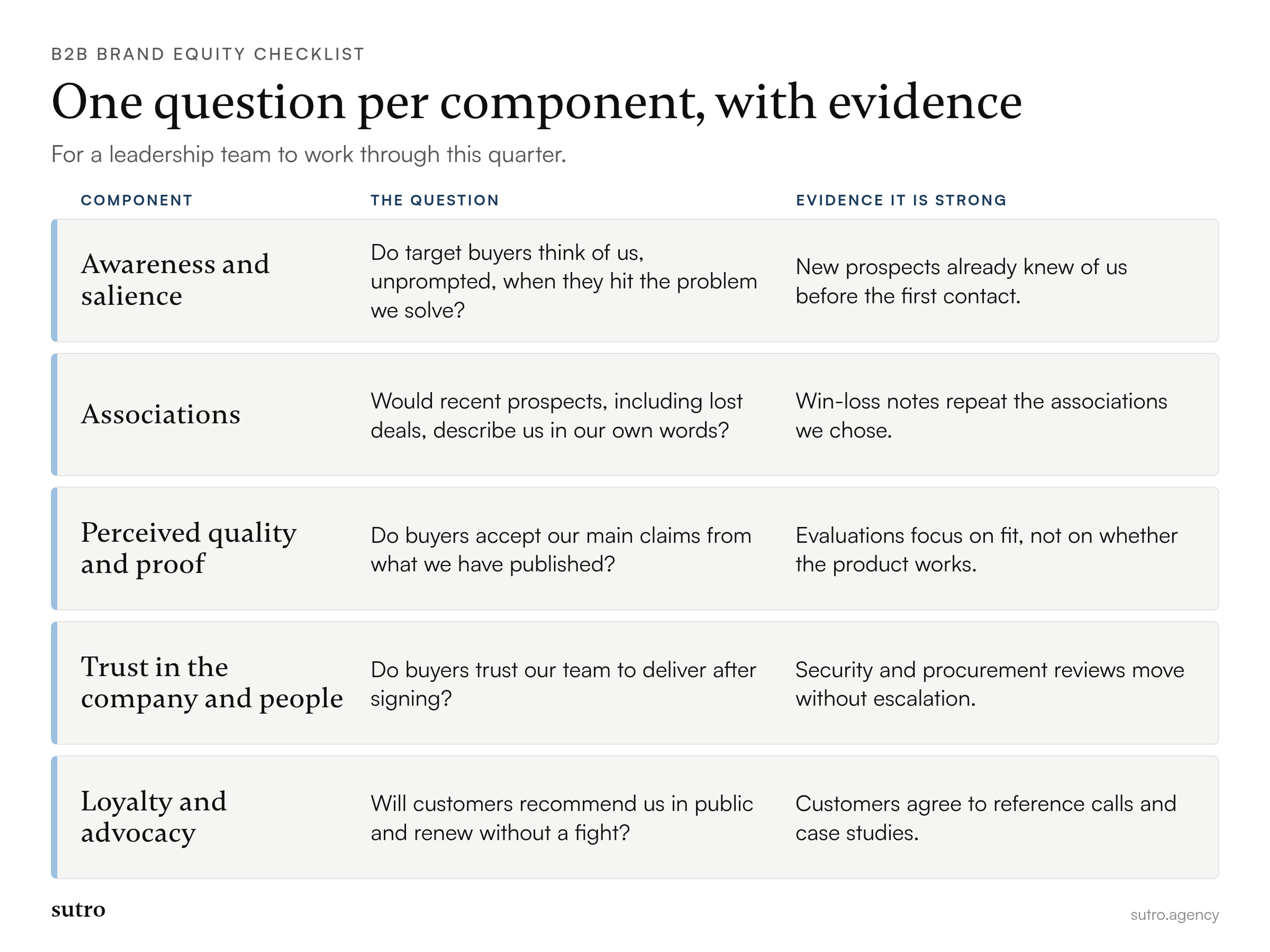
The fastest way to see your brand equity is to ask one hard question per component and look for evidence rather than opinions. Work through it as a leadership team, one component at a time. For each question, write down the evidence you actually have.
Check 1: awareness and salience
- Question: When our target buyers hit the problem we solve, do they think of us without being prompted?
- Evidence it is strong: new prospects say they already knew of you before the first contact, and inbound requests name the right use case.
- Warning sign: almost every new conversation starts from paid or outbound contact, and prospects cannot say what you do.
Check 2: associations
- Question: Would recent prospects, including lost deals, describe what we stand for in the same words we use?
- Evidence it is strong: discovery calls start from the right problem, and win-loss notes repeat your chosen associations.
- Warning sign: sales spends the opening of each call correcting what the buyer thinks you are.
Check 3: perceived quality and proof
- Question: Do buyers accept our main claims based on what we have published, or do they need custom proof each time?
- Evidence it is strong: technical evaluations focus on fit, not on whether the product works as described.
- Warning sign: prospects routinely ask for bespoke pilots to verify basic claims about security or scale.
Check 4: trust in the company and its people
- Question: Do buyers trust our team to deliver after the contract is signed?
- Evidence it is strong: security and procurement reviews move without escalation, and customers mention your people by name.
- Warning sign: late-stage deals stall over concerns about company stability, support or implementation risk.
Check 5: loyalty and advocacy
- Question: Are current customers willing to recommend us in public and renew without a fight?
- Evidence it is strong: customers agree to reference calls and case studies, and champions bring you into their next company.
- Warning sign: reference requests are declined and renewals depend on concessions.
If a component has no evidence at all, that is the answer. Start building there.
How to tell whether brand equity is growing
Growing brand equity shows up as commercial efficiency: more buyers who already know you, less friction in the sale and less pressure on price. You cannot measure a memory directly, but you can measure what it changes.
The signals to watch are the ones the checklist points to, tracked over time, with a baseline set before any brand investment so you can compare later. For the full method, including which metrics to track, leading and lagging indicators and how to present them to a CFO, see our guide to measuring B2B branding ROI.
Conclusion
Brand equity is the part of your advantage that competitors cannot copy from your product page. Features get matched and prices get undercut, but the trust and preference buyers already hold for your name take years to replicate.
Building it is mostly discipline: choose a few associations, show up before buyers need you, prove every claim, keep every touchpoint consistent, and avoid the discounting and repositioning that wear it down. If you are heading into a moment where your brand has to carry more weight, such as an enterprise push or a capital event, tell us which component of your brand equity feels weakest.
Questions
- What is the difference between brand awareness and brand equity in B2B?
- Awareness is whether buyers know your name and recall it in the right situation. Equity is the value attached to that name: what buyers believe about you and how much that belief changes their response. Awareness is one component of equity, not the whole of it.
- How long does it take to build brand equity in B2B?
- Expect years rather than quarters. B2B buyers enter the market rarely, so the memories that make up equity accumulate slowly across many exposures, and they only hold if the product and the people behind it deliver on what the brand says.
- Can a smaller company build brand equity against established competitors?
- Yes, usually by owning a narrower association than the incumbent can. Larger competitors often stand for something broad. A focused company that is clearly known for one problem, with public proof behind it, can build stronger equity within that niche.
- Is brand equity the same as brand value?
- No. Brand equity is about what buyers know and believe and how that changes their behavior. Brand value usually means a financial estimate of what the brand is worth to the business. Equity is the cause; financial value is one way of putting a number on the result.
- Who owns brand equity inside a B2B company?
- Marketing usually leads it, but it cannot own it alone. Sales, product, customer success and leadership all shape what buyers believe, so equity needs a shared set of associations and proof that every customer-facing team uses.
Sources
- Kevin Lane Keller: Conceptualizing, Measuring, and Managing Customer-Based Brand Equity (Journal of Marketing, 1993)
- Castillo-Villar and Murillo: Industrial brand equity, a systematic literature review and directions for future research (Cogent Business & Management, 2025)
- Bain & Company: Explore the B2B Elements of Value
- John Dawes, Ehrenberg-Bass Institute: Advertising effectiveness and the 95-5 rule