Strategy
What Is B2B Branding? A Practical Guide for Technical Companies
B2B branding is how a company earns a clear, credible meaning with every person who signs off on a purchase. Here is what it includes, how it differs from B2C, and how to build it.
Key takeaways
- B2B branding defines what a company means to the people who approve a purchase, then expresses that meaning consistently across marketing, sales, and product.
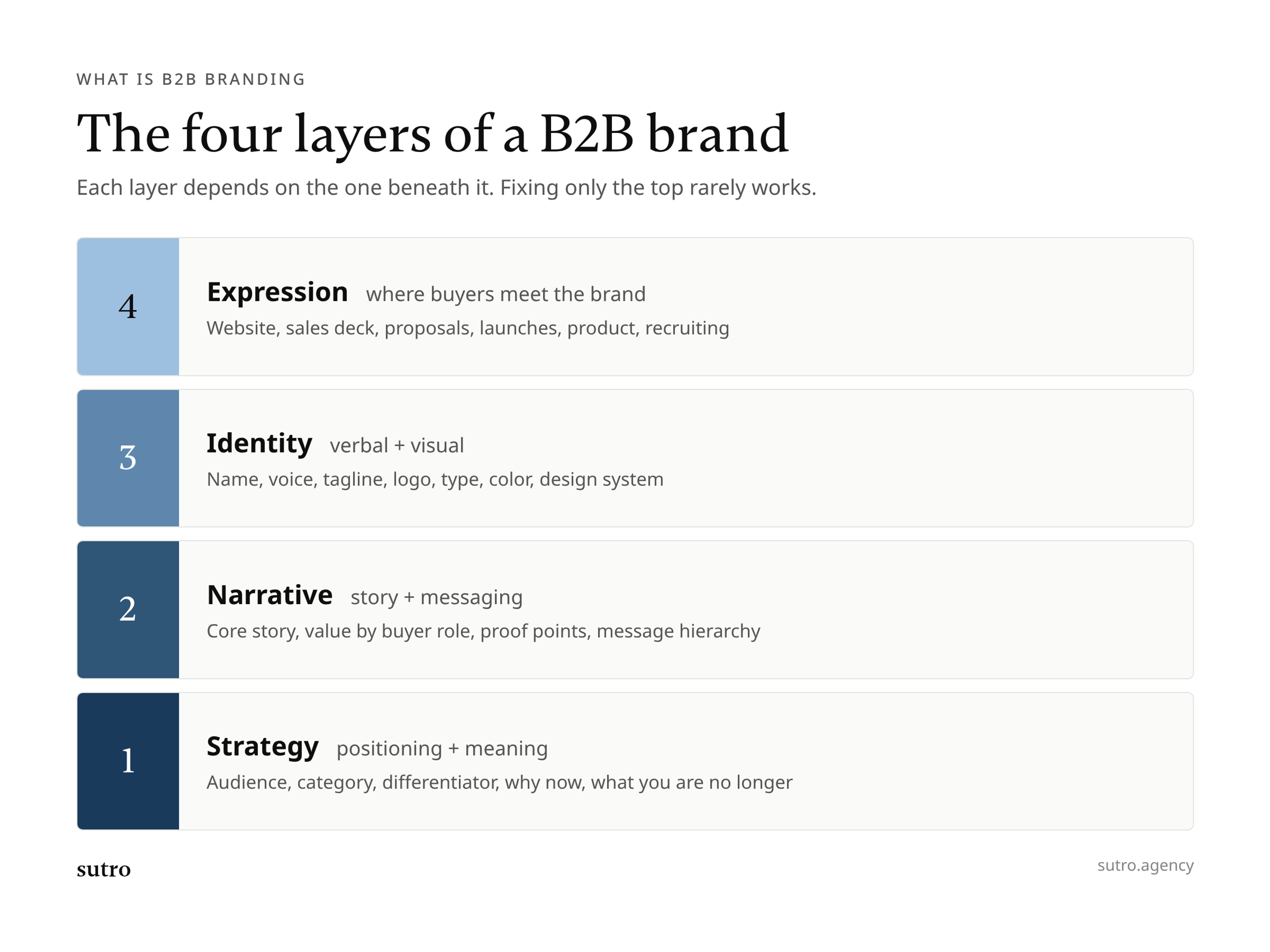
- A B2B brand has four layers: strategy (positioning), narrative (messaging), identity (verbal and visual), and expression (website, sales materials, launches).
- It differs from B2C branding because buying is done by groups, cycles are long, risk is high, and most of your future buyers are not shopping today.
- For technical companies, the most common brand problem is not bad design. It is a product that has evolved faster than the market's understanding of it.
- Measure the brand through business indicators such as win rate, sales-cycle length, pricing confidence, and branded search, not through awareness alone.
B2B branding is the work of deciding what a business-to-business company should mean in its market, and then making that meaning show up the same way everywhere a buyer meets it: the website, the first sales call, the deck, the security review, the proposal. The logo and visual identity are part of it. They are not the point. The point is that a committee of people who have never met you can explain why you are the safe, obvious choice.
That is the short answer I give founders. I'm Denis Pakhaliuk. I run Sutro, an independent B2B tech branding agency for companies at commercial inflection points, and I'm also the founder and CEO of Ramotion, a product and brand design agency that has been in the industry since 2009 and has completed more than 350 projects. The rest of this guide covers what B2B branding actually includes, how it differs from consumer branding, how to build it step by step, and how to tell whether it is working.
What is B2B branding?
The American Marketing Association defines a brand as any distinctive feature, like a name, term, design, or symbol, that identifies goods or services. That definition explains what a brand is made of. B2B branding is about what those features have to do.
In a business purchase, the brand has a job: reduce the perceived risk of choosing you and make your value easy to repeat. A champion inside the buying company has to explain you to a CFO, a security lead, and a VP who were not on the demo. If your brand gives that champion one clear sentence and a reason to believe it, you have a B2B brand. If the champion has to improvise, you have a logo.
So a practical definition is this: B2B branding is the strategic process of defining a company's market meaning and making it consistent, credible, and repeatable across every buyer touchpoint.
What B2B branding is not
- It is not a visual refresh. A new logo on an unclear position is a more expensive version of the same problem.
- It is not just marketing's job. Sales, product, leadership, and recruiting all express the brand, often more than the website does.
- It is not a one-time deliverable. Guidelines that nobody can use in a live deal do not change how the market sees you.
The four layers of a B2B brand
I find it helps to think of a B2B brand as a stack. Each layer depends on the one beneath it, which is why fixing the top layer alone rarely works.
1. Strategy: positioning and meaning
This is the foundation. Who is the company for, what category does it compete in (or create), what does it do better than the alternatives, and why does that matter now? Positioning also means deciding what the company is no longer. Many brands stall because they try to keep every past audience while chasing a new one.
2. Narrative: the company story and messaging
The narrative turns positioning into language people can repeat. It usually includes a core story (the change in the world, the problem it creates, and your point of view on solving it), a value proposition per buyer role, proof points, and a short message hierarchy. Good B2B messaging survives being said out loud by an account executive who is under pressure.
3. Identity: verbal and visual
Verbal identity is the name, tagline if you need one, tone of voice, and vocabulary. Visual identity is the logo, type, color, imagery, motion, and the design system that holds them together. In B2B, identity has a specific job: signal the right level of maturity. An enterprise buyer reads a brand that looks like a seed-stage startup as a risk, regardless of how good the product is.
4. Expression: where buyers actually meet the brand
Expression is the website, product marketing, sales decks, proposals, analyst briefings, launch campaigns, recruiting pages, and the product interface itself. In my experience, this is where most B2B brands break. The strategy lives in a PDF, and the sales team quietly writes its own version of the story in slides.
B2B vs. B2C branding: what actually changes
Branding principles are the same in both worlds: be distinctive, be consistent, be remembered. What changes is the buying context, and that changes the work.
- Groups, not individuals, decide. A B2B purchase usually needs sign-off from several roles with different fears. The brand has to give each of them a reason to say yes, and give the champion language to align them.
- Cycles are long. Weeks or months pass between first contact and signature. The brand has to stay coherent across every artifact produced in that time.
- The cost of a wrong choice is personal. Buyers are protecting their budget and their reputation. Credibility and perceived safety often matter more than delight.
- Most of your market is not buying today. LinkedIn's B2B Institute calls this the 95-5 rule: about 95% of your potential buyers are not ready to buy today, a finding it ties to its joint research with the Ehrenberg-Bass Institute. The brand is how you are remembered when they come back into market.
- The product is often complex. In technical categories the brand has to translate engineering advantage into business value without losing accuracy.
None of this makes B2B branding purely rational. People in buying committees still respond to clarity, confidence, and how a company makes them feel about their decision. The difference is that emotion in B2B usually shows up as trust and relief rather than excitement.
Why B2B branding matters for growth
For a long time, many B2B companies treated brand as something to do after demand generation was working. That view is changing because the economics of a long buying cycle reward memory.
Les Binet and Peter Field's IPA study The Long and the Short of It examines the tension between short-term response activity and long-term brand building, and warns that relying on very short-term online metrics can have dangerous implications for long-term success. B2B is especially exposed here: when 95% of the market is not ready to buy, activity that only captures the ready 5% leaves the rest of the future pipeline to whoever they remember.
In practice, a strong B2B brand helps a company in a few concrete ways:
- It shortens explanation. When the market already understands what you are, sales calls start further along.
- It supports price. Buyers pay more for the option that feels lowest-risk and clearest.
- It aligns the company. One story reduces the number of improvised versions across sales, marketing, and leadership.
- It travels without you. Champions, investors, analysts, and candidates can retell it accurately.
When a technical B2B company needs branding work
Brand work is most valuable at moments when the cost of being misunderstood goes up. At Sutro I see the same business events over and over: moving upmarket, creating a category, raising capital, preparing for exit, consolidating after an acquisition, recovering lost differentiation, rebuilding enterprise trust, and launching a product platform.
The underlying pattern is usually the same. The product has matured, the buyer has changed, and the brand still describes the company that existed two rounds ago. That gap is why I built Sutro around these moments. Signs you are there:
- Sales teams rebuild the pitch deck for every large deal.
- Prospects describe you using a competitor's category or a feature you shipped years ago.
- Enterprise buyers ask for more proof than your product warrants.
- New hires cannot explain what the company does in one sentence.
- Leadership calls it a website problem, but a new website would not fix it.
How to build a B2B brand, step by step
The process below mirrors how I run Sutro engagements, described on our About page. It works whether you run it with an agency or internally.
Step 1: Diagnose the business moment
Start with the commercial event, not the creative brief. What is about to happen (an enterprise push, a raise, an acquisition) and what does the market need to believe for it to succeed? Interview customers, lost prospects, sales, and leadership. Look for the perception gap: the distance between what the company is and how buyers describe it.
Step 2: Define positioning and narrative
Choose the audience, category, and differentiator. Write the core story and the message hierarchy. Make the hard choices explicit, including which segments and messages you are leaving behind. This step needs leadership in the room, because positioning is a business decision.
Step 3: Build the brand system
Translate the strategy into verbal identity, visual identity, messaging by role, and website direction. Design for use, not for the guidelines document: test the system on a real sales deck, a product page, and a security questionnaire cover note.
Step 4: Activate across the company
Roll the new story out to sales, marketing, product, recruiting, and leadership. Give people the tools and the language, then audit the high-stakes touchpoints (homepage, main deck, proposal template) first. A brand that sales cannot use under pressure is not finished.
How to measure B2B branding
Awareness surveys have their place, in my view, but they are hard to connect to revenue. A more useful approach is to pick business indicators the brand should move and watch them before and after the work. The ones I organize Sutro engagements around are:
- Enterprise conversion and qualified pipeline
- Win rate against named competitors
- Sales-cycle length
- Pricing confidence (discounting frequency and depth)
- Branded search volume
- Investor comprehension and recruiting strength
Qualitative signals count too. Listen to how prospects describe you on first calls and how champions summarize you in internal emails. When their words start matching your narrative, the brand is working.
Common B2B branding mistakes
- Starting with the logo. Visual work before positioning produces a nicer version of an unclear message.
- Describing features instead of meaning. Technical teams default to what the product does. Buyers need to know what changes for them.
- Trying to speak to everyone. A brand built for every segment is credible to none of them.
- Leaving sales out. If the people closing deals were not part of the process, they will keep using the old story.
- Treating launch as the finish line. The brand has to be maintained as products, markets, and buyers keep moving.
Conclusion
B2B branding is not decoration and it is not a single launch. It is the discipline of deciding what your company should mean to the people who buy it, and then making that meaning hold in every room where a decision is made. For technical companies, the opportunity is usually large and specific: the product is already strong, and the market simply does not understand it yet.
If your product has evolved faster than the market's understanding of it, that is the moment to do the work. If you are approaching that kind of transition, talk to me at Sutro.
Questions
- What is the difference between B2B branding and B2B marketing?
- B2B branding defines what the company means and how it should be perceived. B2B marketing is the set of activities, such as campaigns, content, events, and demand generation, that carry that meaning to the market. Branding sets the story; marketing distributes it.
- What does a B2B branding agency do?
- A B2B branding agency helps a company define its positioning, narrative, and identity, and then builds the brand system and the key expressions such as the website and sales materials. Specialized agencies focus on the context of business buying: committees, long cycles, and the need for credibility.
- How long does a B2B branding project take?
- It depends on scope. A focused repositioning with messaging and identity typically takes a few months, and activation across the website and sales materials continues after that. The bigger factor is usually how quickly leadership can make decisions about positioning.
- Is B2B branding only for large companies?
- No, but timing matters. Branding pays off most when a company has real product strength and a high-stakes moment ahead, such as moving upmarket or raising a round. Very early companies are often better served by validating the product first.
- What are the elements of a B2B brand?
- The core elements are positioning, a company narrative and messaging framework, verbal identity (name, voice, tagline), visual identity (logo, type, color, design system), and the expressions where buyers meet the brand, such as the website, sales deck, and product.