Positioning
B2B Brand Differentiation: How to Stand Out in a Crowded Category
B2B brand differentiation is a real, provable reason for buyers to choose you over every alternative, including doing nothing. Here is how to find it, test it and show it.
Key takeaways
- B2B brand differentiation is a provable reason to choose you over every real alternative, including in-house builds and doing nothing.
- Differentiation is not positioning and not distinctiveness: positioning sets the frame, differentiation fills it, and distinctiveness makes the brand recognizable.
- Features are easy to copy; durable differences come from architecture, expertise, implementation, risk reduction and customer experience.
- Run a sameness check with names removed, then put every claim through three questions: can a rival say it, can you prove it, does the buyer care.
- A differentiated claim is only as strong as the evidence published behind it.
B2B brand differentiation is a real, provable advantage that gives a buying group a reason to choose you over every alternative on the table, including a rival vendor, an in-house build and doing nothing at all. It only works when three things are true at once: competitors cannot honestly say the same thing, you can prove it, and the buyer cares about it.
Most technical teams believe they already have this. Read their homepage next to three rivals, though, and the lines blur: real-time, secure, scalable, built for the enterprise, powered by AI. The product may be better. The brand does not say how, so the buyer falls back on price, brand familiarity or the safest option.
This is the part of B2B branding I spend the most time on with founders and marketing leaders. I started Sutro as a team of B2B branding experts for technical B2B companies at commercial inflection points, such as moving upmarket, raising a round or recovering ground after a well-funded rival enters the category. I am also the founder and CEO of Ramotion, which has been in the industry since 2009 and has completed more than 350 projects. The pattern I see most often is a strong product described in the same words as everyone else's.
This guide covers what differentiation is and is not, where durable differences come from, a sameness check you can run in an afternoon, a three-question test for every claim, and a worked example that takes one generic claim to a differentiated one.
What B2B brand differentiation is, and what it is not
Differentiation is the specific, provable reason a buyer should pick you. It sits between two ideas it often gets confused with: positioning and distinctiveness.
- Positioning is the frame: who the product is for, which category it competes in and which alternatives it is compared with. This guide does not repeat that work. If you have not set it yet, start with our five-step framework for positioning a B2B brand and come back.
- Differentiation is the content inside that frame: the capability, method or proof that makes you the better choice for those buyers against those alternatives.
- Distinctiveness is recognition: the name, colors, type, voice and recurring assets that let buyers identify you without reading the logo.
The distinction matters because the two do different jobs. Jenni Romaniuk, Byron Sharp and Andrew Ehrenberg asked buyers in 17 consumer markets across Australia and the UK whether the brand they used was different or unique. On average, only 11% of current users saw their own brand as different and 10% as unique, yet those brands were still bought. Their conclusion was that distinctiveness deserves more weight than most brand strategy gives it.
I take two things from that for B2B. First, do not assume buyers notice a difference just because you have one. Second, do not treat a visual refresh as differentiation. A distinctive look makes you easy to find and remember. It does not tell a skeptical engineer or a CFO why you are the safer bet. B2B brands need both, and they need to know which is which.
Why feature claims stop working
Features are the weakest place to differentiate because they are the easiest to copy. A new integration, a cleaner dashboard or a faster query path is a real improvement, but a funded competitor with a capable engineering team can usually ship something similar within a few release cycles, and AI-assisted coding has shortened that cycle further.
When the brand rests on a feature, every copy erodes the story. The buyer ends up with two comparison sheets that look alike and asks for a discount.
There is a second problem. Many claims that feel like differentiators are table stakes: SOC 2, SSO, an uptime SLA, a modern interface. Buyers expect them. They get you into the evaluation; they do not win it. Listing them on the homepage as reasons to choose you signals that you do not have better ones.
None of this means features do not matter. It means the feature is evidence, not the differentiator. The differentiator is the harder-to-copy thing that produces the feature, and the outcome it creates for the buyer. I wrote more about turning a technical fact into buyer preference in a separate guide.
Five sources of durable differentiation
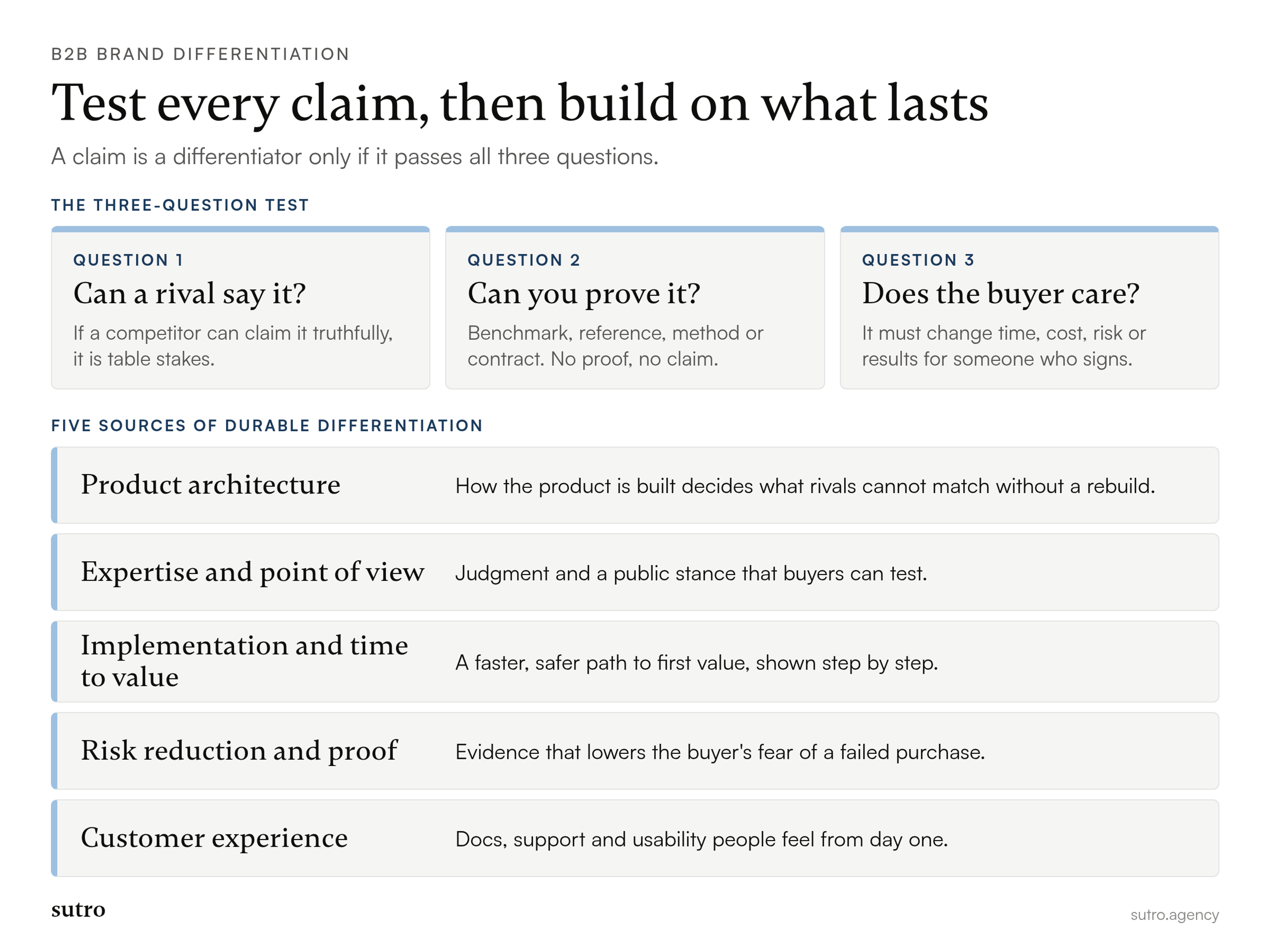
Durable differences come from things that are slow, expensive or impossible for a rival to replicate. In technical B2B categories, they usually come from five places.
Product architecture
How the product is built decides what it can and cannot do. A different data model, a different deployment approach or a design decision made early, such as running inside the customer's own cloud account, can produce advantages a competitor cannot match without rebuilding. Architecture is a strong differentiator when you can explain, in plain language, what it lets the buyer do that the alternatives cannot.
Expertise and point of view
Buyers in complex categories buy judgment as well as software. A team that wrote the standard everyone else implements, or that has run the exact workload the buyer runs, has an advantage that is hard to copy. So does a clear, defensible point of view on where the category is wrong. A point of view only counts if you are willing to say it in public and some buyers disagree with it.
Implementation and time to value
For many buyers the real risk is not the product, it is the rollout. If you can get a customer to first value meaningfully faster than the alternatives, and you can show how, that is a commercial advantage buyers feel directly. It is also harder to copy than a feature, because it lives in process, tooling and people.
Risk reduction and proof
Enterprise buyers are often more afraid of a failed purchase than excited about a successful one. Matthew Dixon and Ted McKenna studied more than two and a half million sales conversations for their book on customer indecision and concluded that once buyers intend to purchase, their main concern is not failing. A vendor that lowers that fear with references in the buyer's industry, transparent security documentation, a clear exit path or contractual commitments has a real difference, even in a category where the products look similar.
Customer experience
How it feels to be your customer can set you apart: the quality of documentation, how fast a real engineer answers a support ticket, how little training the product needs. In categories known for heavy, slow tools, a product that people can use on day one is a reason to choose it. This lever is easy to claim and hard to prove, so it needs the most evidence.
Name what you are really competing against
Your differentiation has to win against the buyer's real alternatives, and the strongest one is often not another vendor. A buying group can also decide to build in-house, stretch a tool they already own, or change nothing and live with the problem.
Each alternative needs a different argument. Against a rival vendor, you show what you do that they cannot. Against an in-house build, you show the cost and time the team would spend to reach your level. Against doing nothing, you show the cost of the current problem and make the change feel safe. The positioning work names these alternatives. Differentiation is where you write the specific argument for each one.
The sameness check: see your category the way buyers do
The sameness check is a simple method to find out how much your messaging blends in. It takes an afternoon and needs no research budget. I use a version of it before any messaging work, because teams rarely see their own copy the way a buyer does.
- Collect the lines buyers actually read. For your company and three to five of the closest alternatives, copy the homepage headline and subheadline, the first line of the main product page and the "why us" section. Add one line for the do-nothing option: how the buyer's current workaround would describe itself.
- Strip every name. Replace product and company names with [Vendor], remove logos and colors, and paste the lines into one document in random order.
- Ask people to match them. Give the document to three people who know the market: a seller, an engineer and, if you can, a recent customer. Ask them to mark which lines are yours.
- Mark the shared words. Highlight every word or phrase that appears in the copy of two or more vendors. Words like seamless, scalable, enterprise-grade and AI-powered usually light up first.
- Send weak lines to the test. Every line of yours that nobody could pick out, or that shares its main claim with a rival, goes through the three-question test below.
My rule of thumb: if people who know your market cannot pick out your copy with the names removed, buyers comparing tabs will not either.
The three-question differentiation test
Every claim you plan to use as a differentiator should pass three questions. If it fails any one of them, rewrite it or drop it.
Can a competitor truthfully say the same thing?
If a rival can make the same claim without lying, it is a category requirement, not a differentiator. "Secure," "reliable" and "easy to use" fail here almost every time. Look for claims that would be false, or at least awkward, on a competitor's site.
Can you prove it to a skeptical buyer?
A claim without evidence is an opinion. Proof can be a public benchmark with its method, an architecture note, a customer reference, a documented process or a contractual commitment. If the proof does not exist yet, the claim is a roadmap item, not a message.
Does the buyer care?
A clever technical advantage that does not change the buyer's time, cost, risk or results will not move a deal. Tie each claim to an outcome a specific person in the buying group is measured on, and check it against how real customers describe why they chose you.
A worked example: from generic claim to differentiated claim
To show how the test works, here is an illustrative example. The company is hypothetical, and the bracketed values stand for measurements a real team would have to produce; I am not suggesting any specific numbers.
Imagine a data infrastructure vendor that keeps operational databases in sync with a warehouse. Its first homepage line reads: "Real-time data integration for the modern enterprise."
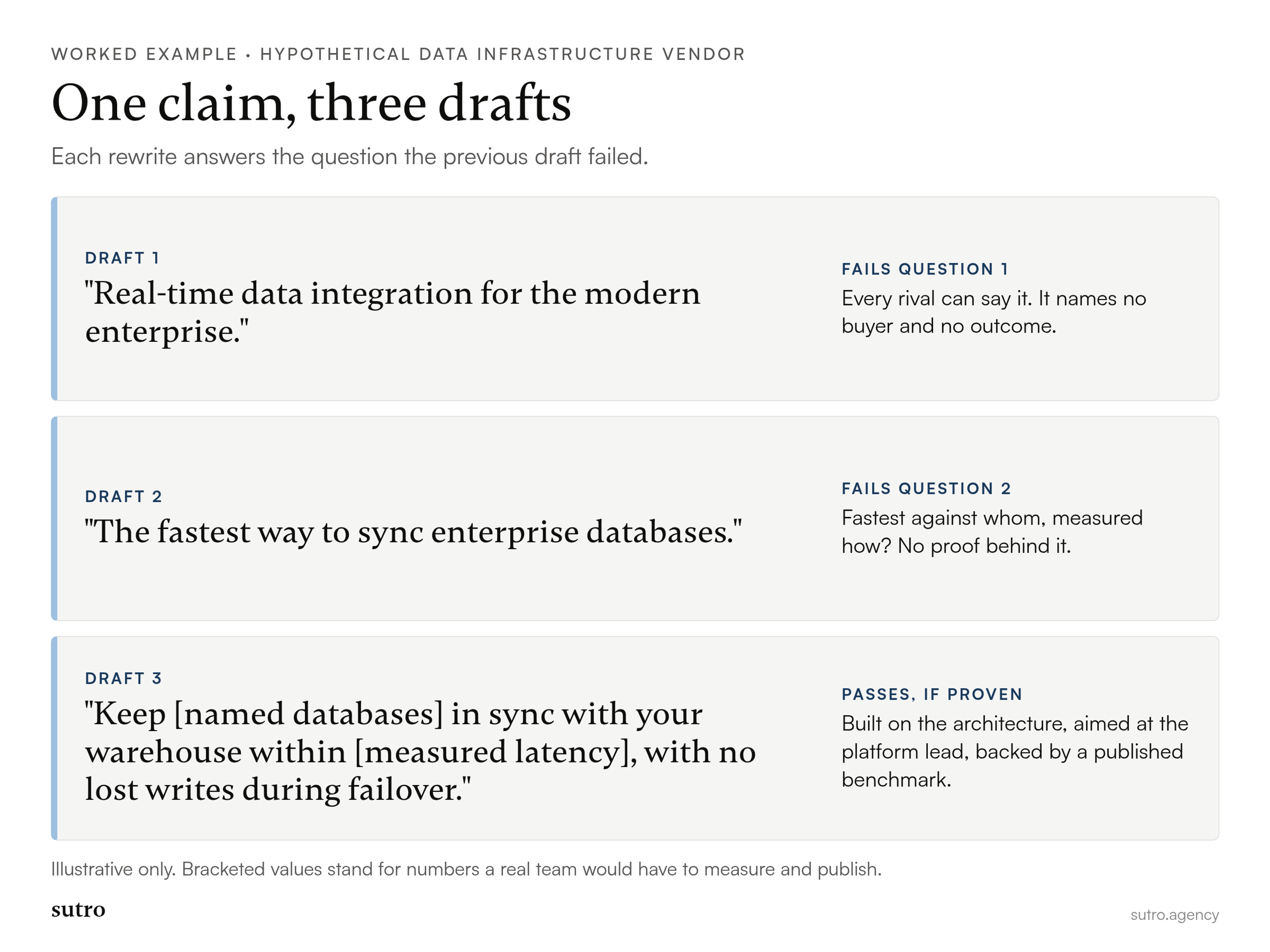
Draft 1 fails the first question. Every rival says real-time. "Modern enterprise" says nothing about who it is for.
Draft 2 comes from a team discussion about what is actually different: "The fastest way to sync enterprise databases." It is more specific, but it fails the second question. "Fastest" against whom, measured how? A skeptical platform lead will ignore it.
Draft 3 starts from the architecture and the person who cares. The team knows its design keeps writes in order during a failover, which is the moment that pages the platform team at night. The line becomes: "Keep [named source databases] in sync with your warehouse within [measured latency], with no lost writes during failover." Underneath it sits the proof: a published benchmark with its method and an architecture note explaining why ordering survives a failover.
Draft 3 passes all three questions, but only if the bracketed numbers are real and published. That is the point of the example. The quality of the claim depends on the evidence behind it, not on the writing.
Show the difference everywhere buyers look
Once a differentiator passes the test, it has to show up consistently, because buyers meet you in many places before they sign and different people in the group see different parts of the brand.
- Website: the headline carries the differentiator, and the proof sits one scroll away, not three clicks deep.
- Sales materials: the deck and the demo follow the same claim and show the same evidence, so the champion can repeat it to people you never meet.
- Product and docs: the product experience delivers what the brand promised. A differentiator built on simplicity collapses during a confusing onboarding.
- Visual identity: this is where distinctiveness does its job. Consistent colors, type, voice and recurring assets make the differentiated message easy to recognize every time it appears.
Repetition matters more than novelty here. Teams tire of their own message long before the market has noticed it.
Common differentiation mistakes
The same few mistakes show up in most technical categories.
- Claiming too many differences. Ten small advantages read like none. Pick the two or three that pass the test and matter most to your best customers.
- Hiding behind jargon. Dense terminology can feel like authority from the inside. To a buying group, plain language that explains the mechanism reads as mastery.
- Differentiating on table stakes. Compliance badges and integrations belong on the page, but not as the reason to choose you.
- Ignoring the do-nothing option. A message built only against rival vendors leaves the most common outcome unaddressed.
- Treating a redesign as differentiation. A new look without a new, provable claim makes you more recognizable, not more preferable.
Conclusion
B2B brand differentiation is not a slogan. It is a short list of claims that competitors cannot honestly copy, that you can prove and that matter to the people who sign. Find them by reading your category the way buyers do, test every claim against the three questions, and carry the survivors consistently from the homepage to the product.
If your messaging reads like everyone else's in your category, tell us which claim you would most like to prove.
Questions
- What is the difference between brand positioning and brand differentiation?
- Positioning decides who the product is for, which category it competes in and which alternatives it is compared with. Differentiation is the specific, provable reason those buyers should choose you over those alternatives. Positioning comes first; differentiation fills it with claims and proof.
- Can visual design be a B2B differentiator?
- Design mostly creates distinctiveness: it makes you easier to notice and recognize. That matters, but it rarely gives a buying group a reason to choose you on its own. Use design to carry a differentiated claim consistently, not as a substitute for one.
- How many differentiators should a B2B brand have?
- Usually two or three. Each should pass the three-question test and connect to an outcome a specific person in the buying group cares about. Longer lists dilute the strongest claim and are hard for sales teams to repeat.
- How do you differentiate when products are functionally similar?
- Look beyond the product: how fast customers reach value, how well you reduce the risk of a failed purchase, the depth of your expertise, and the quality of documentation and support. These are harder to copy than features, but each still needs proof.
- How often should a company revisit its differentiators?
- Review them when the market shifts: a rival matches your main claim, you move upmarket, or customers start describing their reasons for choosing you differently. Changing the core claim too often confuses buyers, so adjust the proof more often than the claim.