Positioning
Branding a Technical B2B Product: How to Turn Product Advantage into Market Preference
A better product rarely wins on architecture alone. How to translate technical advantage into a brand that the engineer evaluating it and the executive paying for it both believe.
Key takeaways
- Technical advantage only becomes market preference after it is translated into practitioner value and business outcomes.
- Every technical deal has at least two readers: the evaluator looking for weak points and the economic buyer weighing risk and cost.
- Run each real differentiator through a four-step chain: technical reality, evaluator value, economic value, market preference.
- Build the identity as evidence: real interfaces, accurate system diagrams and legible typography instead of generic illustrations.
- Documentation, changelogs and status pages are part of the brand, because evaluators decide there whether your claims hold.
Branding a technical B2B product means translating what the product does better into reasons two different buyers can repeat: the engineer who evaluates it and the executive who pays for it. Preference comes from that translation, not from the architecture itself. A technical fact only becomes a reason to buy once it is tied to a practitioner benefit and a business outcome, and once the brand shows proof for both.
Engineering teams tend to assume the better product wins by default. They build cleaner architecture, ship faster and handle edge cases competitors ignore. Then they watch a weaker product take the category because its story was easier to understand.
I founded Sutro to work on exactly this gap, and I have run Ramotion since 2009, across more than 350 projects. The pattern I see most often in branding for engineering-led B2B teams is the same: the company knows its advantage in detail, but its website, deck and docs describe that advantage in the team's own internal language. Buyers are left to do the translation themselves, and most of them won't.
Why technical advantage doesn't turn into preference on its own
Technical advantage stays invisible to the market until someone translates it, because buyers purchase outcomes, not architecture. They pay for lower risk, faster delivery and less operational friction. The architecture is how you deliver those things, which matters, but it is not what the buyer is shopping for.
The curse of knowledge
Founders of technical companies know how hard their system was to build. That knowledge makes it difficult to imagine a reader who doesn't share it. The result is messaging that reads like an internal spec: features, endpoints, infrastructure choices and benchmark names with no explanation of why they matter to the person reading.
This fails because it assumes the buyer has the time and context to connect each fact to their own problem. Most don't. If a visitor has to work out what your product changes for them, they leave and look at the alternative that made it obvious.
What market preference actually is
Market preference is the buyer's belief that your product is the safest and most effective choice for their specific problem. It is a commercial and psychological outcome, so it has to be built on purpose.
A simple test helps here. Every claim you make should contain three parts: the technical truth, what it lets a user do, and the business result it produces. Skip the business result and executives tune out. Skip the technical truth and engineers stop trusting you.
Two audiences in every technical deal
A technical B2B purchase is almost never made by one person, so the brand has to convince at least two very different readers at once without losing either. In most deals those are the technical evaluator and the economic buyer.
The technical evaluator
The technical evaluator is the senior engineer, platform lead or architect asked to check whether your product holds up. They read looking for flaws and treat marketing copy with suspicion.
This reader often goes to your documentation before your landing pages. They care about rate limits, latency, security posture, deployment effort and how your product fits the systems they already run. You win them with precision: accurate architecture diagrams, real code samples, honest limits and docs that answer questions before they are asked. Abstract illustrations and vague claims cost you credibility with this reader.
The economic buyer
The economic buyer is the CTO, VP of Engineering, CFO or business owner who controls the budget and signs the contract. They rarely care how elegant the codebase is.
This reader cares about risk, total cost of ownership, time to value and how the purchase supports the plan they have committed to. If your messaging is all specifications, they file your product as a low-level utility rather than a strategic decision, and utilities get bought on price.
The two readers also meet. The evaluator writes the internal recommendation, and the economic buyer reads it. Your brand has to give the evaluator the language to make the business case for you.
The translation chain: from technical fact to preference
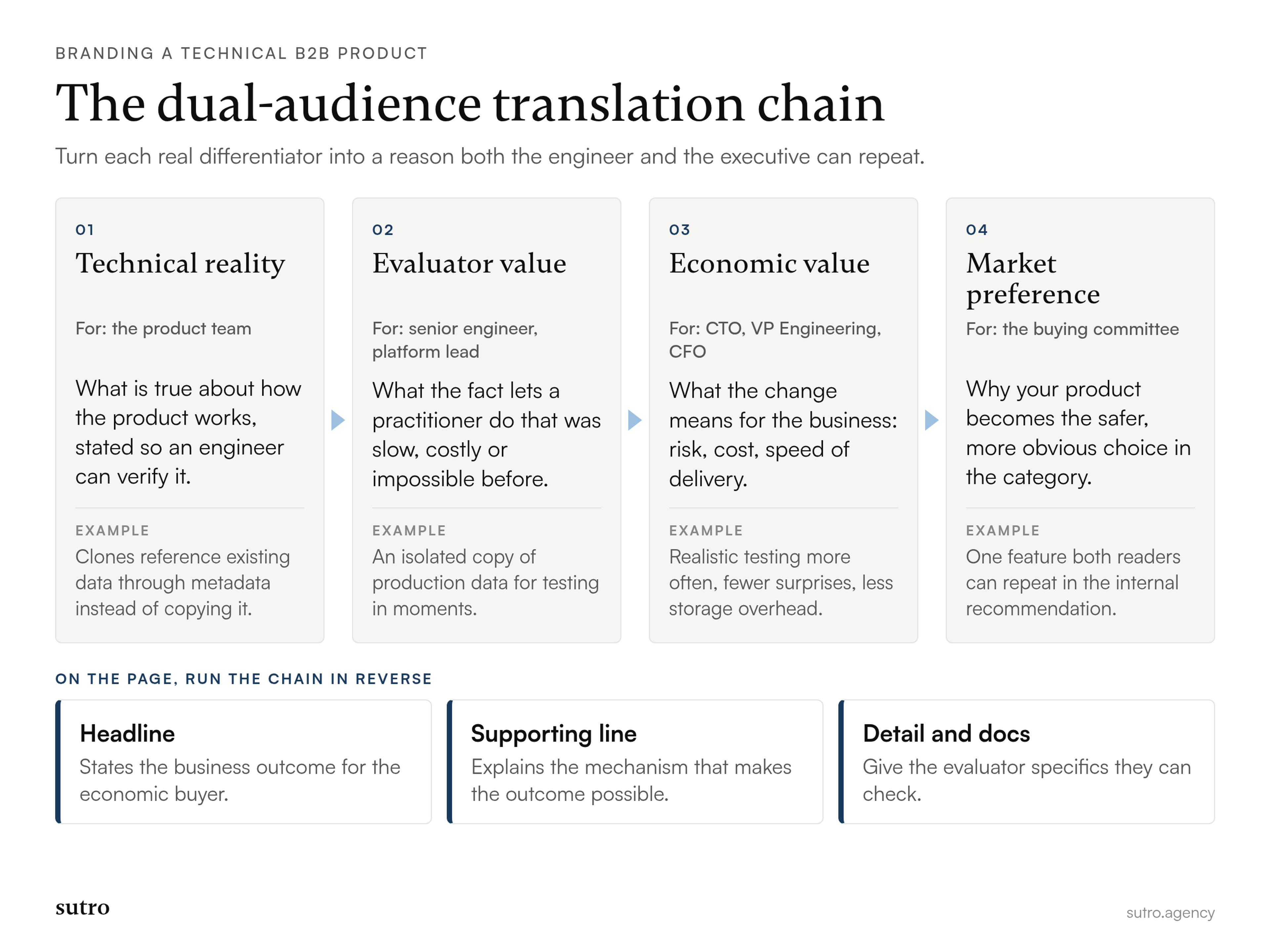
The core of technical branding is a four-step translation chain that you apply to every real differentiator. Each step answers a different question for a different reader.
- Technical reality. What is true about how the product works? This is the fact, stated precisely enough for an engineer to verify.
- Evaluator value. What does that fact let a practitioner do that they could not do before, or do with less effort?
- Economic value. What does that change mean for the business: lower risk, lower cost, faster delivery?
- Market preference. Why does this make your product the safer, more obvious choice in the category?
Take a data platform that supports zero-copy cloning. The technical reality is that a clone references the existing data through metadata instead of duplicating it. The evaluator value is that engineers can spin up an isolated copy of production data for testing in moments, without waiting for a full copy or paying to store a second set. The economic value is that teams test against realistic data more often, so they ship with fewer surprises and less infrastructure overhead. Stated that way, one feature becomes a reason both readers can repeat.
Lead with the outcome, prove it with the mechanism
On the page, the chain usually runs in reverse. The headline states the outcome for the business. The supporting line explains the mechanism that makes it possible. The detail below, or one click away in the docs, gives the evaluator the specifics to verify it.
This order lets the economic buyer understand the value in a few seconds and lets the evaluator confirm it is real. A headline that is only a mechanism loses the first reader. A headline that is only an outcome, with no mechanism anywhere nearby, loses the second.
Pick the few differentiators that matter
Not every feature deserves the full chain. Choose the handful of capabilities that are both genuinely different and connected to a problem buyers already feel. A long list of translated features is still a spec sheet. A short list of translated advantages is a position.
Find the value your customers already describe
Before you write new copy or touch the visual identity, find out how the market already understands your product. At Sutro we call this the Diagnose stage, and for technical companies it usually reveals that customers value the product for a different reason than the team assumes.
Interview the people who chose you
Talk to recent customers, ideally both the evaluator and the buyer on the same account. Ask how they describe the product to a colleague, what they compared it with, and what changed after they deployed it. Then compare their words with your homepage.
The gap is usually large. A team may believe it sells raw performance, while its customers talk about fewer late-night incidents or not having to maintain an internal tool. The phrases customers use unprompted are the best raw material for messaging, because they are already in the buyer's language.
Name the real alternatives
Positioning is always relative to what the buyer would do without you. Sometimes that is a direct competitor. Often it is an open-source project the team maintains itself, a legacy system, a spreadsheet, or doing nothing. Your brand should answer the specific frustrations of that alternative. If the real competitor is a self-hosted tool that needs constant care, stability and a managed experience are the story.
I covered this part in more depth in a step-by-step positioning process. For a technical product, the main addition is to run the translation chain on each capability that survives the comparison.
Build the identity as evidence
For technical buyers, the brand identity works as evidence of how the company builds software. Consumer brands lean on emotional association. Technical B2B brands earn trust through clarity, structure and visible proof.
Design for clarity, not decoration
Technical buyers have seen every generic software illustration, and they discount it. A visual identity for a technical product should make complex information easy to read: a clear type hierarchy, typography that stays legible in code blocks and data, a restrained color palette that directs attention, and layouts that show structure. Design here is about lowering the reader's effort, so the substance carries the page.
Show the real product and the real system
When evaluators look at your site, they look for evidence. Replace stock scenes and floating charts with real interfaces. If the product has no meaningful interface, show the system: accurate diagrams of how data moves, where the product sits in the stack and what it touches. Treat the visual identity as an extension of the documentation, and the evaluator reads that as respect for their expertise.
Documentation, changelogs and community are brand
For a technical product, the brand lives as much in the documentation, changelog and status page as on the homepage. This is where evaluators spend their time, and it is where they decide whether your claims hold.
Treat documentation as a primary brand asset
Developers rely on documentation more than almost any other resource. In the 2024 Stack Overflow Developer Survey, technical documentation was the most used online resource for learning to code, and API and SDK documents were the documentation source of choice for about 90% of respondents (Stack Overflow).
Many companies still treat docs as an afterthought, on a separate subdomain with its own styling and weak search. That undoes the work of the main site. Documentation should share the brand's voice and visual system, load fast, stay accurate and be easy to navigate. When an evaluator sees that kind of care in the docs, they assume the same care went into the product.
Earn trust in public
If your product touches the developer ecosystem, the community's view of you is part of your brand. Publish real engineering write-ups, including what broke and how you fixed it. Keep a changelog that is honest about what changed. Contribute to the open-source projects you depend on. Leave a meaningful share of your educational content open, without a lead form in front of every page. Over time this builds goodwill that a competitor cannot copy quickly.
Mistakes engineering-led teams make
The most common branding mistakes in technical B2B come from either borrowing the wrong playbook or refusing to make choices. Both get more expensive as the company moves upmarket.
Marketing like a consumer brand
Some teams react to a dry, spec-heavy brand by swinging to the other extreme: playful mascots, casual copy and trendy gradients. That rarely works for enterprise buyers. A security leader evaluating network infrastructure is not looking for a fun vendor. They want a serious, reliable one. The tone of the brand should match the weight of the problem the product solves.
Positioning too broadly
As companies grow past Series A, they add features and widen the target market, and the positioning gets diluted. They try to speak to everyone.
A strong technical brand requires saying who the product is not for. If you build for high-throughput financial systems, the brand should make it clear that it is not the cheap, simple option for small teams. Buyers now do much of their research on their own before they ever talk to sales, so the website has to do that qualifying work early. Clear fit criteria mean the sales team spends its time on accounts that can actually win.
Letting the spec sheet become the homepage
The opposite of the consumer mistake is publishing the internal spec as the main message. Specifications belong on the site, but as proof under a clear outcome, not as the headline. If a smart executive outside your field can't explain what you do after reading your homepage, the translation work isn't finished.
Conclusion
Branding a technical product is an exercise in commercial clarity: removing the translation work from the buyer. The advantage is already in the product. The brand's job is to state it in terms each reader can act on and to back it with proof they can check.
Align the messaging, visual identity, website and documentation around the few technical truths that actually set you apart. Translate each one into evaluator value and business value. When the brand satisfies both the engineer looking for weak points and the executive weighing the risk, you stop competing on feature lists and start being the default choice.
If you are leading a technical company toward a commercial inflection point and the brand still describes the product in internal language, tell us what your product does better.
Questions
- Why do technical B2B products struggle with brand messaging?
- Teams that built the product know its architecture so well that they describe how features work instead of what problem they solve. The result reads like an internal spec sheet, and buyers have to translate it into value themselves, which most won't do.
- How do you write for developers and executives at the same time?
- Lead with the business outcome so the economic buyer sees the value quickly, then support it with the mechanism and verifiable detail for the technical evaluator. The headline states the result; the supporting copy and the documentation prove it.
- What role does design play in branding a technical product?
- Design should lower the reader's effort and signal that the company builds carefully. That means clear information hierarchy, legible type for code and data, real product interfaces and accurate architecture diagrams rather than decorative illustrations.
- Is documentation really part of the brand?
- Yes. Technical evaluators often read the docs before the marketing site and judge the product by their accuracy, structure and design. Docs that share the brand's voice and visual system make the rest of the brand more credible.
- How do you know if your positioning is too broad?
- If you can't name a type of company or use case that should not buy your product, the positioning is too broad. Broad positioning pushes you into competing on price or feature count instead of on the specific value you deliver best.