Positioning
B2B Brand Positioning: A Step-by-Step Framework
B2B brand positioning decides what buyers compare you to and why you win. Here is a five-step framework to build it, test it with sales and roll it out.
Key takeaways
- B2B brand positioning is the set of decisions about what you replace, what only you can do, what that's worth, who cares most, and which category frames it.
- Positioning is not messaging: it's the internal logic that your homepage, sales deck and product roadmap are built from.
- Build it in order, starting with the real competitive alternatives, including "do nothing," not the rivals in your pitch deck.
- Most growth-stage B2B companies should claim an existing category and narrow it, rather than try to create a new one.
- Test positioning with your best reps and with real buyers before you change the website, then roll it out to site, deck and roadmap.
B2B brand positioning is the set of decisions that tells a buyer what your product is, what it replaces, who it is for, and why it wins against the alternatives. Get it right and every page, deck and demo gets easier. Get it wrong and sales spends the first three calls undoing the confusion your website created.
When a technical company struggles to close bigger deals, leadership usually blames the sales team or the website. In my experience the root cause is more often positioning. Buyers land on the homepage, read about the product, and still can't say what it replaces or why they should care.
I've worked on this problem for a long time. I founded Sutro to do strategic branding for technical B2B companies at commercial inflection points, and I'm also the founder and CEO of Ramotion, a digital product and brand design agency that has been in the industry since 2009 and has completed more than 350 projects. Positioning is where most of the brand work I see either pays off or falls apart, which is why it's the starting point for Sutro's B2B tech branding work.
This guide covers what positioning is, when to revisit it, a five-step framework to build it, and how to test and roll it out. Positioning is one part of a wider plan, so if you're building the whole thing, start with my guide to building a B2B brand strategy that sales can use.
What B2B brand positioning is (and what it isn't)
B2B brand positioning is the business logic behind your go-to-market story. It defines the context buyers should put you in, and that context sets their expectations about competitors, features, buyers and price.
April Dunford, author of the positioning book Obviously Awesome, puts it bluntly in her quickstart guide to positioning: positioning is not messaging, not a tagline, not your brand story and not your vision. Her example is simple. Call your product a CRM and buyers assume you compete with Salesforce, sell to the head of sales, track deals and accounts, and cost less than the leader. Good positioning triggers assumptions that are true. Bad positioning triggers false ones, and your team pays to correct them in every deal.
That's why I treat positioning as an internal operating document. Product uses it to decide what to build next. Sales uses it to pick which alternatives to attack and which objections to expect. Marketing uses it to decide who to talk to and what to say first. It also sits upstream of the rest of B2B branding: identity, voice and the website all express decisions made here.
Positioning vs. messaging
Positioning is the decision. Messaging is how you say it to a specific audience in a specific place.
You'll have one positioning for a product and many messages built on top of it: the homepage hero, the first slides of the sales deck, the security one-pager, the ad for a CFO. Founders often ask for "new positioning" when what they want is a sharper homepage headline. If you write the headline before you've made the positioning decisions, you get copy that would fit any competitor in your space.
Signs it's time to reposition
Revisit positioning when the business changes faster than the story. For technical B2B companies, that usually happens at a commercial inflection point.
The common triggers I see:
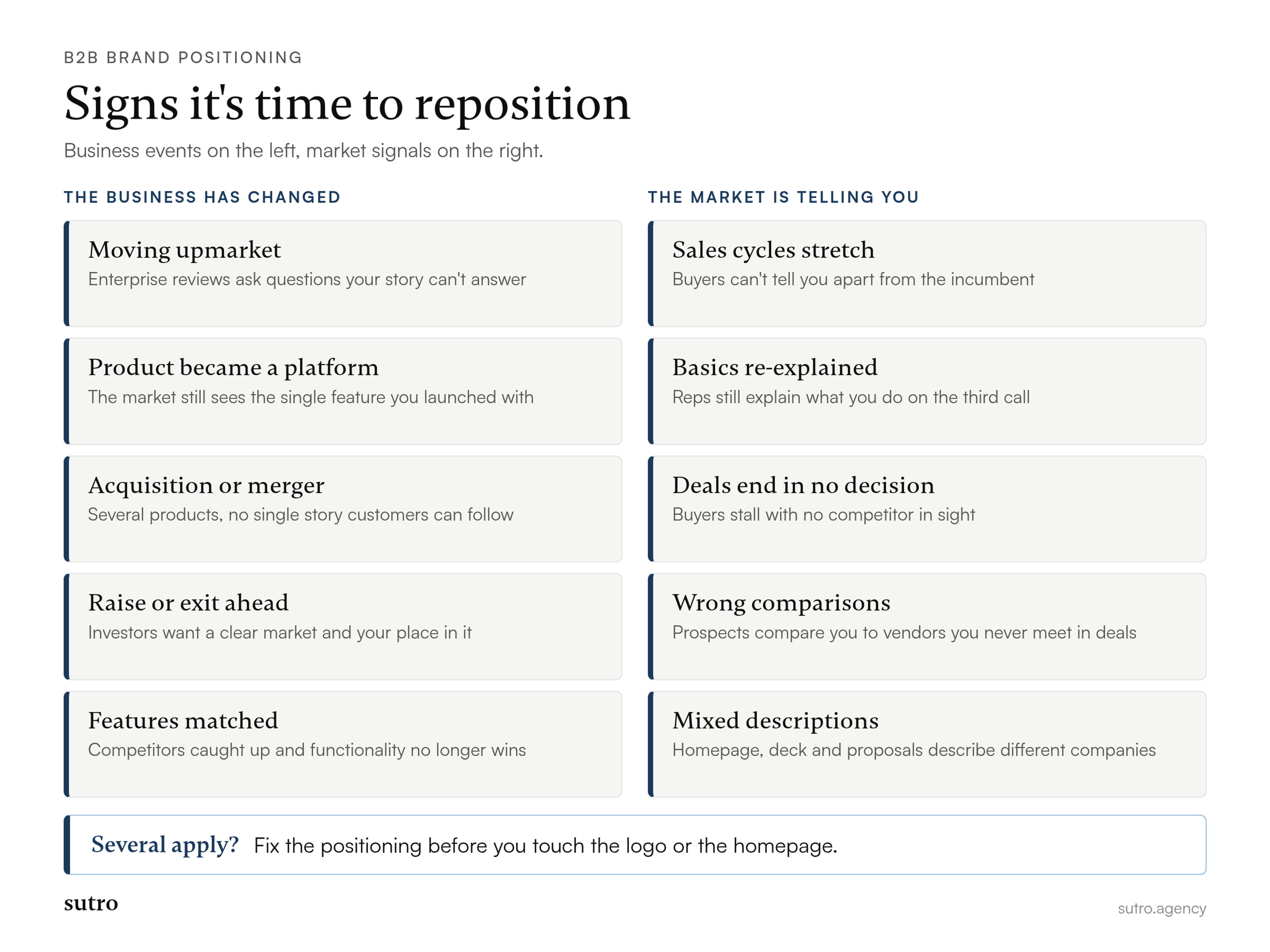
- Moving upmarket. Positioning that won smaller teams rarely works for an enterprise security or procurement review.
- Turning a product into a platform. You launched as a point solution, built more around it, and the market still sees one feature.
- Consolidating after an acquisition. Two or three products now need one story that legacy customers on every side can follow.
- Raising capital or preparing for an exit. Investors and acquirers want to see a clear market and a defensible place in it.
- Losing differentiation. Competitors have matched your feature list, and you can no longer win on functionality alone.
Even without a planned event, the market will tell you when positioning is broken. Sales cycles stretch because buyers can't tell you apart from the incumbent. Reps keep re-explaining basics on second and third calls. And deals stall with no competitor in sight.
That last one deserves attention. In a study of more than 2.5 million recorded sales conversations, Matthew Dixon and Ted McKenna found that 40% to 60% of deals end in no decision: buyers say they intend to buy and then don't act. Positioning won't fix every stalled deal, but if your story never makes the case against the way buyers solve the problem today, you leave the status quo unchallenged.
When you see several of these signs at once, a new logo or a homepage refresh won't help. The problem sits underneath, in the positioning.
The five-step B2B brand positioning framework
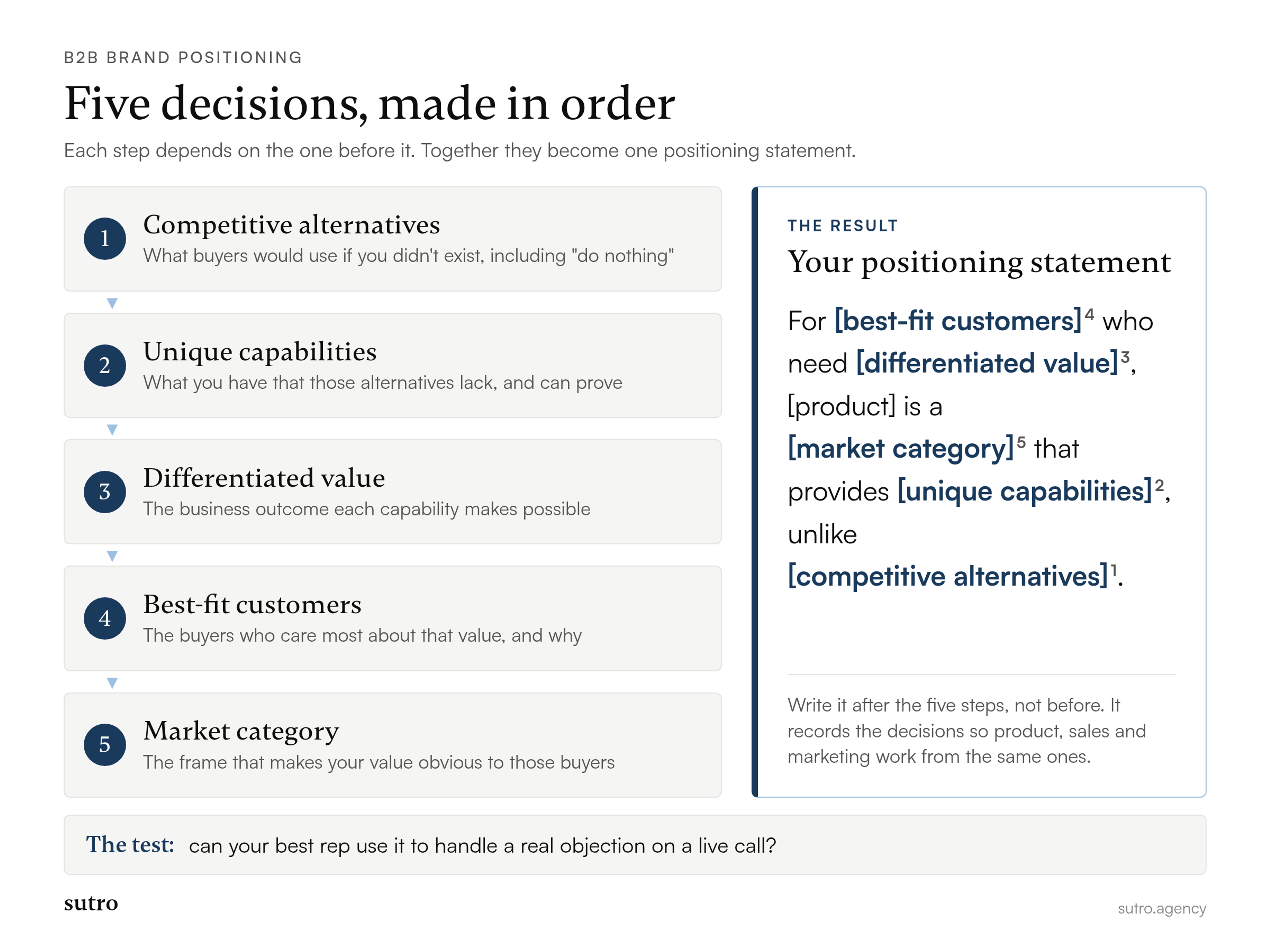
Build positioning from five inputs, in this order: competitive alternatives, unique capabilities, differentiated value, best-fit customers, and market category. The order matters because each step depends on the one before it.
This sequence follows Dunford's method. She found that starting anywhere other than competitive alternatives produced positioning that sounded good in the office but wasn't differentiated for customers. I agree. Most weak positioning I review started with the category or a tagline and worked backward.
Step 1: List the real competitive alternatives
Start with what buyers would do if your product didn't exist. That list is your real competition, and it's rarely the list in your pitch deck.
Executive teams tend to list the best-funded, most impressive rivals. Buyers often compare you to something much more boring: a spreadsheet, an internal script, a legacy on-premise tool, an agency, or a person whose job includes the task. Dunford warns against "phantom competitors," companies that could compete with you in theory but never show up in your deals. Positioning against them waters down your story.
To build the list, pull your last 20 to 30 closed deals, won and lost. Note what each buyer used before, what else they evaluated, and what they chose if you lost. Ask your best account executives which alternatives come up on discovery calls. If "do nothing" keeps appearing, it belongs at the top.
Step 2: Find the capabilities only you have
Next, list what you have that those alternatives don't. These are your unique capabilities: features, technical approaches, data, integrations, certifications, delivery models or expertise.
Keep this list objective. "Great support" and "intuitive interface" don't count, because every vendor claims them and no buyer can verify them before signing. Strong capabilities can be checked:
- A native integration with a system the alternatives can't connect to.
- A security or compliance posture, such as specific certifications or data residency options, that the alternatives lack.
- A pricing model tied to usage rather than seats, when buyers care about that.
- A proprietary dataset or model that improves with each customer.
Judge every capability against the alternatives from step 1, not against the whole market. Something common in your category can still be unique compared to a spreadsheet.
Step 3: Translate capabilities into differentiated value
Value is what a capability lets the buyer achieve. For each capability, ask "so what?" until you reach an outcome a budget owner would pay for.
Buyers don't approve budgets for algorithms or APIs. They approve budgets for more revenue, lower risk, lower cost or time back. If your capability is automated data mapping, the value might be that the engineering team stops spending part of every sprint on manual integration work and ships product instead. Draw a direct line from the feature to the result.
Group related capabilities into two or three value themes. More than that and nobody will remember any of them.
Step 4: Define best-fit customers
Best-fit customers are the ones who care most about your differentiated value. Define them by the characteristics that make them care, not only by industry or company size.
"B2B software companies" doesn't guide anything. "Finance teams at multi-entity companies that still close the books in spreadsheets" does, because it tells sales who to call and tells marketing what pain to name. Look at your best current customers: the ones who bought fastest, expanded and stayed. What do they share?
A tight definition doesn't stop you from selling to others. It tells you where to focus so you can win a segment before you widen it.
Step 5: Choose the market category
The market category is the frame of reference you give buyers. It tells them which mental bucket to put you in, which budget to pay from, and which competitors to compare you with.
Choose the category that makes your value obvious to your best-fit customers. Dunford's own example: a failing "Microsoft Access killer" took off once it was repositioned as an "embeddable database for mobile devices." Same product, different frame, different buyers, different result.
The category creation trap
Many founders want to invent a new category. In my view, most companies shouldn't, including most of the $10M to $150M ARR companies Sutro works with.
A new category has to be taught before it means anything, and that takes years and a large budget. Buyers don't search for terms they've never heard. Dunford notes that 90% of tech companies that went public in the five years before she wrote her guide were positioned in existing markets, and that many famous category creators began as a niche inside an existing category. The better move for most is to claim a known category, then narrow it with a qualifier that only you can win, such as a segment, a use case or a deployment model.
Write the positioning statement
Once the five inputs are set, write them down in one internal statement. A common template:
For [best-fit customers] who need [differentiated value], [product] is a [market category] that provides [unique capabilities], unlike [competitive alternatives].
A filled-in example for a hypothetical vendor: "For security leaders at mid-market fintech companies who need audit-ready compliance reporting, Acme is a cloud security posture management platform that provides continuous infrastructure scanning and guided remediation, unlike manual internal audits or legacy on-premise scanners."
Use the statement to record decisions, not to make them. Dunford calls the fill-in-the-blanks exercise pointless and potentially dangerous when teams use it to find their positioning, because it assumes each blank has one obvious answer. Do the five steps first. The statement is the summary you hand to product, sales and marketing so everyone works from the same decisions.
Pressure-test the positioning with sales and buyers
Positioning written in a conference room is a hypothesis. Test it with the people who hear buyers every day, and then with buyers themselves, before you touch the website.
With sales. Take the draft to your strongest account executives. Ask whether the alternatives match what prospects actually mention, whether the capabilities are the ones that close deals, and whether they could handle the top three objections with it. If your best rep can't use it on a live call, it isn't done.
With buyers. Talk to a few customers who signed recently and a few prospects who chose something else. Ask them to describe what you do in their own words, what problem started their search, and what else they considered. If their description contradicts your statement, believe them and adjust.
Two more quick checks help. Ask three people from sales, product and marketing to explain the company in one sentence without notes; three different answers mean the positioning isn't clear yet. Then put your homepage, main deck and a recent proposal side by side and check that they describe the same company.
Roll the positioning out across the company
Positioning only pays off when it changes what buyers see and hear. Roll it out to the website, the sales materials and the product roadmap, in that order of urgency.
The website
The homepage hero should make the positioning obvious at a glance. The headline states the value. The line under it names the category and who it's for. If you sell billing automation for dental clinics, say exactly that. Clarity beats cleverness in B2B.
Sales materials
Rebuild the first slides of the main deck around the positioning. Open with the cost and risk of the buyer's current alternative, then show how your capabilities remove that problem. Use the same words everywhere. If the website says "automated compliance reporting," the deck and the demo shouldn't call it something else.
The product roadmap
Positioning sets expectations the product has to meet. If you position for enterprise buyers, the roadmap needs what enterprise buyers check for, such as single sign-on, role-based access and audit logs. When the product keeps the promise the positioning makes, trust builds deal after deal.
Common B2B positioning mistakes
The most common mistake I see is positioning for investors instead of buyers. Founders refine a fundraising story full of market-size slides and big trends, then paste it onto the commercial website. An IT director doesn't care about your total addressable market or your last round. They care whether the product fits their stack and solves their problem.
The others are just as familiar:
- Positioning against everyone. A long competitor list usually means no clear alternative and no clear reason to switch.
- Treating features as value. A feature list without the "so what" leaves buyers to do the translation, and most won't.
- Targeting everyone who could buy. A broad audience produces generic messaging that convinces no one in particular.
- Choosing a clever category. If buyers can't place you in a bucket, they can't budget for you.
- Never updating it. Products, buyers and competitors change. Positioning needs an owner and a review whenever the business shifts.
For how to diagnose each positioning mistake, use the symptom-test-fix guide.
Conclusion
B2B brand positioning comes down to honest answers to five questions: what buyers would use without you, what only you can do, what that's worth to them, who cares most, and which frame makes all of that obvious. Work through them in order, write the result down, test it with sales and buyers, and then change the website, the deck and the roadmap to match.
If your company is at an inflection point and you want to put this into practice, book a call and tell us where your positioning stands.
Questions
- What is the difference between B2B brand positioning and messaging?
- Positioning is the decision about what you are, what you replace, who you're for and why you win. Messaging is how you express that decision to a specific audience in a specific place. One positioning supports many messages: the homepage, the sales deck, a security one-pager, a campaign.
- What are the five components of B2B positioning?
- Competitive alternatives, unique capabilities, differentiated value, best-fit customers and market category. Work through them in that order, because each one depends on the previous: capabilities are only unique compared to the alternatives, and value only matters to the customers who care about it.
- How often should a B2B company revisit its positioning?
- Revisit it whenever the business changes in a material way: moving upmarket, launching a platform, merging with or acquiring another company, preparing to raise or exit, or seeing competitors match your features. Rising "no decision" losses and longer sales cycles are also signs it's time.
- Who should own positioning inside the company?
- At early stages, the founder or CEO. At growth stage, product marketing or the CMO usually runs the process, but the decisions need sign-off from the CEO, product and sales leadership. Positioning that only marketing believes in won't survive the first sales call.
- Should we create a new market category?
- Usually not. A new category has to be taught before buyers can search for it or budget for it, which takes years and a lot of money. Most companies do better claiming a known category and narrowing it with a qualifier they can own, such as a segment, use case or deployment model.