Positioning
B2B Positioning Mistakes That Stall Growth and How to Spot Them
Seven B2B positioning mistakes that quietly slow growth, the pipeline symptom each one leaves, a one-week test to confirm it and the fix to make first.
Key takeaways
- B2B positioning mistakes show up as pipeline symptoms: no-decision losses, repeated basic explanations, wrong-fit wins and unexplained discounting.
- Ignoring the status quo is the costliest mistake, because many lost deals name no competitor at all.
- Default positioning and product-centric vocabulary leave buyers unable to link their situation to your name.
- A five-day review of lost deals, customer language, first-call openings, buying triggers and segment results usually exposes the main mistake.
- Fix upstream problems (alternatives, fit, frame) before claims, rollout or visual identity.
B2B positioning mistakes that stall growth rarely look like mistakes in the positioning document. They show up in the pipeline: deals that end with no decision, reps who re-explain the basics on the third call, wins that churn within a year. If you know which symptom maps to which mistake, you can confirm the cause in about a week instead of guessing.
Most lists on this topic name five to eleven errors and stop there. That is useful for awareness, less useful for a leadership team that needs to decide what to fix this quarter. So this guide opens with a compact diagnosis map (mistake, symptom, test, fix), then shows how to run the tests and which mistake to fix first. It assumes you already have positioning of some kind. If you are starting from zero, begin with the full positioning framework, from alternatives to category, then come back here once it has been in market for a few months.
I see the same handful of errors in almost every engagement, and they cluster around inflection points: moving upmarket, launching a platform, raising a round, integrating an acquisition. That pattern shapes the brand positioning work for technical B2B companies we do at Sutro, and it is why the diagnosis below starts from sales evidence, not from the wording of the statement.
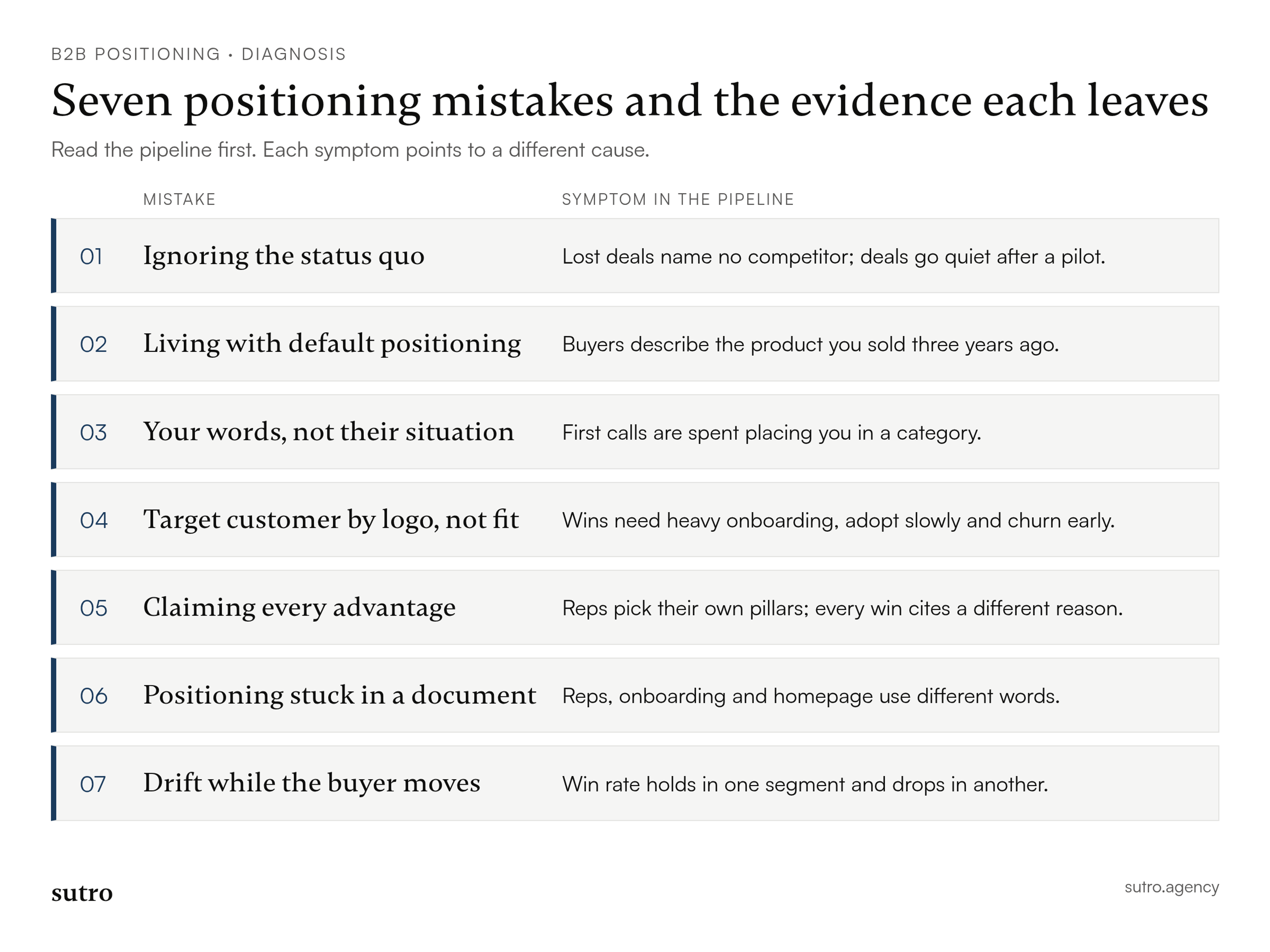
Seven B2B positioning mistakes at a glance
Sutro's editor has no table block, so the comparison sits here as short H3s with labelled bullets. Concrete symptom first, then a test that uses data you already have, then the first fix. Details and worked examples follow.
1. Positioning against rivals and ignoring the status quo
Symptom: a high share of closed-lost deals with no competitor recorded, and late-stage deals that go quiet after a pilot.
Test: pull your last 20 closed-lost opportunities. Count how many name a competitor. If fewer than half do, your positioning is fighting the wrong opponent.
Fix: add the status quo to your alternatives and write what it costs the buyer to keep it. Address rollout risk directly; more urgency rarely moves a buyer who is afraid of being blamed.
2. Living with default positioning
Symptom: buyers describe you as the product you sold three years ago. Your best customers use you for something the homepage barely mentions.
Test: ask your five most recent new customers, in their own words, what they bought and what they would use if you disappeared. Compare their answers with your homepage headline.
Fix: rebuild positioning deliberately rather than patching the founding story onto the homepage. Keep what is still true; put the origin story on the About page.
3. Describing the product in your vocabulary, not the buyer's situation
Symptom: prospects arrive late in their search, mostly through referrals, and the first call is spent placing you in a category.
Test: list the five situations that triggered your last ten deals, taken from discovery notes. Search your website for those exact phrases. If they are missing, buyers cannot connect their moment to your name.
Fix: keep the technical proof, but lead with the situation and the outcome. The mechanism becomes the reason to believe, not the headline.
4. Choosing the target customer by logo, not by fit
Symptom: good-looking wins that need heavy services to onboard, low product adoption, and renewals that need executive rescue.
Test: sort customers by time to first value and by retention, not by contract size. Look at what the top quartile has in common: stack, team structure, trigger event.
Fix: position for the profile that succeeds, and let sales qualify harder against it. Specificity shortens cycles.
5. Claiming every advantage
One line, because the same failure is covered as me-too differentiation in B2B brand differentiation: too many pillars and no sacrifice.
Symptom: reps pick their own two pillars per call. Proposals run long. Win/loss notes cite different reasons for every win.
Test: ask your three strongest account executives which two claims close deals. If their answers do not overlap, the positioning has not chosen.
Fix: keep two or three claims a competitor cannot honestly copy and that you can prove. Move the rest into proof points.
6. Positioning that lives in a document, not in the company
When the words never leave marketing, you get the same handoff failures that break sales adoption of messaging.
Symptom: inconsistent descriptions across channels, and new hires who learn the pitch from whoever sits next to them.
Test: listen to the first two minutes of five recent discovery calls from different reps, then open last month's new-hire onboarding. If reps, onboarding and the homepage disagree, the positioning never left the document.
Fix: name an owner, publish a one-page version with the exact words to use, and change the deck and proposal template in the same week as the website.
7. Letting positioning drift while the buyer moves
Symptom: enterprise security and procurement reviews derail late, new objections appear in calls, and win rate drops in one segment while holding in another.
Test: split win rate and sales cycle length by segment for the last four quarters. A widening gap usually means the positioning fits one buyer and not the other.
Fix: review positioning at every inflection point, not on a calendar. Before a move upmarket, rewrite for the new buying group: who signs, who can block, what each needs to see.
How positioning mistakes show up in the pipeline
Weak positioning makes buyers work harder to understand why you matter, and they respond by slowing down. You rarely get a clear "no." You get delay, discounting and confusion that looks like a sales problem.
The scale of that delay is large. In an interview about research behind The JOLT Effect, Matt Dixon described a study of about 2.5 million recorded sales conversations and said between 40 and 60% of deals are lost to the customer doing nothing. He also said preference for the status quo explains less than half of those losses; the larger share comes from buyers worried about making a mistake. Positioning cannot fix every stalled deal. It can make the case against inaction and lower the perceived risk of choosing you.
The symptoms worth tracking are concrete:
- Deals closed lost with no competitor named.
- Second and third calls spent on what the product is, not how it fits.
- Wins with long onboarding, low adoption or early churn.
- Discounts granted with no competitor to explain them.
- Three teams describing the company three different ways.
Each symptom points to a different mistake above. Treating all of them as "the messaging needs work" is how companies end up with a new homepage and the same pipeline.
April Dunford put two of the most common positioning mistakes plainly in a MaRS interview: companies fall into default positioning and never construct it deliberately, and they consider only direct competitors instead of every alternative a customer could use. The LinkedIn B2B Institute's paper with Ehrenberg-Bass on category entry points in B2B adds a third lens: most purchases start from memory, so brands linked to more buying situations see higher acquisition and retention. Those three sources sit behind mistakes 1, 2 and 3 in the map.
A one-week positioning diagnosis
You do not need a research project to find out which mistake you have. Five working days and existing data are enough for a first answer.
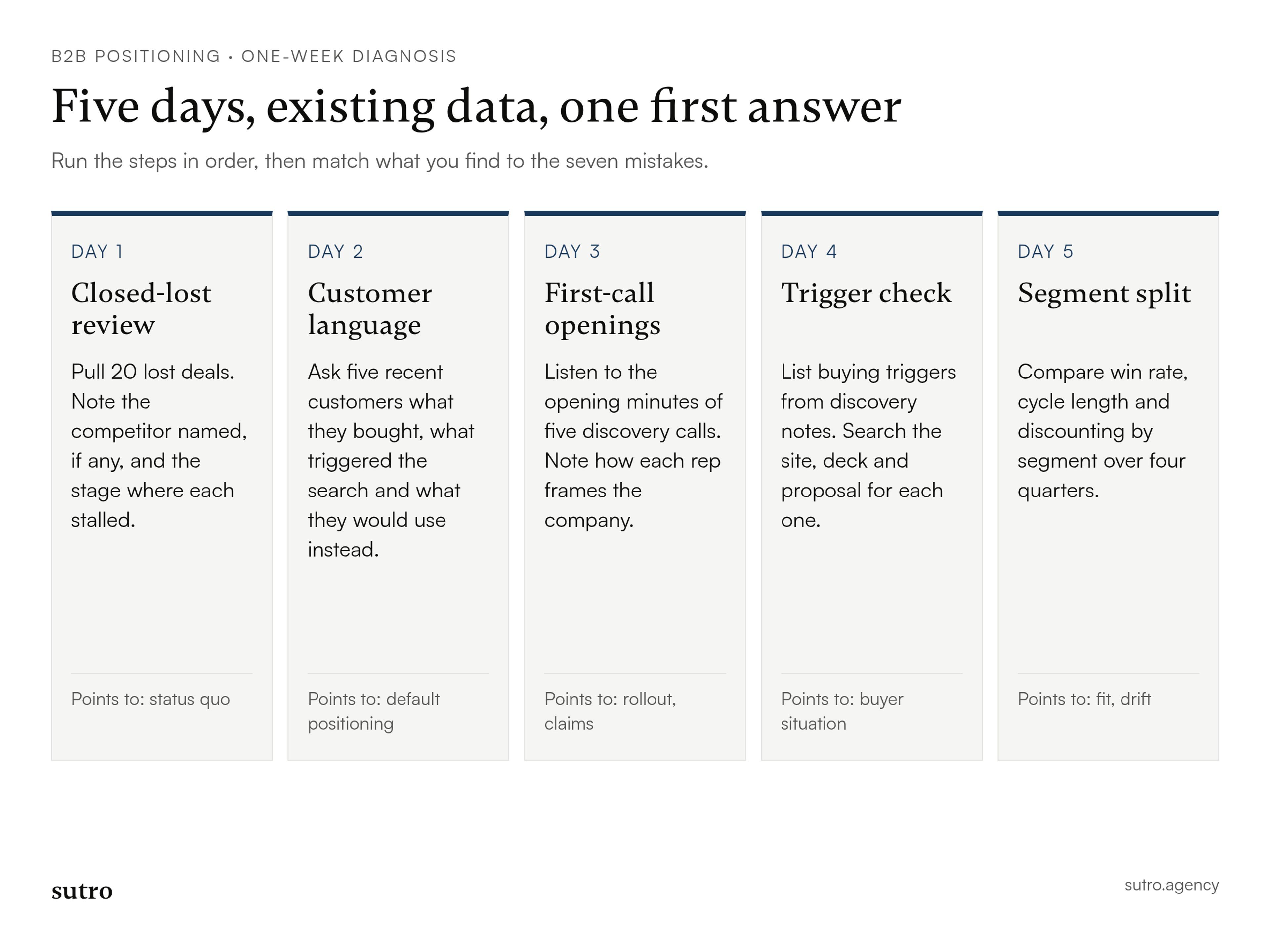
- Day 1, closed-lost review. Pull 20 recent lost deals. Record whether a competitor was named and at which stage the deal stalled.
- Day 2, customer language. Talk to five recent customers. Ask what they bought, what triggered the search and what they would use instead.
- Day 3, first-call openings. Listen to the opening minutes of five recent discovery calls and note how each rep frames the company and the problem.
- Day 4, trigger check. List the triggers from recent discovery notes and search the website, deck and proposal template for each one. Mark the triggers that appear nowhere.
- Day 5, segment split. Compare win rate, cycle length and discounting by segment. Then match what you found to the seven mistakes above.
Most companies find two mistakes, not seven. One is usually upstream (alternatives, fit or frame) and one downstream (too many claims or weak rollout). Fix the upstream one first, because downstream fixes built on the wrong frame have to be redone.
A worked example
The company below is fictional, a composite built to show the method, not a client.
Picture a data observability vendor at roughly Series B. Its homepage leads with "AI-native observability for modern data stacks." Pipeline is healthy at the top, but late-stage deals keep slipping.
The closed-lost review finds 13 of 20 lost deals with no competitor named. Customers describe the product as "the thing that tells us before the dashboard breaks," not as observability. Discovery notes show the most common trigger is a bad number reaching the board. And the segment split shows win rate holding with mid-market data teams while dropping with enterprise buyers, where security reviews stall.
That points to mistake 1 (the status quo, here manual checks and hope, is the real rival), mistake 3 (the buyer's situation is a board-level data incident, not "observability") and mistake 7 (drift as the company moves upmarket). The rewrite leads with the situation and the cost of the status quo, names the buyer who gets blamed when a bad number ships, and adds a short section for enterprise reviewers on access, deployment and rollback. The mechanism, the AI part, moves to the proof.
Notice what did not change: the product, the category name in the analyst deck and the visual identity. Positioning fixes are mostly about order and emphasis, not about starting over.
Which mistake to fix first
Fix in the order the positioning is built: alternatives, then customer fit, then the buying situation and frame, then claims, then rollout. Each layer depends on the one before it. A sharper claim does little if it is aimed at the wrong buyer or framed against the wrong alternative. For the step-by-step build itself, use the framework linked in the intro rather than reinventing it here.
Two exceptions. If the company is weeks from a launch or a fundraise, fix rollout first, because three different stories in front of investors or analysts cost more than an imperfect frame told consistently. And if one segment is clearly winning, protect it: position harder for that segment before you try to fix the one that is losing.
What I would not do is start with the visual identity or the tagline. Both matter, but they express positioning. Changing them first gives the company a new look on top of the same confusion.
Conclusion
Positioning mistakes are easiest to see in sales evidence: deals lost to no decision, calls spent explaining the basics, wins that do not stay. Match the symptom to the mistake, confirm it with a week of data you already have, and fix the upstream problem before you touch the words on the homepage.
If your deals are slowing and you are not sure which of these is the cause, tell us which deals keep stalling and where.
Questions
- What are the most common B2B positioning mistakes?
- The ones I see most are positioning only against rival vendors while ignoring the status quo, keeping the default positioning from the founding days, describing the product in internal vocabulary, choosing the target customer by size or logo, claiming too many advantages, failing to roll positioning out, and letting it drift as the buyer changes.
- How do I know whether a stall is a positioning problem or a sales problem?
- Look at the pattern. If one or two reps struggle while others win, it is likely execution. If most reps lose deals to no decision, spend early calls explaining what you are, or win in one segment and lose in another, the cause sits in the positioning.
- How long does it take to fix a positioning mistake?
- Diagnosis can take a week with existing data. Rewriting the positioning usually takes a few weeks of work with sales, product and leadership. Rolling it into the website, deck and proposals is what takes longest, because every asset has an owner and a schedule.
- Should we rebrand to fix positioning?
- Usually not. Most positioning fixes change order and emphasis: which alternative you name, which buyer you speak to, which claim leads. A visual change makes sense only when the identity itself contradicts the new positioning, and it should come after the positioning is settled.
- How often should positioning be reviewed?
- Review it at every commercial inflection point: moving upmarket, launching a platform, raising capital, preparing for exit or integrating an acquisition. Between those events, watch the symptoms above in quarterly pipeline reviews.
Sources
- Adrian Swinscoe, interview with Matt Dixon: The problem of customer indecision and how to get over it (2022)
- MaRS Startup Toolkit, April Dunford: Product positioning, key tips and common mistakes
- LinkedIn B2B Institute and Ehrenberg-Bass Institute (Jenni Romaniuk): Category Entry Points in a B2B World