Positioning
B2B Brand Messaging: A Framework Sales Can Actually Use
A B2B messaging framework is the shared source of truth for what you say, to whom, and why it is credible. Here is how to build one sales will actually use.
Key takeaways
- A B2B messaging framework is the shared source of truth for what you say, to whom, and why it is credible, sitting between positioning and copy.
- Keep positioning, messaging and brand voice separate: strategy, words-and-proof, and tone.
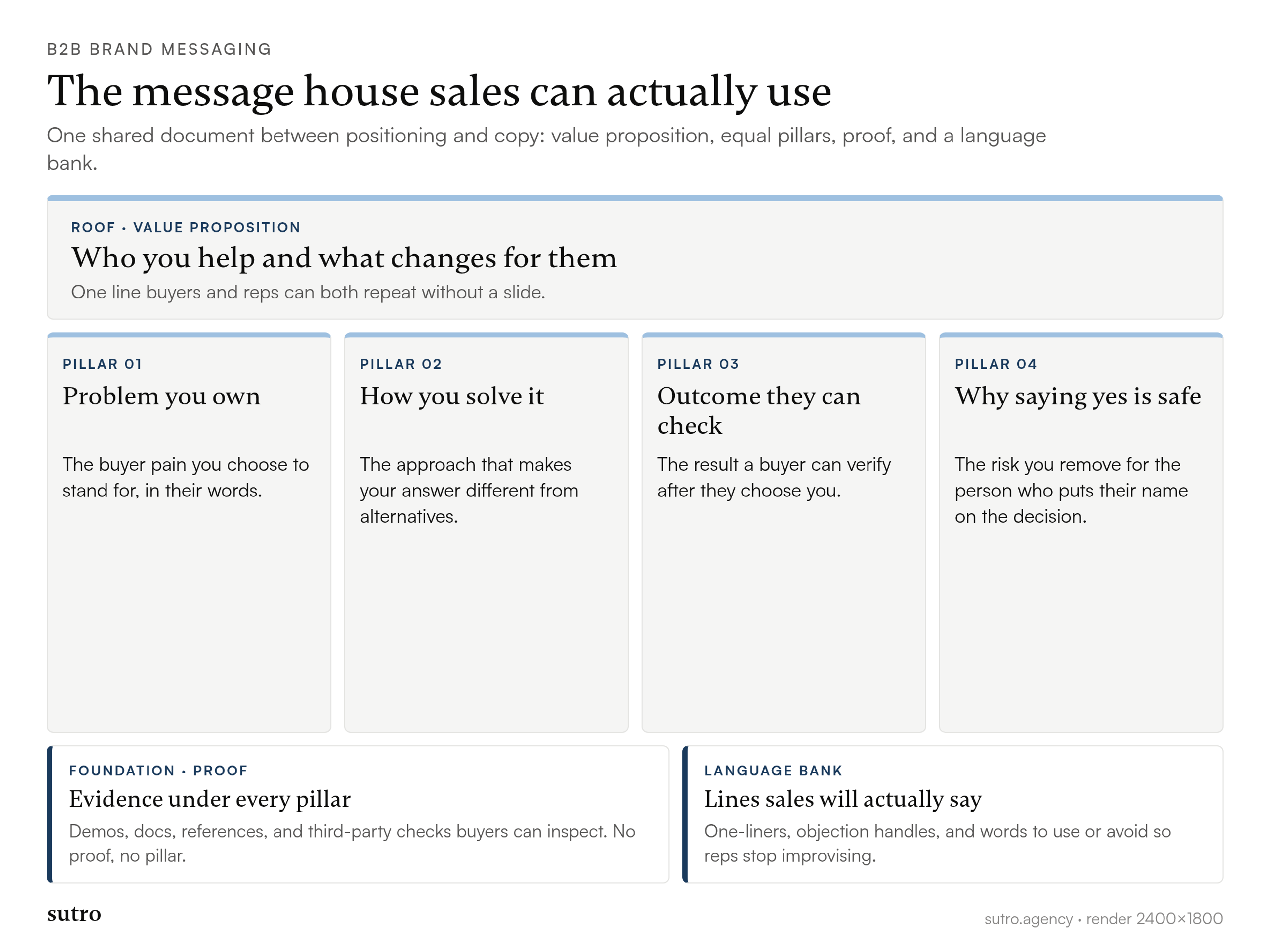
- Structure it as a message house: value proposition, three or four equal pillars, proof under each pillar, and a language bank.
- Build from buyer language in win/loss notes, calls and interviews; do not invent pillars you cannot prove.
- Persona and stage variants reorder emphasis and proof; they do not invent new claims.
- Freeze a dated version after a sales read-through, or reps will keep writing their own.
A B2B messaging framework is the shared source of truth for what you say, to whom, and why it is credible. It sits between finished positioning and the copy that shows up in decks, pages, emails and talk tracks, so marketing, product and sales stop improvising different versions of the same story.
Most technical teams I work with already have a positioning draft. What they lack is the document that turns that choice into language a rep can use without rewriting it on every call. That gap is where deals stall: the website says one thing, the deck says another, and the AE invents a third version under pressure.
That shared document is most of what a branding agency for technical B2B companies ends up building once category and audience are settled. I am also the founder and CEO of Ramotion, which has been in the industry since 2009. The pattern is steady: when messaging is vague, sales invents; when it is specific and proven, sales repeats it.
This guide covers what a messaging framework is, how it differs from positioning and brand voice, the layers that belong in one, how to build it from buyer language, how to adapt it by persona without inventing new claims, a worked example for a fictional technical product, and the mistakes that keep sales from adopting it.
Positioning vs messaging vs brand voice
Positioning is the strategic choice of where you compete and for whom. Messaging is the words, proof and objections that express that choice. Brand voice is how those words sound when spoken or written.
April Dunford puts the sequence plainly: strong positioning is the starting point for a company's messaging, branding, lead generation, and sales strategy. Messaging does not invent the market, the buyer or the competitive alternative. It translates a finished choice into language people can repeat.
Brand voice sits one layer further out. It covers tone, rhythm and the words you prefer or avoid. Voice without a framework produces consistent personality and inconsistent claims. A framework without voice produces accurate claims that sound like they came from different writers.
If positioning is still open, stop here and finish how to lock positioning before you write the messaging document. Messaging built on unsettled positioning only locks in confusion.
The layers of a B2B messaging framework
A usable B2B messaging framework is layered like a message house: a value proposition at the roof, three or four equal messaging pillars under it, proof under each pillar, and a language bank sales can reuse. University brand teams describe the same structure as a messaging house with brand truth, positioning, pillars and proof points. Product marketing guides list the same essential pieces: value proposition, three to four messaging pillars, and proof points.
Value proposition
The value proposition is one sentence that names who you help and what changes for them. It is not a tagline and not a feature list. It should be short enough that a founder and an AE can say it the same way without reading a slide.
Write it as a claim a buyer could falsify. A line like we help platform teams ship safer releases is usable. A line like we empower modern organizations to unlock potential is not, because nobody can check it.
Messaging pillars
Pillars are three or four equal themes that carry the value proposition. Equal matters. If one pillar is the real story and the others are decoration, sales will ignore the decoration and you have a slogan, not a framework.
Each pillar should be a claim buyers already care about, stated in language they use. Typical technical pillars cover how you solve the problem, what outcome the buyer can measure, why you fit this buyer rather than every buyer, and why saying yes is operationally safe. Do not force four if three are enough. Do not stretch to five; the house collapses into a feature dump.
Proof points
Every pillar needs evidence a buyer can check: named customer patterns, product behavior they can see in a demo, public documentation, security posture, benchmarks you would defend under scrutiny, or third-party validation. A pillar without proof is a wish. Sales will quietly drop it the first time a prospect pushes back.
CXL's guidance on value propositions makes the same point in plain terms: a strong claim is specific and backed with proof, not adjectives.
Language bank
The language bank is the part most teams skip and the part sales notices first. It holds approved one-liners, short answers to the objections that kill deals, words to use, and words to retire. It is not a glossary of jargon. It is the phrase sheet that keeps five AEs from inventing five metaphors for the same product.
How to build the framework from buyer language
Build the framework from what buyers already say, not from a whiteboard of what you wish they said. Start with finished positioning, then mine win/loss notes, call transcripts, support tickets and a handful of recent customer interviews for the words buyers use when they describe the problem, the failed alternatives and the reason they chose you or walked away.
Pragmatic Institute's win/loss checklist is blunt about the first step: sit down with the sales team involved in the win or loss before the buyer interview. The internal debrief surfaces the talk track reps already use under pressure. That talk track is often closer to usable messaging than the website copy.
Step 1: Collect the raw language
Pull 15 to 30 recent opportunities across wins, losses and no-decisions. Tag every phrase buyers used for the problem, the trigger that put them in market, the alternatives they considered, the objections that stalled them, and the proof that moved them. Keep buyer quotes intact. Do not clean them into marketing English yet.
Step 2: Cluster into pillar candidates
Group the quotes into three or four clusters that each support the value proposition. Kill clusters that only your team cares about. Kill clusters you cannot prove. Keep clusters that show up in both wins and hard-fought losses; those are the claims the market already debates.
Step 3: Attach proof to every cluster
For each surviving pillar, list the evidence you already have and the evidence you still need. If the evidence does not exist, the pillar does not ship. You can keep it as a product or content backlog item, but it does not enter the sales document.
When a pillar rests on a competitive claim, pressure-test it before you promote it. Use how to pressure-test a competitive claim before it becomes a pillar rather than copying a rival's adjective set.
Step 4: Write the language bank
Translate each pillar into a one-liner, a 30-second spoken version, and two objection handles. Add a short do-not-say list for phrases that sound clever in marketing and false on a call. Read every line out loud. If an AE would never say it, rewrite it.
Step 5: Freeze a version and name an owner
Have two or three AEs skim the draft for lines they would actually say tomorrow, then freeze version 1.0 with a date and a named owner. Messaging that never freezes never gets used, because nobody trusts it will still be current next week.
Persona variants without new claims
Persona variants change emphasis and proof, not the underlying claims. The CIO, the security reviewer and the end user can hear the same pillars in a different order, with different examples. They should not hear three different products.
A practical pattern:
- Keep the value proposition identical across personas.
- Reorder pillars so the buyer's primary risk comes first.
- Swap proof examples for ones that persona can verify.
- Keep objection handles shared, with one extra handle per persona if needed.
If a persona seems to need a brand-new claim, you either found a real gap in the framework or you are inventing a side brand. Most of the time it is the second. Put the new claim through the same proof test as every other pillar before you add it.
Stage variants work the same way. Early discovery leans on problem and outcome pillars. Late-stage evaluation leans on proof and risk reduction. The house does not change. The path through it does.
Worked example: a fictional messaging house
Here is a filled mini-framework for a fictional product, Catenary, a policy engine that sits in CI/CD and blocks non-compliant releases before they reach production. The company and numbers below are invented for teaching. They are not research findings and not client results.
Value proposition: Catenary helps platform teams stop non-compliant releases in CI before they reach production, without slowing everyday merges.
Pillar 1 : Catch policy breaks before production. Releases fail in the pipeline against the rules your org already wrote, not after an incident review.
Pillar 2 : Rules as code your teams can review. Policies live next to application code, so platform and product engineers share one source of truth.
Pillar 3 : Fast enough for merge-heavy teams. Checks run inside existing pipelines and are designed to stay out of the critical path of routine merges.
Pillar 4 : Audit trail security and compliance can read. Every block and exception is logged in a form reviewers already ask for.
Proof under the pillars (illustrative, not real metrics): demo of a blocked release against a sample policy pack; public docs showing policy-as-code format; architecture note on where the check runs in GitHub Actions and GitLab CI; sample audit export a security reviewer can inspect.
Language bank (short):
- One-liner: We fail the build when a release breaks your own rules, before it hits production.
- Objection, we already have linters: Linters catch style and basic bugs. Catenary checks org policy that spans services, ownership and change windows.
- Objection, this will slow merges: The check runs in the pipeline you already have. If it is slow, that is a policy design problem we help you trim, not a reason to discover breaks in production.
- Do not say: AI-powered governance platform, seamless compliance, transform your SDLC.
Persona emphasis: a platform lead hears pillars 1 and 3 first. A security reviewer hears pillars 1 and 4 first. A VP of Engineering hears pillars 2 and 3 first. Same house, different door.
Common mistakes that break sales adoption
Messaging frameworks fail in predictable ways. The product is rarely the problem. The document is.
Writing for the website first. If the framework only exists as homepage copy, sales will not find it, trust it or repeat it. Write the talk track first, then derive page copy from it.
Pillars that are features in costume. Has SSO, has an API, and has dashboards are not pillars. They are proof or table stakes. A pillar states why the buyer should care.
Proof that marketing believes and sales cannot defend. If the only evidence is an unsourced percentage on a slide, cut it. Reps will not die on that hill in front of a technical buyer.
A new framework every quarter. Teams get bored of their own message long before the market has absorbed it. Update proof and examples freely. Change pillars only when positioning or the product has actually moved.
No owner and no freeze date. Someone in product marketing or brand has to own version control. Without that, every stakeholder edits a private copy and the shared source of truth disappears.
Skipping the sales read-through. A framework that has never been spoken by an AE is a theory. The read-through is where you learn which lines survive contact with a real buyer.
Conclusion
A B2B messaging framework is not a brainstorming artifact. It is the operating document that keeps positioning honest once it leaves the strategy deck: one value proposition, a few equal pillars, proof under each, and a language bank sales will actually say.
Build it from buyer language, keep persona variants honest, freeze a version, and retire the phrases that sound good in a draft and false on a call. If your current talk tracks still diverge by rep, tell us which talk track your reps still rewrite.
Questions
- What belongs in a B2B messaging framework?
- A value proposition, three or four messaging pillars, proof points under each pillar, and a language bank of one-liners and objection handles. Optional extras include persona emphasis notes and stage-specific paths through the same pillars. Leave positioning statements and brand-voice guides in their own documents so this one stays usable in a sales meeting.
- How is a messaging framework different from a positioning statement?
- A positioning statement records the strategic choice: market, buyer, alternative and unique value. A messaging framework turns that choice into language and evidence people can repeat. One decides; the other equips. If you only have a statement, sales still has to invent the talk track.
- How many messaging pillars should we have?
- Three or four. Fewer than three usually means you are restating the value proposition. More than four tends to become a feature list, and sales will pick favorites and ignore the rest. Equal weight across pillars matters more than hitting a round number.
- How often should we update the messaging framework?
- Update proof points and examples whenever you earn better evidence. Revisit pillars when positioning changes, a major product bet ships, or win/loss notes show the market has moved. A quarterly rewrite of the whole house is usually a sign of boredom, not of new insight.
- Who should own the messaging framework?
- Product marketing or brand usually owns the document. Sales and customer-facing engineers must co-author the language bank and sign off on version freezes. Without a named owner and a dated version, every team keeps a private fork and the shared source of truth disappears.
- Can we create different frameworks for each persona?
- You can create persona paths through one framework. Separate frameworks per persona almost always invent conflicting claims. Keep one house, reorder pillars, and swap proof examples the persona can verify.
Sources
- April Dunford: positioning as the starting point for messaging, branding, lead generation, and sales strategy
- University of Oregon Communications: brand messaging framework described as a messaging house (brand truth, positioning, pillars, proof points)
- Product Marketing Alliance: key elements of a product messaging framework (value proposition, three to four messaging pillars, proof points)
- Pragmatic Institute: Win/Loss Analysis Checklist for Product Managers (debrief sales before the buyer interview)
- CXL: Unique Value Proposition guidance on specific claims backed with proof