Strategy
B2B Brand Strategy: How to Build One That Sales Can Actually Use
A B2B brand strategy only works if sales can use it in a live deal. Here is how to build one in four steps, what sales needs from it, and how to measure it.
Key takeaways
- A B2B brand strategy is only useful if a sales rep can use it on tomorrow's call without rewriting it.
- Most strategies fail to reach sales because they are written without sales input, too abstract, delivered as a long document, and left without an owner.
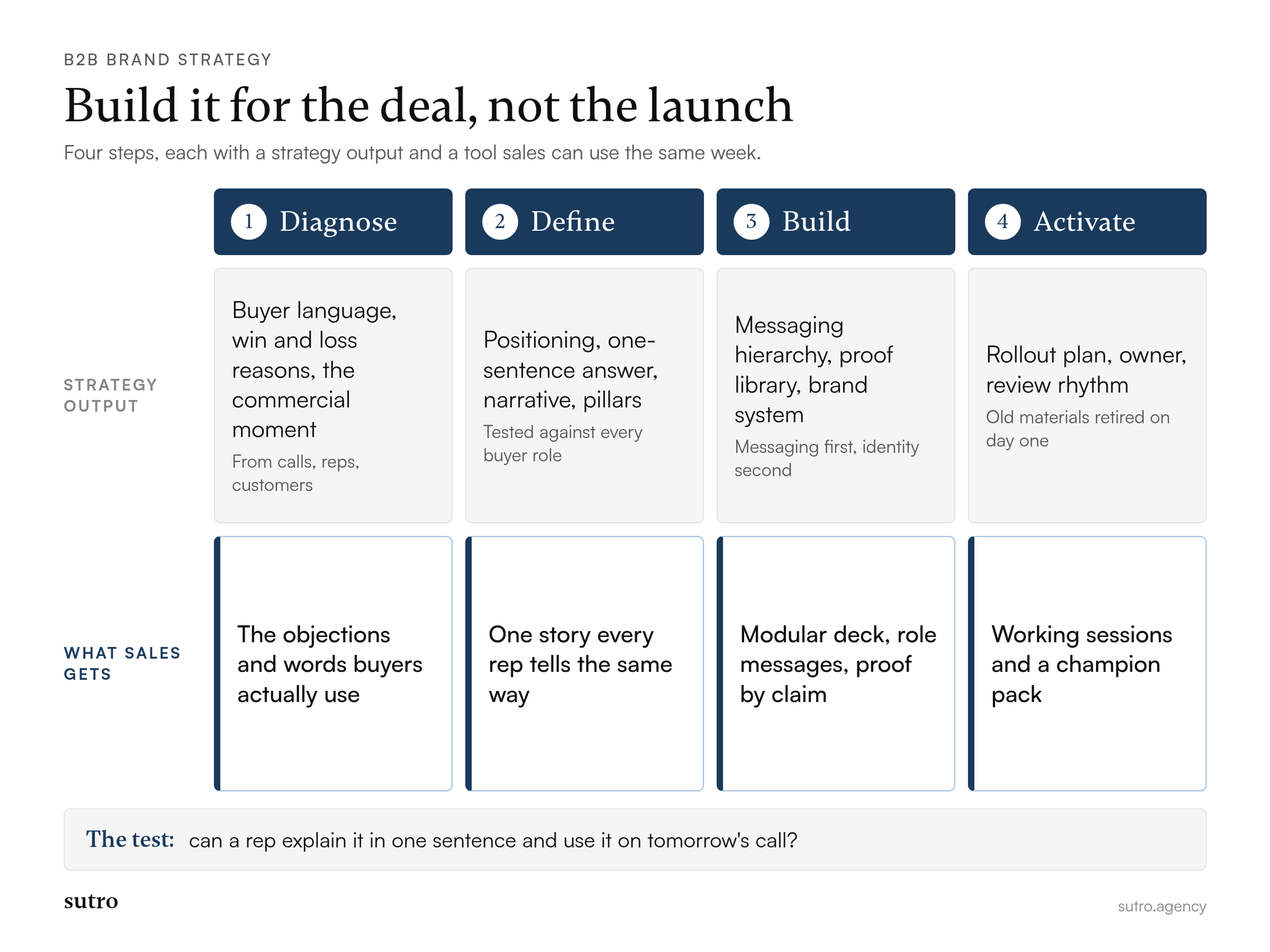
- Build it in four steps: diagnose from real deals, define the position and narrative, build messaging before identity, then activate it in sales.
- Sales needs a small kit made from the strategy: a one-sentence answer, a modular narrative deck, role-based messages, a proof library and a forwardable champion pack.
- Test the strategy with reps and buyers before calling it done, then measure it through win rate, sales-cycle length, pricing confidence, pipeline and branded search.
A B2B brand strategy is the set of decisions about who your company is for, what it stands for, and how it proves it, written so that sales, marketing, and product tell the same story. The real test is simple: can a rep use it on tomorrow's call without rewriting it first? If not, it's a document, not a strategy.
Most brand strategies fail that test. A team spends months on positioning, archetypes, tone of voice, and a visual system. The result lands as a long PDF in a shared drive. Sales opens it once, closes the tab, and goes back to the deck they built two years ago, because that deck at least answers the questions buyers ask.
I've watched this pattern for a long time. I founded Sutro to do strategic branding for technical B2B companies at commercial inflection points, and I'm also the founder and CEO of Ramotion, a digital product and brand design agency that has been in the industry since 2009 and has completed more than 350 projects. Across that work, including the B2B engagements at Sutro, a B2B tech branding studio, the brand strategies that paid off had one thing in common. They were built for the deal, not for the launch.
This guide covers what a B2B brand strategy includes, why most never reach sales, a four-step way to build one, and how to check that it works. If you need the basics first, read my guide on what B2B branding is and what it includes.
What a B2B brand strategy is (and what it isn't)
A B2B brand strategy is an operating plan for how the market should understand your company, plus the language and proof that make that understanding stick. It sits above identity and campaigns and tells both what to do.
It is not a logo, a guidelines file, or a tagline. Those are outputs. It is also not a one-off campaign. A campaign runs for a quarter. A strategy should hold for years, until the business itself changes.
A strategy that sales can use usually contains seven parts:
- Market and buyer definition: the segment you serve, the problem you solve for it, and the roles in the buying group.
- Positioning: the category you compete in, the alternative you replace, and the one reason to choose you.
- Company narrative: the story of the change in the market, why the old way breaks, and why your approach wins.
- Messaging hierarchy: one core message for everyone, then supporting messages for each role.
- Proof: the evidence behind every claim, such as product capabilities, security facts, customer outcomes you're allowed to share, and third-party validation.
- Brand system: verbal and visual identity, so every touchpoint looks and sounds like one company.
- Activation plan: who uses what, in which channel, starting when.
The first five parts are where most of the commercial value lives. The brand system makes them recognizable. The activation plan makes them real.
Why most B2B brand strategies never reach sales
Most brand strategies don't reach sales because they are written for the wrong reader. They speak to the board or the marketing team, use abstract language, and arrive as a document instead of as tools a rep can use in a meeting.
That has a cost. In a Gartner survey of 632 B2B buyers published in 2025, 69% reported inconsistencies between what a supplier's website said and what its sellers told them, according to Demand Gen Report's coverage of the survey. Gartner's analyst warned that this kind of mismatch creates mistrust and can put the deal at risk. When the brand strategy and the sales story drift apart, the buyer notices.
The buying group makes the problem worse. Gartner's B2B Buying Report puts the average enterprise buying group at five to 11 stakeholders from about five business functions. Your rep will meet some of them. Your champion will have to sell you to the rest, in rooms you never enter, using whatever words they remember.
In the engagements I run, the failure usually comes from one of four causes:
- No sales input. Marketing wrote the positioning without listening to real calls, so it answers questions buyers don't ask.
- Too abstract. Words like "innovative" or "trusted partner" can't be repeated in a meeting without sounding empty.
- Wrong format. A long PDF competes with a rep's working deck and loses.
- No owner after launch. Nobody updates the materials when the product, pricing, or market moves, so sales forks its own version.
Each of these is fixable. The fix starts with how you build the strategy, not with a better rollout email.
How to build a B2B brand strategy in four steps
Build it in four steps: diagnose the commercial situation, define the position and narrative, build the messaging and brand system, then activate it in sales. This is the same sequence we use at Sutro. The order matters because each step feeds the next.
Step 1: Diagnose from the deal backward
Start with real deals, not with a mood board. The goal is to understand how buyers describe their problem, why you win, why you lose, and where deals stall.
Useful inputs:
- Recorded sales calls, especially lost and stalled deals.
- Interviews with your best reps and with recent customers.
- Win/loss notes and objections from the CRM.
- The materials sales actually uses today, which often differ from the official ones.
- How competitors describe themselves, and how buyers describe them.
The most useful finding is usually the gap between the words your team uses and the words buyers use. Technical teams describe features. Buyers describe a problem, a risk, or a goal they have to defend to their boss. A strategy built in the buyer's words travels much further.
Also name the commercial moment. A brand strategy for moving upmarket is different from one for creating a category or preparing for an exit. If you can't say which inflection you're in, the strategy will try to do everything.
Step 2: Define the position and the narrative
Next, make the hard choices. Positioning is a decision about what you are, who you are for, and what you are better at than the realistic alternative. The alternative is often not a named competitor. It's a spreadsheet, an internal build, or doing nothing.
Write the result in three layers:
- One sentence a new rep could memorize in their first week.
- A one-paragraph narrative about what changed in the market and why your approach fits the new reality.
- Three to five pillars, each with the proof that supports it.
Then test it against the buying group. The engineering lead, the CFO, the security reviewer, and the executive sponsor should each find their own reason to say yes inside the same story. If one role can't find theirs, the deal will stall at that role. I covered how this group differs from a consumer buyer in B2B vs. B2C branding.
Step 3: Build the messaging and the brand system
Now turn the position into things people can use. Messaging comes first, identity second. A strong visual system wrapped around a vague message only makes the vagueness look expensive.
The messaging layer should include a core message, role-specific messages, a proof library, and a short list of words you use and words you avoid. The brand system covers verbal identity, visual identity, website direction, and sales expression: the decks, proposals, and one-pagers that carry the brand in most deals.
Design matters here for a commercial reason. Buyers judge maturity by what they see. If you're asking for an enterprise commitment, your site, deck, and documentation have to look like a company that will still be around when the contract renews.
Step 4: Activate it in sales
Activation is where most brand projects stop and where most of the value is. It means putting the strategy into the tools sales uses every day and teaching people to use it.
In practice:
- Replace the old deck and templates on the same day the new ones launch. Two decks in circulation means the old one wins.
- Run working sessions with reps, not a presentation. Have them pitch the new story out loud and fix what sounds unnatural.
- Update the website, email templates, and proposal language in the same window, so buyers see one story across channels.
- Agree on an owner and a review rhythm, so the materials change when the product does.
What sales actually needs from your brand strategy
Sales needs a small kit of tools built from the strategy, not the strategy document itself. If a rep can find the right sentence, slide, or proof point in under a minute, the brand is in the deal.
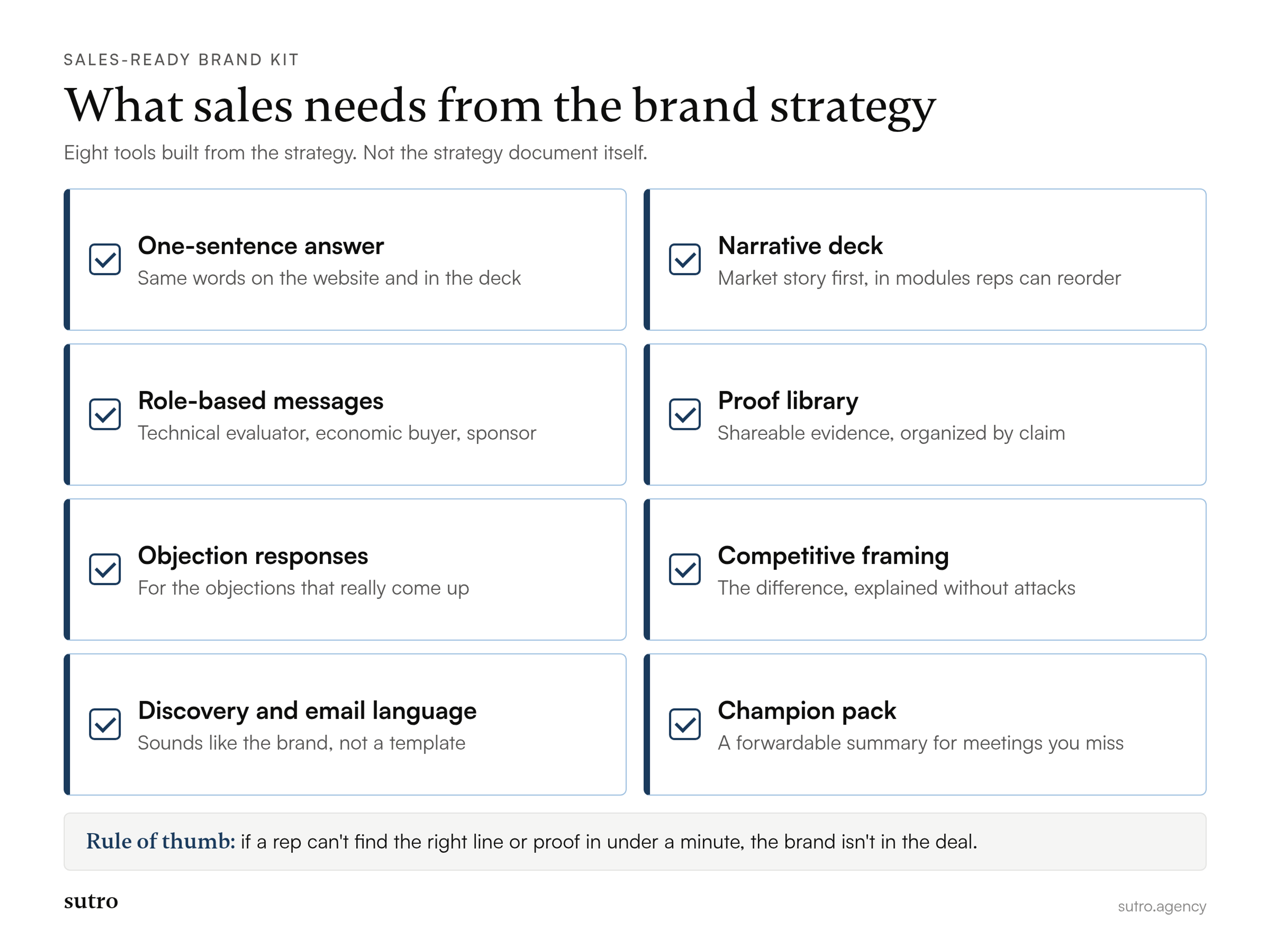
Here is the kit I'd expect at minimum:
- The one-sentence answer to "what do you do?", identical on the website and in the deck.
- A narrative deck that tells the market story first and the product story second, built in modules a rep can reorder.
- Role-based messages for the technical evaluator, the economic buyer, and the executive sponsor.
- A proof library of shareable evidence, organized by claim, so a rep doesn't hunt for it.
- Objection responses written in the brand's voice, for the objections that actually come up on calls.
- Competitive framing that explains the difference without attacking anyone.
- Discovery and email language that sounds like the brand, not like a template.
- A champion pack: a short, forwardable summary your champion can send to colleagues without editing.
The champion pack is the piece most teams skip. It's also the one that works hardest, because it represents you in the meetings you're not invited to.
How to test whether sales can use it
Test the strategy in the field before you call it done. Four quick checks tell you more than any internal review.
- The explain-back test. Ask three reps to explain the company in one sentence without notes. If you get three different answers, the positioning isn't clear yet.
- The first-call test. Have reps use the new narrative on real calls for two weeks, then collect what buyers repeated back and what fell flat.
- The forward test. Give the champion pack to a friendly customer and ask whether they could send it to their CFO as is.
- The consistency audit. Put your homepage, your main deck, and a recent proposal side by side. If they describe three different companies, buyers see that too.
Expect to revise after these tests. A brand strategy that never changes after meeting real buyers was probably never tested.
How to measure a B2B brand strategy
Measure a B2B brand strategy through commercial outcomes rather than awareness alone. At Sutro we look at enterprise conversion, qualified pipeline, win rate, sales-cycle length, pricing confidence, and branded search, plus investor comprehension and recruiting strength when those matter for the moment.
Some of these move fast and some move slowly:
- Leading signals: reps using the new materials, fewer basic "what do you do?" questions on calls, consistent language in buyer emails, and more branded search.
- Lagging signals: higher win rate against named alternatives, shorter cycles in the target segment, less discounting, and larger deals where you're moving upmarket.
Set a baseline before launch. Without one, every result becomes an argument instead of a measurement.
Common B2B brand strategy mistakes
The most common mistake is treating brand strategy as a design project. The others follow from the same root: building for the launch instead of for the deal.
- Writing it without sales. The people closest to buyers know which words work.
- Confusing complexity with intelligence. Technical founders often want every capability on the homepage. Buyers choose outcomes and reduced risk.
- Picking a position nobody can defend. If you can't back a claim with proof, a skeptical stakeholder will find that out.
- Launching with a party, not a rollout. Without new tools and training, the old story stays in use.
- Letting it go stale. Products, pricing, and competitors change. A strategy needs an owner who updates it.
When to revisit your brand strategy
Revisit it when the business changes faster than the brand. For technical B2B companies, that usually happens at a commercial inflection point: moving upmarket, creating a category, raising capital, preparing for an exit, consolidating after an acquisition, recovering lost differentiation, rebuilding enterprise trust, or launching a product platform.
A good signal is when sales starts building its own materials again. That's not a discipline problem. It usually means the official story no longer matches the deals the team is working.
Conclusion
A B2B brand strategy is only as good as its use in real deals. Build it from the deal backward, make hard positioning choices, put messaging before identity, and activate it in the tools sales already uses. Then test it with reps and buyers, measure it against commercial outcomes, and keep it current as the company changes.
If your company is at one of those inflection points and your sales team is still working from an old story, I'm happy to compare notes. Tell us where you are and we'll start there.
Questions
- What is a B2B brand strategy?
- It is the set of decisions about who your company is for, what it stands for, and how it proves it, plus the language and tools that let sales, marketing and product tell the same story. Identity, campaigns and the website are outputs of the strategy, not the strategy itself.
- How is a brand strategy different from a marketing strategy?
- A brand strategy defines what the market should believe about you and why. A marketing strategy decides how to reach buyers with that message: channels, budgets, campaigns and targets. The marketing plan can change every quarter; the brand strategy should hold until the business itself changes.
- Who should own the B2B brand strategy?
- Marketing usually owns it day to day, but the CEO has to sponsor the positioning choices and sales leadership has to co-own the parts reps use. Without a named owner and a review rhythm, sales starts building its own materials again within a few quarters.
- Do we need a new visual identity to get a new brand strategy?
- Not always. If positioning and messaging are the problem, fixing them and rolling them out in sales can matter more than a new logo. A visual update makes sense when the current identity signals the wrong maturity for the buyers you now sell to, for example when moving upmarket.
- How do I know our brand strategy isn't working?
- Listen to sales calls. If reps keep answering basic questions about what you do, explain the company differently from one another, or build their own decks, the strategy isn't in use. Inconsistency between your website and what sellers say is another clear signal.