Strategy
B2B vs. B2C Branding: 7 Differences That Change the Work
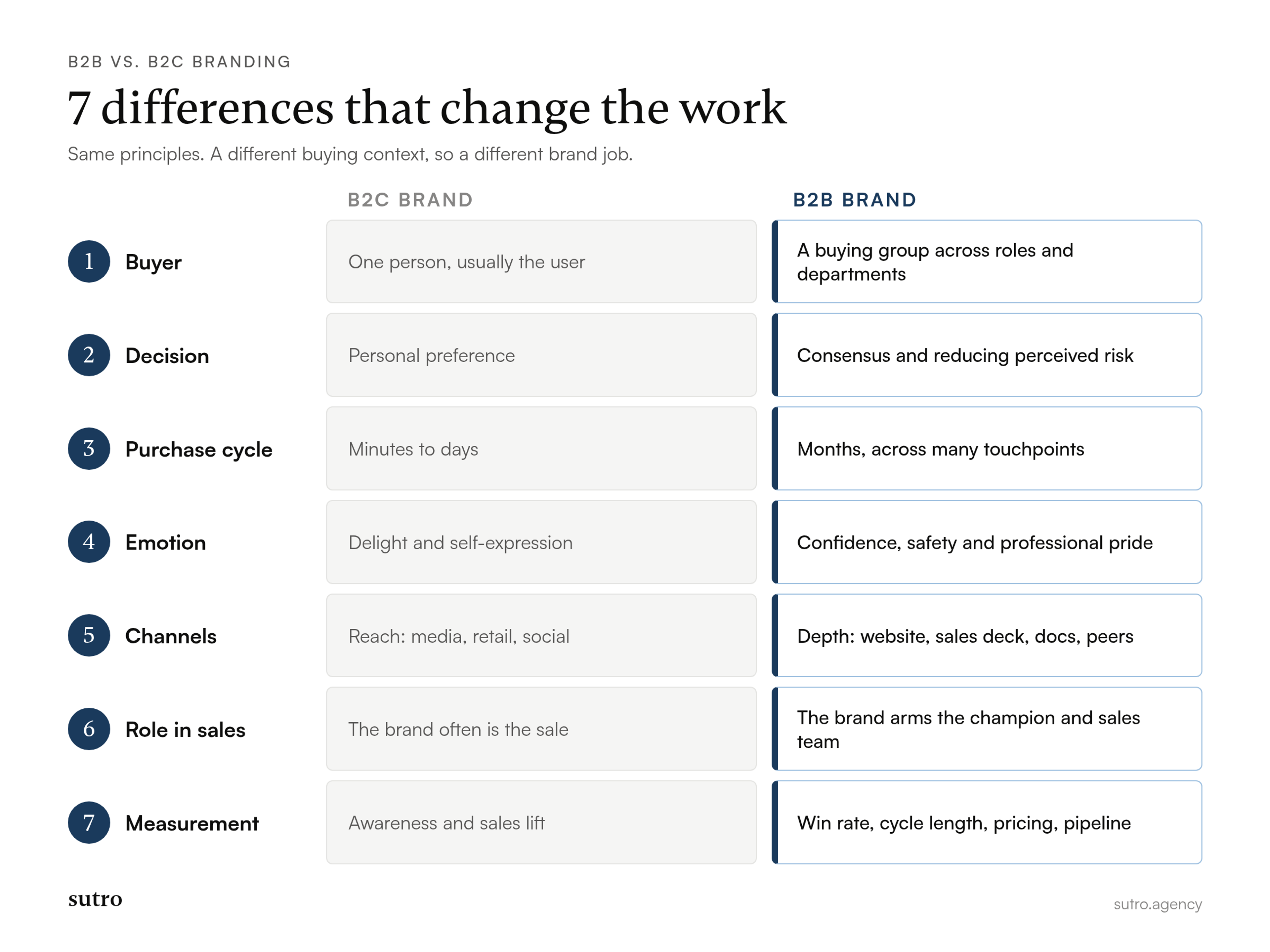
B2B and B2C branding share principles but not buying contexts. Here are the seven differences that change how a technical B2B company should do brand work.
Key takeaways
- B2B and B2C branding share the same principles; the buying context is what changes the work.
- A B2B brand has to win a buying group of many roles, not one person, and help that group reach consensus.
- B2B buying is emotional too, but the emotions are confidence, safety and professional pride rather than delight.
- In B2B the brand rarely closes the sale; it arms the sales team and the internal champion with a story they can repeat.
- Measure B2B brand work through win rate, sales-cycle length, pricing confidence, qualified pipeline and branded search.
- Technical B2B companies should start with positioning and narrative before identity, then activate the brand in sales.
B2B and B2C branding follow the same principles, but they serve different buying situations. A consumer brand usually has to win one person in one moment. A B2B brand has to earn the trust of a group of people over months, survive a procurement process, and give an internal champion words to defend the choice when you are not in the room.
That gap changes almost every decision in the work: what the brand says, where it shows up, who it is built for, and how you know it is working. I've spent my career on this question. I founded Sutro to do strategic B2B branding in San Francisco for technical companies at commercial inflection points, and I'm also the founder and CEO of Ramotion, a product and brand design agency that has been in the industry since 2009 and has completed more than 350 projects. That volume of work is where the patterns in this article come from.
This guide walks through the seven differences that matter most, then what they mean for how a technical B2B company should approach its brand. If you want the foundations first, start with my guide on what B2B branding is and what it includes.
What stays the same in B2B and B2C branding
The fundamentals don't change: a brand is what people believe about you, and it only works if it is distinctive, consistent, and easy to remember. Both B2B and B2C brands need a clear position, a recognizable identity, and a story that holds up when repeated.
The mistake is to stop there. I often hear "people buy from people, so B2B branding is just branding." The first half is true. The second half hides the fact that the people buying a data platform behave very differently from the people buying running shoes. They buy as a group, they buy slowly, and they carry personal risk. The seven differences below come from that context.
1. The buyer: one person vs. a buying group
The biggest difference is who you are talking to. In B2C, the buyer and the user are usually the same person. In B2B, the buyer is a group of people with different jobs, different fears, and different definitions of a good outcome.
Forrester's State of Business Buying, 2024 reports that, on average, 13 people within an organization are involved in a buying decision, and 89% of purchases involve two or more departments. That matches what I see in practice. An engineering lead cares about how the product works. A CFO cares about cost and risk. A security reviewer cares about what could go wrong. A CEO wants to know whether the vendor will still exist in three years.
What this changes in the work:
- Positioning has to hold across roles. One core idea, with proof points that translate it for each stakeholder.
- Messaging needs a hierarchy. The headline is for everyone; the second layer speaks to each role.
- The brand has to look credible to the most skeptical person in the room, as well as to the champion who found you.
A consumer brand can afford to be loved intensely by a narrow group. A B2B brand that only one role understands will stall in committee.
2. Decision-making: preference vs. consensus and risk
B2C decisions are mostly about preference. B2B decisions are mostly about consensus and the avoidance of a bad outcome. Nobody gets promoted for choosing the vendor with the nicest logo, but people do get blamed for choosing the one that failed.
The same Forrester release found that 86% of B2B purchases stall during the buying process. Stalls rarely happen because a buyer suddenly dislikes you. They happen because the group can't agree, priorities compete, or someone inside can't make the case clearly enough.
That makes the brand's job in B2B less about desire and more about reducing perceived risk. In my experience, the brand elements that move committees are:
- A clear category and point of view, so people can explain what you are in one sentence.
- Signals of maturity, in design, language, and documentation, that match the size of the commitment.
- Proof that travels: credible evidence that a champion can forward without editing.
When I diagnose a stalled B2B brand, the problem is usually not that buyers dislike it. It's that the champion can't summarize it for a skeptical colleague.
3. The purchase cycle: minutes vs. months
A consumer purchase can happen in minutes. A B2B purchase often takes months, with dozens of touchpoints between first visit and signed contract. The brand has to stay coherent the whole time.
Forrester names long purchase cycles as one of the forces making B2B buying harder, alongside tight budgets and negative buying experiences. A long cycle has two consequences for brand work.
First, consistency becomes a commercial issue, not a style issue. Over a six-month deal, a buyer will see your website, two or three decks, a proposal, a security questionnaire, product documentation, and maybe an analyst report. If each one tells a slightly different story, the buyer starts to wonder which version is true.
Second, memory matters more than impact. Most companies in your market are not buying today. When they come back into market, they shortlist the vendors they remember and understand. A B2B brand is built to be recalled clearly at that moment, which is why distinctive, repeated assets often beat clever one-off campaigns.
4. Emotion vs. rationality: different emotions, not fewer
B2B buying is not purely rational. It runs on different emotions than B2C: confidence, safety, professional pride, and relief, rather than delight or self-expression.
This is one of the most misunderstood parts of the B2B vs. B2C branding debate. Research by Google and CEB's Marketing Leadership Council, From Promotion to Emotion, surveyed 3,000 purchasers of 36 B2B brands and compared them with consumer benchmarks. Of the hundreds of consumer brands Motista has studied, most have emotional connections with between 10% and 40% of consumers, while seven of the nine B2B brands in this study passed 50%. The same research found buyers were almost 50% more likely to purchase when they saw personal value, such as career advancement or confidence in their choice, and 8x more likely to pay a premium.
Bain's B2B Elements of Value framework points the same way. It identifies 40 distinct kinds of value in business purchases and notes that considerations like enhancing the buyer's reputation or reducing anxiety can play a large role alongside the rational ones.
What I take from this:
- Rational proof is the entry ticket. Specs, security, integrations, and pricing logic have to be there.
- Emotional value decides between finalists. The buyer is choosing the option they feel safest and proudest defending.
- B2B emotion should feel calm. Confident, specific, and precise. Hype reads as risk to a buying committee.
The common error is to strip a B2B brand of personality in the name of seriousness. That produces a brand nobody remembers. The opposite error is to copy consumer-style excitement, which makes an enterprise buyer nervous.
5. Channels: reach vs. depth
B2C brands are usually built through reach: broad media, retail presence, social, and repeated exposure to large audiences. B2B brands are built through depth: a smaller number of high-stakes touchpoints where a few people study you closely.
For a technical B2B company, the channels that carry the brand are usually:
- The website, which is often the first serious evaluation, done without talking to sales.
- Sales materials, such as decks, proposals, and one-pagers, which often carry the brand more than any campaign.
- Product and documentation, because technical buyers judge the company by how it explains its own product.
- Peers, analysts, communities, and events, where reputation is formed second-hand.
- Recruiting and investor materials, which shape how the market reads the company's trajectory.
Forrester also notes that buyers rely heavily on self-service while still expecting vendors to help them make decisions. In practice, that means a lot of brand judgment happens on your site and in your content before a sales rep ever joins the conversation.
This shifts the brand budget. In B2C, a large share goes to media. In B2B, a lot of the value sits in expression: the site, the narrative, the sales story, and the design system that keeps every team on message.
6. The brand's role in sales: closing the sale vs. arming the champion
In B2C, the brand often is the sale. A shopper sees the product, recognizes the brand, and buys. In B2B, the brand rarely closes a deal on its own. Its job is to make every sales conversation start further along and to arm the people who sell you internally.
There are two sellers in every B2B deal. One is your account executive. The other is the champion inside the buying company, who will present you to people you'll never meet. The brand has to work for both.
In the engagements I run, this is where the gap between brand and revenue is most visible. The positioning lives in a strategy document. The sales team, under pressure, writes its own version in slides. Before long there are several stories in the market, and none of them is the official one.
So B2B brand work should include sales expression from the start:
- A narrative the sales team can tell out loud, tested in real conversations.
- A deck and proposal system, alongside the website and the logo.
- Language a champion can reuse, short enough to fit in an internal email.
If the brand doesn't change what happens on the sales call, it hasn't done its main B2B job.
7. Measurement: sales lift vs. pipeline quality
B2C brands are measured mostly through awareness, consideration, and sales lift across large samples. B2B brands are harder to measure because the numbers are smaller and the cycles are longer, so the useful signals sit closer to the pipeline.
Brand tracking surveys can work in B2B, but with thin samples they're often noisy. I find it more useful to watch business indicators that a stronger brand should move:
- Win rate against named competitors.
- Sales-cycle length, especially time from first meeting to shortlist.
- Pricing confidence, meaning how often deals close without heavy discounting.
- Qualified pipeline, including inbound deals that already understand what you do.
- Enterprise conversion as the company moves upmarket.
- Branded search, as a proxy for memory and demand.
- Investor comprehension and recruiting strength, which show whether the story travels outside sales.
These are the outcomes we measure brand work against at Sutro. None of them is a perfect brand metric. Together, they tell you whether the market understands you better than it did before.
What these differences mean for a technical B2B company
The practical takeaway is simple: a technical B2B company should build its brand for a skeptical group, over a long timeline, across sales as much as marketing. That rules out treating brand work as a visual refresh or a campaign.
Borrow from B2C, carefully
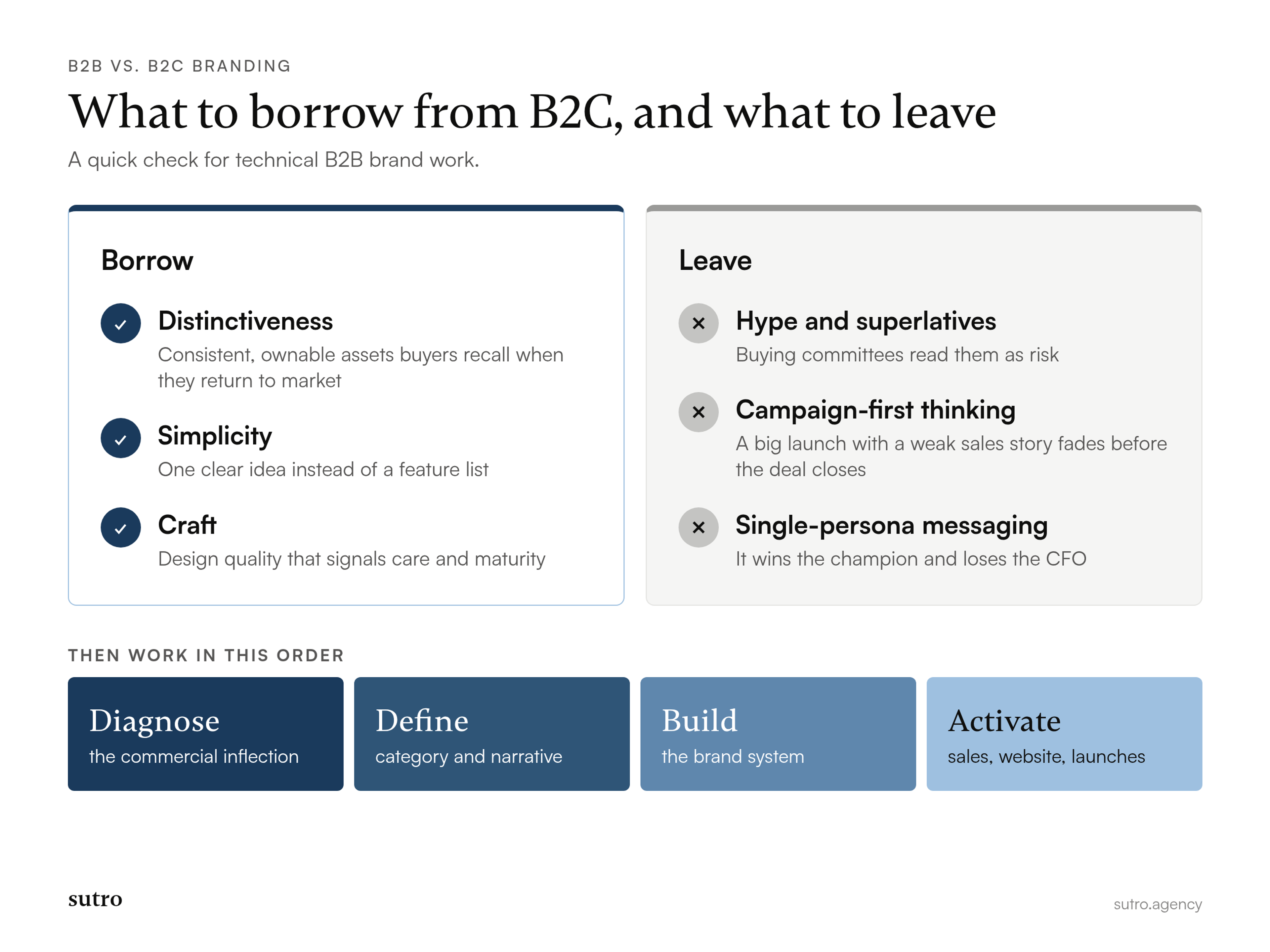
Some B2C habits do help B2B brands:
- Distinctiveness. Consistent, ownable assets make you easier to remember when buyers return to market.
- Simplicity. One clear idea beats a list of features.
- Craft. Good design signals care and maturity to technical buyers.
Don't borrow these
Other B2C habits hurt B2B brands:
- Hype and superlatives. Committees read them as risk.
- Campaign-first thinking. A great launch with a weak sales story fades before the deal closes.
- Single-persona messaging. It wins the champion and loses the CFO.
Start with positioning, not identity
Most technical companies I meet don't have a design problem first. They have a product that has moved faster than the market's understanding of it. That's why we start every engagement by diagnosing the commercial inflection, then define the category and company narrative, then build the brand system, and only then activate it across sales, the website, and launches. You can read more about how Sutro approaches this work.
The order matters. A new identity on top of an unclear position is just a more expensive version of the same confusion.
Conclusion
B2B vs. B2C branding is not a question of serious vs. creative. It's a question of context. B2B brands serve groups instead of individuals, consensus instead of preference, months instead of minutes, and pipeline outcomes instead of sales lift. Emotion still matters, but it shows up as confidence and safety.
For a technical B2B company, that means building the brand around a clear position, a narrative every stakeholder can repeat, and an expression system that works in sales as well as marketing. If your company is approaching a moment where the market needs to understand you differently, such as moving upmarket, raising, or launching a platform, I'm happy to talk through where your brand stands.
Questions
- What is the main difference between B2B and B2C branding?
- The buying context. A B2C brand usually has to win one person in one moment. A B2B brand has to earn the trust of a buying group over a long cycle and give an internal champion language to defend the choice. The principles are the same; the job is different.
- Is B2B branding less emotional than B2C branding?
- No. B2B buying runs on different emotions: confidence, safety, professional pride and relief. Research by Google and CEB found that most B2B brands studied had stronger emotional connections with customers than most consumer brands. The tone should be calm and precise, not excited.
- Can a B2B company use B2C branding tactics?
- Some of them. Distinctive assets, a single clear idea and strong design craft help B2B brands. Hype, campaign-first thinking and messaging aimed at one persona usually hurt, because buying committees read them as risk or never see their own concerns addressed.
- How do you measure B2B brand performance?
- Watch business indicators a stronger brand should move: win rate against named competitors, sales-cycle length, discounting and pricing confidence, qualified and inbound pipeline, enterprise conversion and branded search. Brand surveys can help, but B2B samples are often too small to rely on alone.
- Where should a technical B2B company start with brand work?
- With positioning, not the logo. Most technical companies have a product that has moved faster than the market's understanding of it. Clarify the category and company narrative first, then build the identity and messaging system, then roll it out across sales, the website and launches.