Strategy
M&A Branding: How to Integrate Brands After an Acquisition
Make acquisition brand decisions with named owners, evidence and release conditions. Coordinate customer messages, support, product naming and both sales teams.
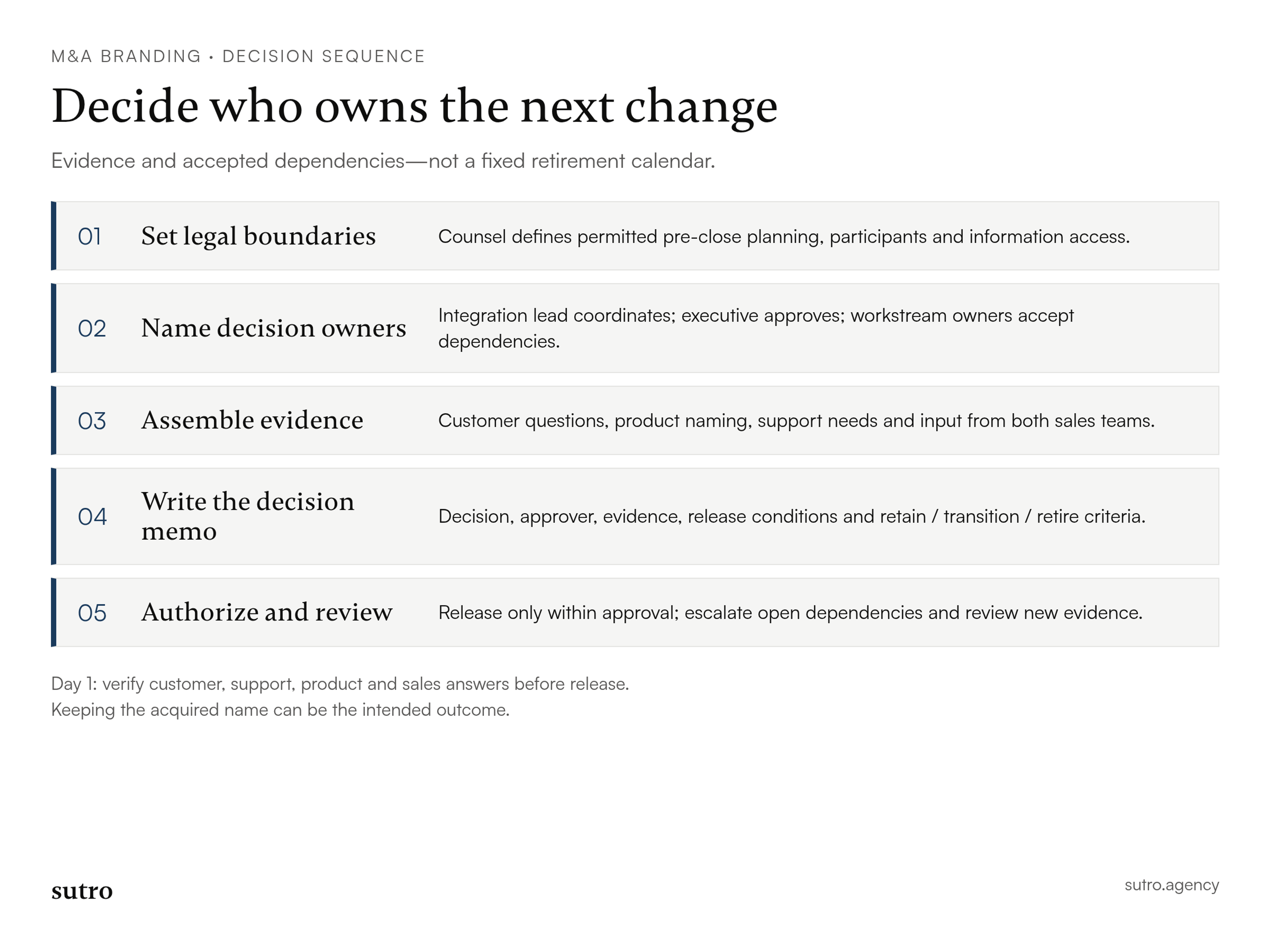
Key takeaways
- Assign an accountable approver and accepting workstream owners to each customer-facing decision.
- Counsel defines permitted pre-close participants, planning and information access.
- Day-1 readiness requires verified answers from customer, support, product and both sales teams.
- A decision memo records evidence, alternatives, dependencies and release conditions.
- Retaining an acquired name can be the intended outcome; retirement needs its own rationale and criteria.
- A 90-day review is illustrative, not a mandatory renaming deadline.
M&A branding means deciding how the combined business identifies itself after an acquisition and authorizing changes that customers can understand. The operational challenge is deciding who approves each change, what evidence they need and which teams must be ready before it reaches customers.
This guide covers that decision sequence, not architecture selection or a general rebrand. An acquired name can remain, change or stay under review. None of those choices automatically requires a website move, a product rename or retirement of the acquired brand.
For technical B2B businesses, the company name, product name and contracting entity can answer different questions. That distinction informs the acquisition work discussed here and Sutro's B2B tech branding practice. The goal is consistent answers across both organizations, not an appearance of unity before the operational decisions are made.
Start with a decision register, not a launch calendar
An integration owner should separate approval of a direction from permission to release a particular change. Leadership might approve a naming direction while support or product still has an unresolved dependency.
For each proposed change, record the decision, accountable approver, contributing teams, evidence, blocked dependencies and review trigger. One person maintains the register. That coordinator does not inherit legal, commercial or technical approval authority merely by owning the document.
If leadership needs to choose the relationship between brands, use the separate guide to choosing a structure for B2B brands. Treat that choice as an input here. The integration register translates it into responsibilities and customer-facing consequences rather than teaching the models again.
Distinguish reversible wording changes from consequential operational changes. Updating an approved explanation is different from changing an identifier customers use in their systems. Ask each owner about reversibility and dependencies instead of assuming every surface carries the same risk.
Before close: get counsel's planning boundaries
Pre-close work must remain within counsel-approved deal and regulatory limits. An announced transaction is not permission to combine operations, coordinate commercial behavior or share unrestricted customer, pricing, pipeline or product information.
The FTC's discussion of premerger coordination and gun-jumping distinguishes legitimate planning from conduct crossing legal boundaries. It is background, not transaction-specific advice. Counsel must define permitted participants, information access, safeguards and decisions that must wait.
Within that approved scope, prepare a planning charter. Name the participants, restrictions, reviewers and conditions under which prepared material could be used. If an input cannot lawfully be shared, leave that dependency unresolved. Do not replace it with a guess or an informal request to the other sales team.
Prepare conditional drafts only where permitted. Separate confirmed facts from statements dependent on closing, product decisions or contract review. Preparing a statement does not authorize publishing it.
Calendar assumptions need caution too. TechCrunch reported that IBM's HashiCorp acquisition closed about ten months after announcement. That is one transaction, not a timing benchmark. Tie release dependencies to confirmed events, not a hoped-for closing date.
Assign owners and accepting teams
Each workstream needs an accountable owner and an explicit handoff. Job titles vary; the practical requirement is a named person who can accept or reject the proposed action and explain the missing dependency.
Customer continuity and support
The customer lead establishes who contacts each account and which continuity claims are verified. Legal and commercial owners confirm statements about contracts, billing and commitments. Do not tell customers nothing changes unless the responsible people have confirmed it.
The support lead owns contact routes, response ownership and escalation. Before a message changes where customers ask for help, support confirms that the destination is staffed and agents have the approved explanation. A website relationship line does not complete that handoff.
Record audience-specific exceptions. Self-serve users, enterprise customers and partners may need different instructions. The common dependency is an accurate answer, not identical wording. Put the sender, recipient group and accepting support owner beside each proposed message.
Product naming and documentation
The product owner separates public naming from technical identifiers. Specify where a proposed label applies: product pages, application headers, documentation titles or account messages. A marketing approval must not silently rename packages, commands or integrations.
Product and support review the same naming map. For each surface, record the current name, proposed alternative, customer explanation and readiness owner. Where documentation cannot explain both names clearly, keep that dependency open rather than treating a scheduled date as permission.
Ask what customers must do differently, if anything. If the answer is unknown, the communication should not imply a seamless transition. An approved company-level statement can coexist with unchanged product terminology while the relevant owners investigate.
The two sales teams
Name a commercial owner from each business and a shared escalation path once coordination is legally permitted. Resolve conflicting answers about product scope, account responsibility and what the acquisition does not yet promise.
When authorized, maintain a joint question log for prospects evaluating both products, overlapping accounts and requests about roadmap or contract consolidation. Product and legal approve answers within their remits. Neither sales team should improvise combined functionality because the brand narrative sounds unified.
Sales readiness means both teams can explain the approved decision, identify its limits and escalate unresolved questions. It does not mean one team has received the other's deck. Record who owns follow-up when an account receives conflicting answers.
Communications and integration leadership
Communications maintains approved wording and audience versions. The integration owner checks accepted dependencies before requesting release. A leadership sponsor resolves cross-functional trade-offs, such as whether a relationship statement must wait for support readiness. Make that escalation path visible to both organizations.
Day 1: release verified operational answers
Day-1 communication should explain the confirmed transaction and its approved implications. The acquisition-specific task is assigning responsibility for the questions the announcement creates, not producing another general announcement checklist.
Before release, verify these handoffs:
Legal and the deal lead: confirm closing status and the permitted relationship description. A prepared draft is not evidence of closing.
Customer leads: assign senders and account escalation owners. Verify statements about contracts and account responsibility.
Support: confirm contact routes, response ownership and language for customers using either brand name.
Product: identify names remaining in use and changes not yet authorized. Supply an escalation route for product questions.
Both sales leads: distribute the same approved boundaries on claims and assign overlapping opportunities where authorized.
Communications: release the approved version and maintain a correction path if an answer proves incomplete.
IBM's announcement of its completed HashiCorp acquisition named Terraform and Vault while describing their place in its portfolio. The limited lesson is that a corporate transaction announcement can retain recognizable product names. It does not determine the permanent relationship appropriate for another deal.
Collect evidence for the disputed decision
Build an evidence packet around a question leadership must answer. An inventory alone does not explain why a name should remain or change for a particular audience.
Customer leads record actual continuity questions. Sales leads distinguish buyer language from their preferences. Product and support identify where a change would make instructions ambiguous. Authorized search and usage data can provide context, but a single metric should not decide the relationship between brands.
Use the separate B2B brand audit method to organize an audit and the guide to studying B2B brand perceptions for research design. The integration task is assigning those inputs to decisions and owners, not repeating either method.
A 90-day review is an illustrative checkpoint, not a mandatory research window or renaming deadline. It can retain existing names, request more evidence, approve a scoped change or identify an unresolved dependency. Define what would change the recommendation before collecting information merely to defend it.
A leadership decision-memo template
Use a short memo to make the requested approval explicit. Two pages can be a useful constraint, with supporting evidence in an appendix. Distinguish a recommendation from an approved decision.
1. Decision requested and authority
State the exact question, such as whether the acquired product should retain its public name for a defined audience. Name the executive approver, integration owner and required legal, product and commercial reviewers. Specify exclusions, including technical identifiers or contract language that need separate approval.
2. Evidence and alternatives
Summarize the evidence, collector, date and limitations. Explain alternatives without assuming ownership makes the acquirer's name preferable. State what additional information could reverse the recommendation. Separate observed customer language from leadership's expectations about how customers will respond.
3. Dependencies and release conditions
List the required accepting owners. Support confirms instructions; product confirms naming consistency; both sales leads confirm answers; legal approves relevant claims. An unresolved dependency creates a hold or an explicit scoped exception. It must not disappear from the executive summary.
4. Retention, transition and retirement criteria
State whether the recommendation retains a name, transitions it or leaves the question open. Retention can be the intended outcome, not unfinished integration. If retirement is proposed, define the supporting evidence, readiness conditions, exceptions and reconsideration trigger. A tentative date is not an unconditional promise.
5. Review and escalation
Record approval, dissenting concerns and the next review trigger. Assign monitoring of misunderstandings reported by customers, support and both sales teams. Name who can pause a change if those signals reveal a problem. Test the rationale, not just whether a calendar milestone passed.
Fictional example: Keelson acquires Tidewire
Keelson and Tidewire are fictional companies. This is a planning exercise, not a client case, observed research or a claim about results. Assume Keelson sells an API security platform and Tidewire sells a secrets-scanning tool. Neither name is presumed to disappear.
The integration owner proposes a question: should Tidewire keep its public product name while the company relationship is explained separately? Leadership requests evidence and dependencies rather than approving a visual direction as a substitute for that decision.
The customer lead would gather authorized account questions. Tidewire's support lead would identify where customers use its name to find help. Product would map the proposed wording against documentation and identifiers. The two sales leads would prepare consistent answers without promising combined functionality that product has not approved.
The memo would name the executive approver and exclude contract language from the naming approval. A release condition might require support instructions and sales answers to be ready before a relationship statement changes. If unmet, the integration owner would escalate rather than treating a planned date as permission.
At an illustrative 90-day review, leadership could retain Tidewire, consider a transition or request evidence. Retirement would require its own rationale and conditions. The exercise ends with accountable decisions and open questions, not invented gains in retention, search or sales.
Keep implementation separate from approval
An approved decision needs an execution plan from the relevant owners. The memo is not a technical migration plan. Use the separate guide to B2B rebrand rollout and implementation for rollout mechanics and redirects.
If a decision requires a domain move, the technical owner should consult Google's Change of Address guidance. That is a conditional dependency, not a reason to merge sites after every acquisition. The register identifies who accepts the plan and can stop release; it does not prescribe a universal sequence for changing sales materials, websites, products and billing.
Conclusion
M&A branding needs named owners, evidence and explicit release conditions. Keep pre-close planning within counsel-approved limits, verify Day-1 answers across both organizations and separate the chosen direction from permission to implement it. Retain an acquired name when that is the approved direction; transition or retire it only when the rationale and dependencies support it. To clarify responsibilities, tell us which acquisition decisions are still open.
Questions
- Who should own M&A branding decisions?
- An integration owner coordinates the register and memo. A named executive approves the direction, while legal, product, customer, support and commercial owners accept dependencies within their remits. Coordination does not replace their authority.
- What can teams plan before closing?
- Only work permitted by counsel for the particular transaction and regulatory context. Counsel defines participants, information access and safeguards. Do not infer permission to coordinate operations or share sensitive information from an announcement.
- What should Day-1 communications cover?
- The confirmed transaction and approved operational answers: account responsibility, support routes, product names and the limits of what either sales team may promise. Verify continuity claims rather than automatically saying nothing changes.
- Does an acquired brand have to retire?
- No. Retaining it can be the approved outcome. Any transition or retirement proposal needs evidence, exceptions and operational conditions rather than assuming every acquisition ends with one name.
- Must naming decisions be finished in 90 days?
- No. Ninety days is an illustrative review checkpoint. A review can retain names, request evidence or approve a scoped change when dependencies are accepted. The transaction's circumstances determine the timing.