Strategy
Brand Research for B2B: Methods That Reveal How Buyers See You
B2B brand research is the design of a buyer-perception study, from research question and sampling to coding and a perception-gap readout.
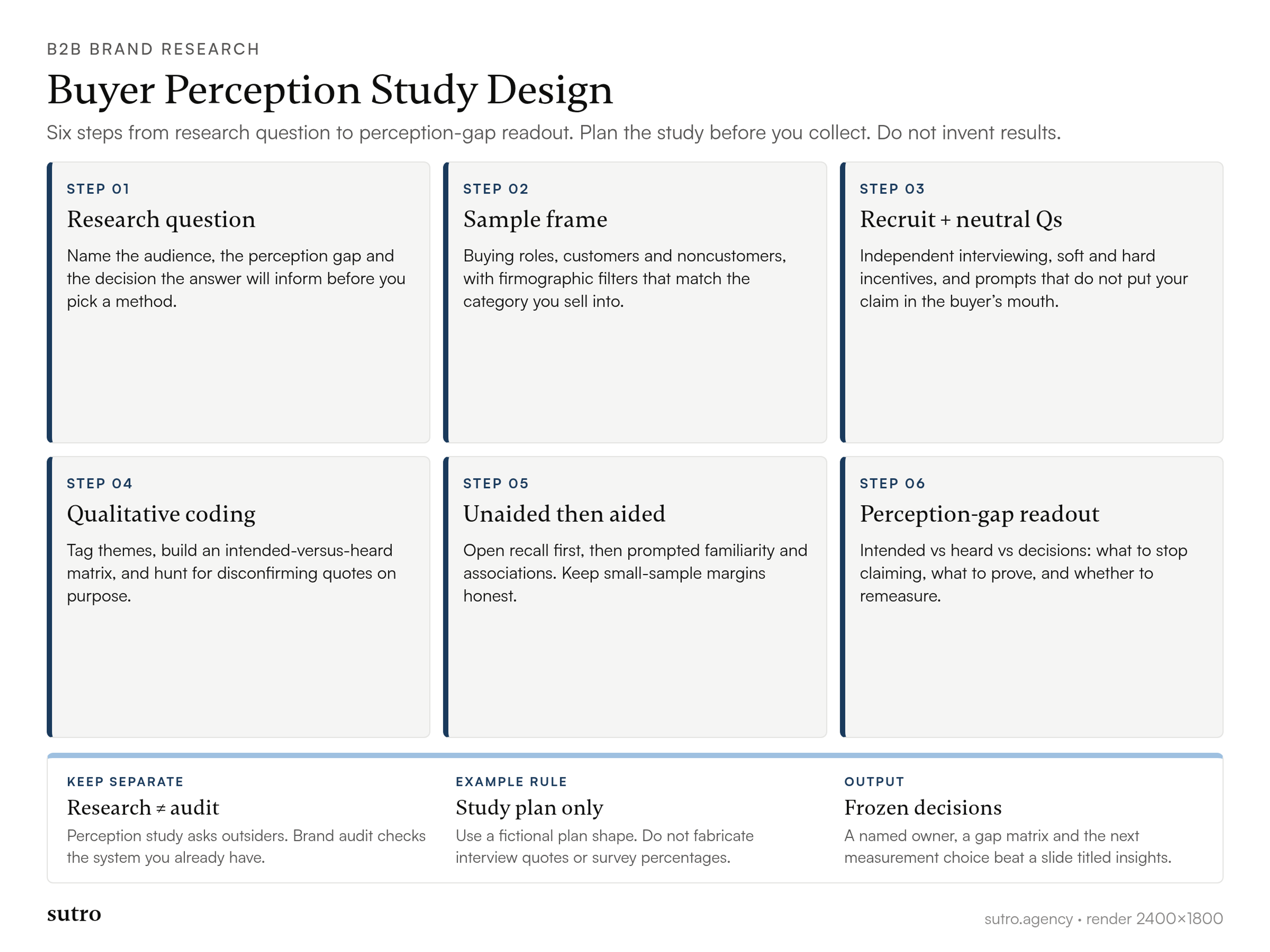
Key takeaways
- B2B brand research designs a buyer-perception study; a brand audit evaluates whether your current brand system is coherent.
- Write one decision-facing research question and the perception you intend before you choose interviews or a survey.
- Sample economic buyers, technical evaluators and users across customers and noncustomers, not only champions.
- Recruit with neutral prompts, code open answers against intended perception, and keep unaided questions ahead of aided lists.
- Treat small samples as directional, report unaided and aided separately, and end with a perception-gap readout that names decisions.
- Use a fictional study-plan shape for planning; do not invent results and pass them off as evidence.
B2B brand research is the design of a buyer-perception study: a clear research question, a sample across buying roles, customers and noncustomers, neutral interviews and surveys, coded qualitative themes, and a readout of where market perception parts from the story you intend. It is not a logo preference poll, and it is not an internal brand audit. Research asks outsiders what they notice, trust, shortlist and associate with you. An audit asks whether your current brand system is coherent and ready for change.
When I start a Diagnose engagement at Sutro, I still meet teams that treat a positioning workshop as if it were evidence. A polished deck is not a living map of how buyers see you. Without a study design, leadership argues from anecdote, sales rewrites the homepage story, and messaging drifts until someone pays for research after the redesign is already locked.
Buyer-perception work is part of what our B2B branding company does before the redesign starts. I also founded Ramotion, which has been in the industry since 2009. Across both practices the pattern holds: teams that write the research question and sample plan first make cleaner brand decisions than teams that only argue about adjectives in a slide deck.
This guide covers how to move from research question to method selection, how to sample buying roles plus customers and noncustomers, how to recruit and write neutral perception questions, how to code qualitative answers, how to order aided and unaided survey items and read small samples honestly, how to build a perception-gap findings readout, and one fictional study-plan example you can copy the shape of. It does not invent study results. For evaluating the current brand system itself, use a brand audit that scores assets and claims as a separate workstream.
From research question to method selection
Every useful B2B brand research project starts with one decision-facing question. Write it before you pick a method. Good questions name the audience, the perception gap you need to settle, and the decision the answer will inform.
Examples that hold up in technical B2B markets:
- Among ops leaders who evaluate analytics vendors, which brands come to mind first for shift-level decisions, and which attributes do they attach to us versus three named rivals?
- Among security buyers who are not our customers, what words do they use when they describe us, and how do those words differ from our intended positioning statement?
- Among economic buyers and technical evaluators in the same deals, where do unaided awareness and shortlist membership diverge?
Bad questions are vague ("How is our brand doing?") or method-first ("Should we run a survey?"). Method follows the question. If you need language, barriers and criteria, start with qualitative interviews. If you need how many buyers in a defined market recognize you and associate which attributes, run a structured survey after you know which attributes matter. Cascade Insights argues that B2B brand studies should run upfront qualitative research before surveying larger samples of B2B buyers, so the survey asks about the criteria buyers actually use instead of the criteria your team hopes they use.
Choose methods in this order:
- Lock the research question and the decision it will inform.
- Write the perception you intend in three plain words or one short sentence before you collect anything.
- Run a short qualitative wave to surface language and barriers.
- Build the survey instrument from those findings.
- Field the survey with unaided items first.
- Code open answers, count closed answers, and compare both with the intended perception.
Skip the vanity sample of five friendly customers who already love you. Skip the 60-question survey that no busy buyer finishes. Keep the core instrument short enough that people will take it again later if you remeasure.
Sample across buying roles, customers and noncustomers
Strong B2B brand research samples the people who build the shortlist, not only the person who signs. Economic buyers, technical evaluators, operators who live with the product, and influencers outside the vendor call all shape perception. A sample of only customers explains why you won. A sample of only champions flatters you. You need both customers and noncustomers in the defined category, plus the roles that actually write the shortlist.
Wynter’s brand perception guidance is blunt: survey your market, not only your customers, and include manager-level people who often build the shortlist rather than only C-suite titles that are harder to recruit and less involved in early vendor lists. Segment the analysis by role, company size and market status when sample size allows. Customers explain delivery language and advocacy. Prospects explain awareness barriers and shortlist math. Partners sometimes hear competitive talk you never hear on a sales call.
Write a sample frame before recruiting:
- Buying roles: economic buyer, technical evaluator, day-to-day user, and one influencer role if deals in your category include them.
- Relationship status: current customer, past customer, evaluated-and-lost, aware noncustomer, unaware category buyer.
- Firmographic filters: industry, company size, and the product category definition you will use in every question.
If the frame is too wide, the study becomes noise. If it is only your installed base, the study becomes a customer-satisfaction survey with brand vocabulary taped on.
Recruiting and neutral perception questions
Recruiting B2B decision-makers is the hard part of the design. Adience’s qualitative guidance stresses independent interviewers, soft incentives that respect time-poor buyers, and the risk that in-house interviewers introduce bias or hear only what confirms the deck. Use a mix of soft incentives (curiosity about the topic, a useful readout for the participant’s team, a trusted introduction) and hard incentives (charity donation or a modest honorarium where policy allows). Promise a short, fixed length and keep it.
Write perception questions that do not lead. Neutral questions ask for recall, associations and comparisons without putting your preferred claim in the respondent’s mouth.
Qual interview prompts that stay neutral:
- When a team like yours last evaluated [category], which vendors came up first, and why those?
- What three words would you use to describe [brand] to a peer who has never heard of it?
- What would make you leave [brand] off a shortlist even if you recognized the name?
- Which other brands do you put in the same set, and what job do they share?
Survey items that stay neutral:
- When you think about [category], which brands come to mind? (open text, unaided)
- How familiar are you with each of the following brands? (aided list after unaided)
- Which attributes do you associate with each brand? (buyer-derived attributes, not your slogan list)
- If you were shortlisting for [need] in the next 6 to 12 months, which brands would you consider?
Ban leading attribute labels such as "best-in-class AI" or "industry-leading security." Use the words buyers used in the qualitative wave. Keep your brand name out of the first unaided items so earlier answers do not contaminate later ones.
Qualitative coding that leadership can use
Coding turns interview transcripts and open survey answers into themes you can compare with the perception you intended. Articos describes the analysis move cleanly: count the closed answers, then read every open-ended answer and tag the recurring words and themes, then line those codes up against the three words you wanted buyers to use. The gaps are the findings.
A practical coding pass for B2B brand research:
- Transcript hygiene: anonymize, keep role and relationship status tags, and keep quotes attached to codes.
- Open coding: mark associations, barriers, category frames, rival comparisons and proof buyers trust.
- Axial pass: collapse near-duplicate codes into a short theme list (usually 8 to 15 themes, not 80).
- Intended-versus-heard matrix: rows are the words or claims you intended; columns are frequency and intensity of what buyers actually said.
- Disconfirming search: deliberately hunt for quotes that contradict the preferred story so the readout is not a confirmation exercise.
Do not stop at a word cloud. Leadership needs themes with definitions, exemplar quotes, and a note on which roles said what. A theme that only current customers use is a different finding from a theme that noncustomers use when they leave you off the list.
Aided and unaided questions, and small-sample limits
Order matters. Ask unaided questions before you show any brand names. Wynter’s brand perception survey template puts unaided awareness first ("When you think about [category], which brands come to mind?"), then aided familiarity from a list, then consideration, preference and attribute association. Showing the list too early contaminates recall and inflates aided scores that look like awareness but are only recognition under prompt.
Treat small samples with honest margins. The same Articos guide notes that about 100 responses is a rough read near a ±10% margin of error, while about 385 responses supports roughly ±5% under ideal assumptions that brand surveys rarely meet. Wynter’s guidance lands in a similar place: 100 respondents is a common B2B brand-tracker bar, with larger samples when you need segment cuts. A 100-person study split four ways is four directional reads, not four precise trackers.
What that means in practice:
- Report unaided and aided separately. Never blend them into one "awareness" number.
- Mark differences that sit inside the margin as inconclusive, not as wins.
- Prefer role and relationship cuts only when each cell has enough responses to be directional on purpose.
- Keep 80 percent or more of the instrument identical if you remeasure later, so you can compare like with like.
Small qualitative samples still earn their keep when the audience is niche and the goal is language, not population percentages. Say so in the readout. Do not dress eight interviews as a market share claim.
Perception-gap findings readout
The end of B2B brand research is a perception-gap readout, not a dashboard of vanity scores. Line up three columns:
- Intended perception: the three words or one sentence you wrote before fieldwork.
- Heard perception: the coded themes and the unaided or aided associations buyers actually used.
- Gap and decision: what to stop claiming, what to prove, what to measure next, and which audience still cannot describe you.
A useful readout also separates customers from noncustomers and economic buyers from technical evaluators when the sample allows. The same brand can look precise to users and vague to buyers who only see the homepage. That split is often the finding that matters most for how to define where a B2B brand competes and for whom and for the messaging framework sales can actually use. Over time, the same study design also feeds how brand equity builds from awareness and associations, but the first job of this article’s method is the gap itself, not a full equity model.
Freeze the readout. Name an owner. Schedule whether you will remeasure. Do not reopen the research question every time one executive has a new anecdote.
Worked example: Harborline Analytics study plan (fictional)
Harborline Analytics is a fictional mid-market ops analytics vendor invented for teaching. It is not a client. This section is a study plan only. It does not invent interview quotes, survey percentages or competitive wins.
Research question: Among plant ops leaders and IT evaluators at mid-market manufacturers in North America, which brands come to mind for shift-level ops decisions, which attributes do they attach to Harborline versus a fixed set of three rivals, and where does that heard perception differ from Harborline’s intended claim of "real-time plant visibility"?
Intended perception (written before fieldwork): real-time, operator-ready, shift-level action.
Sample frame:
- Roles: plant ops leader, IT or data evaluator, and one finance influencer when deals include them.
- Relationship status: current customer, evaluated-and-lost, aware noncustomer in-category.
- Filters: manufacturing, 200 to 2,000 employees, North America.
Methods:
- Eight to twelve in-depth interviews (mix of roles and relationship statuses) with neutral prompts on unaided category brands, associations, shortlist barriers and rival set.
- Qualitative coding into an intended-versus-heard matrix before the survey is locked.
- Survey instrument with unaided awareness first, then aided familiarity, consideration, attribute association using buyer-derived attributes, and a segmenting question on current category use.
- Target about 100 completed responses for a directional market read, with role cuts treated as directional only.
Perception-gap readout template (empty until real data exists):
- Intended words versus top heard themes by role and relationship status.
- Unaided versus aided mention of Harborline and each rival.
- Attributes Harborline is associated with versus attributes it intended to own.
- Decisions deferred until data lands: which claim to keep, which to prove, which to retire from the homepage until evidence catches up.
Copy the shape. Do not invent the cells.
Conclusion
B2B brand research is study design for buyer perception. Start with a decision-facing research question. Sample across buying roles, customers and noncustomers. Recruit with care and ask neutral questions. Code qualitative answers against the perception you intended. Put unaided items before aided ones and respect small-sample limits. End with a perception-gap readout that freezes decisions instead of a slide titled "insights."
If you want help designing a first buyer-perception study before the next brand change, tell us which perception gap you need to settle.
Questions
- What is B2B brand research?
- B2B brand research is the design of a buyer-perception study that measures how target buyers notice, describe and shortlist your brand relative to rivals. It combines a clear research question, sampling across roles, qualitative coding and structured aided and unaided questions into a perception-gap readout.
- How is brand research different from a brand audit?
- Research looks outward at buyer and market perception. An audit looks inward at whether identity, claims, assets and delivery are consistent and ready for change. Keep them as separate workstreams so an internally tidy brand is not mistaken for a brand buyers understand.
- Who should be in the sample?
- Include customers and noncustomers in the defined category, and cover the buying roles that build and approve the shortlist. A customer-only sample explains wins. A market sample explains why you are invisible or misread.
- Why put unaided questions before aided ones?
- Unaided questions capture which brands come to mind without a prompt. Showing a brand list first contaminates recall and inflates recognition scores that look like awareness. Keep unaided items first, then aided familiarity and associations.
- How should we treat small sample sizes?
- Report them as directional. Roughly 100 survey responses is a common B2B bar for a market read with a wide margin. Segment cuts need enough responses per cell or they should stay qualitative. Do not present eight interviews as population percentages.
- What belongs in the findings readout?
- An intended-versus-heard matrix, unaided and aided results kept separate, attribute associations by role where possible, and explicit decisions on what to stop claiming, what to prove and whether to remeasure. A dashboard without decisions is unfinished research.