Strategy
How to Run a B2B Brand Audit (With Checklist)
A B2B brand audit compares what you say about the business with what buyers and your own sales team actually hear. When to run one, what to review, how to collect evidence, and a checklist.
Key takeaways
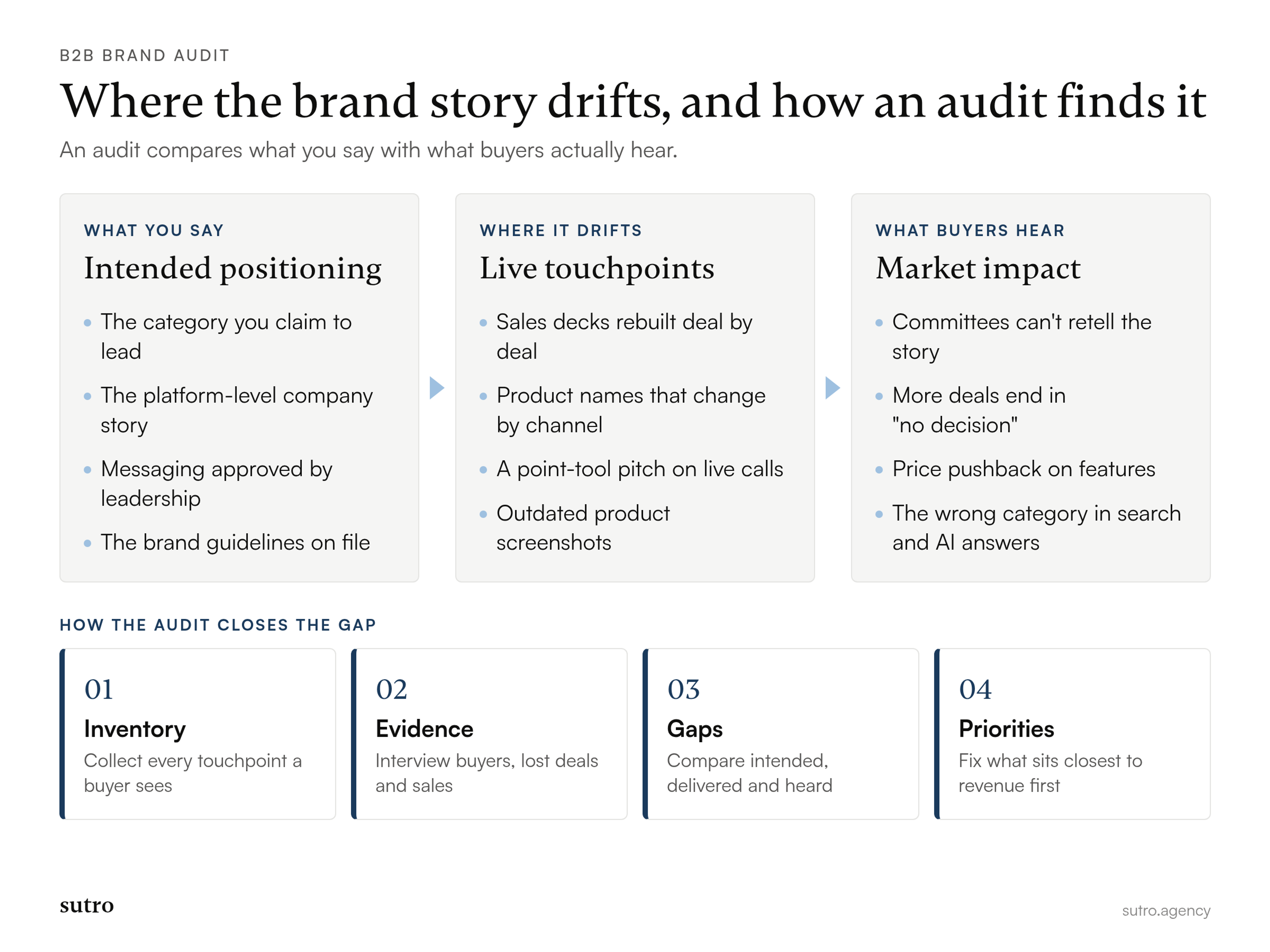
- A B2B brand audit measures the gap between how a business describes itself and how buyers, lost prospects and its own sales team understand it.
- Run one before a commercial change: moving upmarket, raising or exiting, integrating an acquisition, or losing deals you should win.
- Review six areas: positioning, messaging, visual identity, website and digital presence, sales materials, and brand architecture.
- The strongest evidence comes from outside the leadership team: buyer and lost-deal interviews, sales call recordings, competitor messaging and branded search data.
- Score findings by how close they sit to revenue and fix the assets that hurt live deals first.
A B2B brand audit is a structured review of the gap between how a business describes itself and how buyers, prospects and its own sales team actually understand it. You run one by collecting every place the brand shows up, interviewing people who bought and people who didn't, comparing the two pictures, and ranking the gaps by how much revenue they put at risk. For a technical B2B business, the useful output is a short list of fixes, not a scorecard of logo usage.
The need usually shows up as a sales problem before anyone calls it a brand problem. Deals stall because prospects can't explain the product to their own buying committee. Account executives rebuild the deck because the official one doesn't land. The website promises a platform while sales pitches a point tool. Each of those is a symptom of the same thing: the story has drifted, and nobody has looked at all of it at once.
At our B2B branding team, an audit is the first part of every engagement. We call that phase Diagnose, and it comes before we define the category and narrative, build the brand system, or activate anything. I also founded Ramotion and have run it as CEO since 2009, across more than 350 projects, and the pattern is the same there: teams that skip the diagnosis end up redesigning the wrong thing.
This guide covers what a brand audit includes, when to run one, the six areas to review, how to collect evidence, a four-week process, a checklist, and how to turn findings into a plan.
What a B2B brand audit covers
A brand audit has two halves: an inventory of what the business puts into the market, and research into what the market takes away. Kevin Lane Keller's textbook on brand management splits it the same way, into a brand inventory and a brand exploratory (Keller and Swaminathan, Strategic Brand Management).
The inventory is the easy half. You gather the website, sales decks, one-pagers, product UI, onboarding emails, pricing pages, analyst briefings, recruiting pages and every document a buyer might see. Then you read them side by side, the way a buying committee would encounter them over a few months.
The exploratory half is where the value is. It asks what buyers believe about you, what words they use, what they compare you to, and where they got confused. In B2B the second half has to include your own customer-facing teams, because sales and solutions engineers hear objections every week that marketing never sees.
A brand audit is not a design review and not a website audit. Visual identity is one input. Page speed, conversion paths and technical SEO belong to a separate exercise, though the audit can tell you which pages matter most.
When to run a brand audit
Run an audit when the business is about to change what it sells, to whom, or at what price, and the current brand was built for the old version. The trigger is commercial, not aesthetic. These are the moments that most often justify one.
Moving upmarket
A product sold to a team lead on a credit card needs a different story than the same product sold to a CIO through procurement. Enterprise buyers look for risk reduction, integration depth, security and evidence of staying power. A brand built for self-serve adoption often reads as too small, too casual or too narrow for that committee. The audit shows which assets still work and which ones quietly signal "not ready for us."
Preparing for a raise or an exit
Investors and acquirers read the brand as evidence of category position. If the company story on the website, in the deck and in analyst conversations doesn't match, someone in diligence will notice. An audit a few quarters ahead of the process leaves time to fix the narrative before it gets tested.
Integrating an acquisition
An acquisition forces decisions about names, product lines and which story leads. The audit maps how customers of both businesses currently describe each product, which tells you whether to merge, endorse or keep a name separate. I covered those options in the brand architecture guide; the audit supplies the evidence for choosing among them.
Losing deals you should win
If win rate is falling against the same competitors, or more deals end in "no decision," the positioning is probably not doing its job. The clearest signal is a sales team that builds its own slides. When account executives keep rewriting the official deck, they are telling you the brand narrative doesn't survive a live call.
Losing distinctiveness
Competitors copy successful language fast. If three vendors in your category now use your headline, your differentiation has become category vocabulary. An audit checks if your claims still belong to you.
The six areas to review
A complete B2B brand audit looks at six areas. Each one answers a different question, so skipping one leaves a blind spot.
Positioning and category
Does the business state clearly what category it competes in, which problem it solves and why its approach wins? Check whether the homepage, the first slide of the sales deck and the boilerplate in press releases describe the same category. If they name three different categories, buyers will pick one for you.
Messaging and verbal identity
Review headlines, value statements, product names, proof points and tone across every channel. Look for drift: different names for the same feature, claims that appear on the website but not in sales materials, and generic software phrases any competitor could use.
Visual identity
Check the logo system, typography, color, imagery, product screenshots and templates. In technical markets, an inconsistent or outdated visual system can make a mature product look early. Outdated UI screenshots are the most common problem, and the easiest to fix.
Website and digital presence
Your site has to tell a new visitor what you do and for whom within a few seconds. Review the homepage, product pages, case studies and the about page. Then check how search engines and AI assistants describe you: the snippet under your brand name, the knowledge panel if one exists, and what an assistant says when asked what your company does.
Sales materials
Audit the decks, solution briefs, case studies, security documents, demo scripts and proposal templates sales actually sends, not the ones in the shared drive. Ask for the last ten decks that went to prospects. The differences between them are the findings.
Brand architecture
List every product, module, edition and acquired name. Check whether buyers can tell how they relate and what to buy. Naming that grew one launch at a time is often the hidden reason a platform story doesn't land.
How to collect evidence
Opinions inside the company are not evidence, because everyone there knows the product too well to see it as a buyer does. Collect evidence from four places outside the leadership team.
Buyer and lost-deal interviews
Interview recent customers and recent lost prospects, including deals that ended with no decision. Ask how they described the product to colleagues, what they compared it to, what nearly stopped the deal, and what they remember from the website. Their exact words are the most valuable output of the audit.
Who asks the questions matters. Pragmatic Institute recommends considering an unbiased third party for win-loss interviews, because buyers are more candid with someone who isn't selling to them (Pragmatic Institute). Phrasing matters too. Clozd's guide suggests asking "What was your interaction with the sales team like?" instead of a question that assumes something went wrong (Clozd). Keep questions open and follow up on specifics.
Sales debriefs and call recordings
Interview account executives, solutions engineers and customer success leads separately. Ask where prospects get confused, which slides they skip and which competitor claims they hear most. Then listen to recorded calls and note the exact moment a prospect asks for clarification or goes quiet. Those moments show where the narrative breaks.
Competitive messaging map
Collect homepage headlines, category claims and proof points for your closest direct competitors and the main alternative, which is often doing nothing or building in-house. Put them side by side. Shared phrases tell you what has become table stakes; gaps show territory nobody owns.
Search, brand demand and distinctive assets
Branded search is one of the few brand signals you can track over time. Google's branded queries filter in Search Console splits performance data into branded and non-branded queries, and Google describes it as a way to measure brand recognition (Google Search Central). Note the baseline before any change, so you can compare later.
For visual and verbal assets, test whether buyers connect them to you. Jenni Romaniuk's work on distinctive brand assets measures two things: fame (how many category buyers link the asset to your brand) and uniqueness (whether they link it to competitors too) (Romaniuk, Building Distinctive Brand Assets). An asset that fails both is a candidate to drop; one that scores well on both should survive any redesign.
A four-week audit process
A focused audit fits in about four weeks if one internal owner, usually the CMO or VP of Marketing, has authority to collect materials and book interviews. Larger portfolios or acquisitions take longer.
Week 1: Inventory and leadership interviews
Collect every active touchpoint into one place. Interview the CEO and the heads of product, sales and customer success separately. Ask each to describe the company, the ideal customer and the main competitor in two sentences. Disagreement among leaders is itself a finding.
Week 2: External research
Run buyer and lost-deal interviews, listen to sales calls and build the competitive map. Pull branded search data and website analytics for the same period. Keep interview notes verbatim; paraphrasing removes the language you need.
Week 3: Gap analysis
Lay the leadership answers next to buyer answers, then compare both with what the materials say. Mark every gap with the touchpoint where it appears and the buying stage it affects. Group similar gaps; most audits produce a few root causes and many symptoms.
Week 4: Prioritize and present
Score each gap, write a short recommendation for each root cause, and present to the leadership team in one session. End with a decision about scope: a messaging fix, an identity update, a positioning rebuild, or a combination.
B2B brand audit checklist
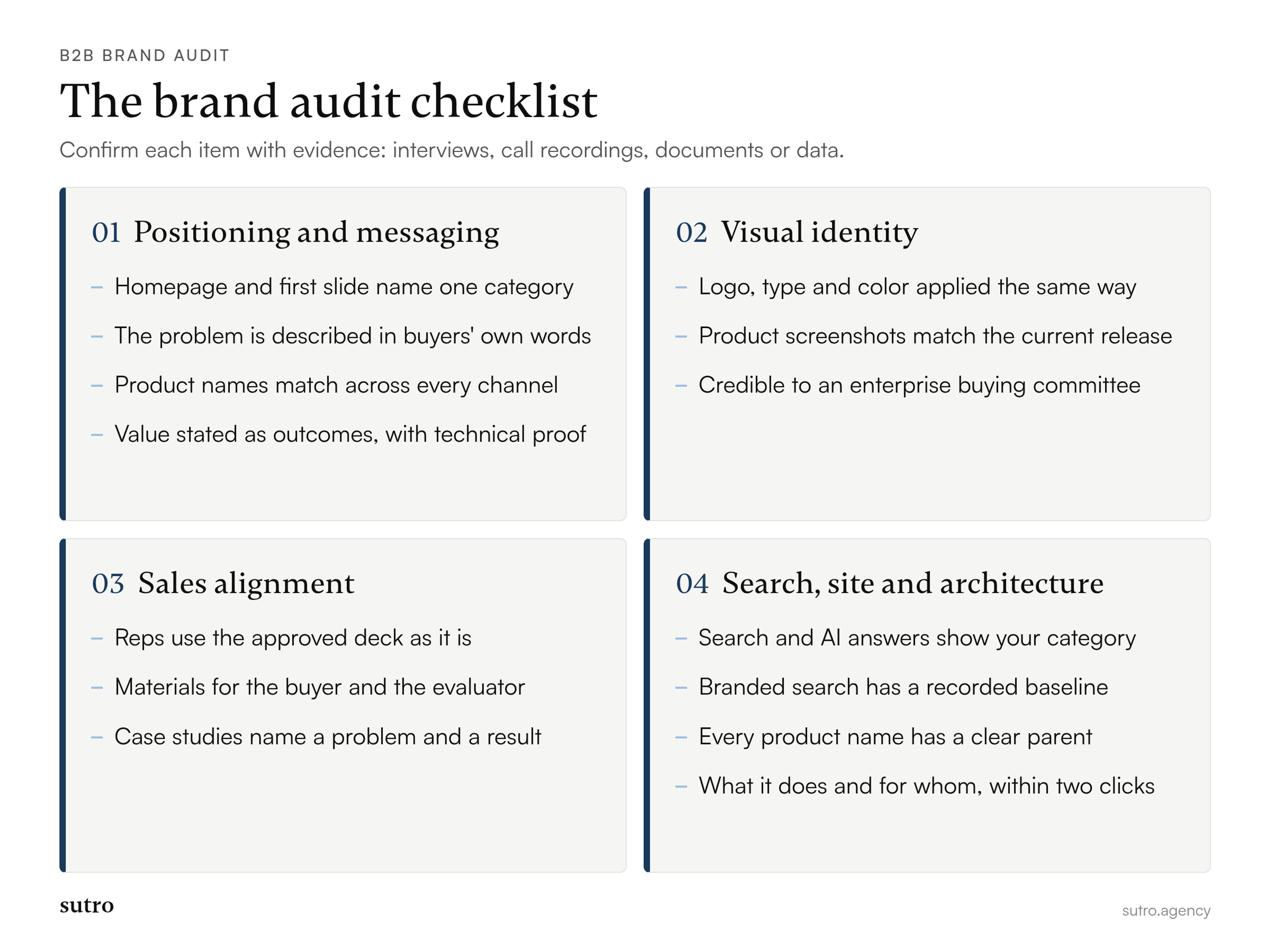
Use this checklist to structure the inventory and the gap analysis. Each item should be confirmed with evidence, not with an internal opinion.
Positioning and messaging
- The homepage headline and the first slide of the sales deck describe the same category and the same main benefit.
- The company names the problem it solves in words buyers used in interviews.
- Product and feature names are identical in marketing, sales materials and the product itself.
- Value statements describe business outcomes, with technical detail as proof.
Visual identity
- Logo, type, color and templates are applied the same way on the website, in decks and in PDFs.
- Product screenshots match the current release.
- The visual system looks credible to an enterprise buying committee as well as to early adopters.
Sales alignment
- Account executives use the approved deck without rebuilding the core story.
- Materials exist for both the economic buyer and the technical evaluator.
- Case studies name a specific problem and a specific result, not general satisfaction.
Search, site and architecture
- Search results, knowledge panels and AI assistants describe the company in its current category.
- Branded search has a recorded baseline.
- Every product and acquired name has a clear relationship to the parent brand.
- A new visitor can find what the product does and who it is for within two clicks.
How to score and prioritize findings
Score every gap by how close it sits to revenue, then fix in that order. A simple three-tier model works.
Fix now
Assets that hurt live deals: conflicting claims in sales decks, a homepage that names the wrong category, product names that confuse procurement, screenshots of a product that no longer exists. These get fixed before any new campaign spends money sending people to them.
Fix next
Assets that work but drift: older blog posts, secondary one-pagers, inconsistent templates. They wear down credibility slowly. Schedule them for the next quarter.
Keep and reuse
Assets that match the target positioning and that buyers mentioned favorably in interviews. Use them as the reference for everything else.
To decide what each gap is worth, tie it to the metrics leadership already tracks. At Sutro we measure brand work against enterprise conversion, qualified pipeline, win rate, sales-cycle length, pricing confidence, branded search, investor comprehension and recruiting strength. A gap that touches two or three of these goes to the top of the list.
If the audit shows the positioning itself is the problem, not its expression, the next step is rebuilding it. I walk through rebuilding positioning from buyer evidence in a separate guide.
Common mistakes
Most failed audits fail for one of four reasons.
Turning the audit into a taste debate
If the discussion is about whether leadership likes the colors, the audit has lost its purpose. Every finding should point to an interview quote, a call recording, a document or a data point.
Reviewing design before positioning
A polished site with an unclear category still fails to convert. Review positioning and messaging first, then decide how much the visual identity needs to change.
Leaving sales out
Audits run only by marketing miss the materials that buyers actually see late in the deal. Sales has to contribute decks, recordings and objections, and should review the findings before they go to leadership.
Auditing once and filing it
An audit is a baseline. Without a record of branded search, win rate and interview language before the change, nobody can tell later whether the brand work helped. Repeat the lighter parts, especially interviews and search data, once a year or before the next inflection.
Conclusion
A B2B brand audit replaces internal opinion with evidence about how the market reads you. Inventory everything the business says, collect what buyers and your own sales team hear, compare the two, and fix the gaps closest to revenue first. Done before a move upmarket, a raise or an integration, it tells you if you need a messaging fix, an identity update or a new position.
If you are heading into one of those moments and want an outside read on the brand, send us a short note about where things stand.
Questions
- What is a brand audit in B2B?
- A B2B brand audit is a structured review of how a business presents itself across every touchpoint compared with how buyers, prospects and its own sales team actually understand it. It combines an inventory of materials with interviews and data, and ends with a ranked list of gaps to fix.
- How long does a B2B brand audit take?
- A focused audit usually takes about four weeks: one week for the inventory and leadership interviews, one for buyer interviews and call reviews, one for gap analysis, and one to prioritize and present. Large product portfolios or recent acquisitions add time.
- Who should run the brand audit?
- One internal owner, usually the CMO or VP of Marketing, should own it, with input from the CEO, product and sales. Buyer interviews often work better with an outside interviewer, because customers and lost prospects speak more openly to someone who isn't selling to them.
- What is the difference between a brand audit and a website audit?
- A website audit covers performance, conversion paths and technical SEO on one channel. A brand audit covers the whole story across all channels, including positioning, messaging, sales decks, product names and buyer perception. The brand audit tells you which pages and messages matter most.
- How often should a B2B company audit its brand?
- Run a full audit before major commercial changes such as moving upmarket, a raise, an exit or an acquisition. Between those, repeat the lighter parts once a year: a round of buyer interviews, a check of sales decks and a look at branded search trends.
Sources
- Keller & Swaminathan: Strategic Brand Management, 5th ed. (Pearson), chapter "Conducting Brand Audits": brand inventory and brand exploratory
- Pragmatic Institute: Eight Win-Loss Analysis Best Practices
- Clozd: How to Conduct Win-Loss Interviews
- Google Search Central Blog: Introducing the branded queries filter in Search Console (Nov 20, 2025)
- Jenni Romaniuk: Building Distinctive Brand Assets (Oxford University Press, 2018)