Strategy
Brand Architecture for B2B Companies: Models and When to Use Each
Brand architecture decides how your company brand, product names and acquired brands relate. The four models, how to choose one, and how to switch without losing pipeline.
Key takeaways
- Brand architecture is the set of rules for how your master brand, product names and acquired brands relate; it decides which name carries the promise to the buyer.
- The four models are branded house, endorsed brand, hybrid and house of brands, trading efficiency for independence as you move along that line.
- If your products sell to the same buying committee through the same sales team, a branded house with descriptive product names is almost always the right default.
- Use endorsement for acquired products with real recognition, as a planned bridge rather than a permanent compromise.
- Change models in phases (audit, rules, visible bridge, technical migration) so customers, contracts and search traffic follow the new structure.
Brand architecture is the set of rules that decides how a company's master brand, its product names and any acquired brands relate to each other. There are four models: a branded house, an endorsed brand, a hybrid, and a house of brands. Most B2B tech businesses that sell to one buying committee through one sales team should run a branded house, use endorsement as a temporary bridge for acquisitions, and avoid a house of brands unless the businesses truly have nothing in common.
The question rarely comes up in the first years. A startup has one product and one name, and the two are the same thing. Architecture becomes a problem later, when a second product ships, an acquisition closes, an enterprise tier gets its own name, or a point product turns into a platform. By then the structure has usually been decided by accident, one launch at a time.
At Sutro, a B2B branding agency in San Francisco, we work with technical B2B companies at commercial inflection points: moving upmarket, launching a product platform, consolidating after an acquisition, preparing for a raise or an exit. Architecture shows up in almost every one of those engagements, because each of those moments changes what the company sells and to whom. I also founded Ramotion and have run it as CEO since 2009, across more than 350 projects, and the same pattern repeats there: naming debt builds quietly and gets expensive at the worst possible moment.
This guide covers what brand architecture is, the four models with real B2B examples, a set of questions for choosing between them, product naming rules, and how to move from one model to another without confusing customers or losing search traffic.
What brand architecture is (and what it isn't)
Brand architecture is a decision about how many brands you run and how much they borrow from each other. It answers three practical questions: which name carries the promise to the buyer, how product names are built, and what the relationship between brands looks like on the website, in the product, on invoices and in contracts.
It is easy to confuse with neighboring work, so it helps to draw the lines.
- It isn't positioning. Positioning decides what a brand stands for and why it wins. Architecture decides how many brands need positioning in the first place, and which one gets the investment.
- It isn't a logo system. Lockups and sub-brand logos express the architecture. They don't decide it.
- It isn't your org chart. Business units, legal entities and product teams often map poorly to how buyers think. Architecture follows the buyer, not the reporting lines.
- It isn't a one-time naming exercise. It is a policy that tells product and marketing teams what to do with the next launch and the next acquisition.
In a full brand program, architecture gets settled after positioning and before identity work, because the identity system has to know how many brands it is designing for. I cover where it sits in the stages of a full brand development program.
The four brand architecture models
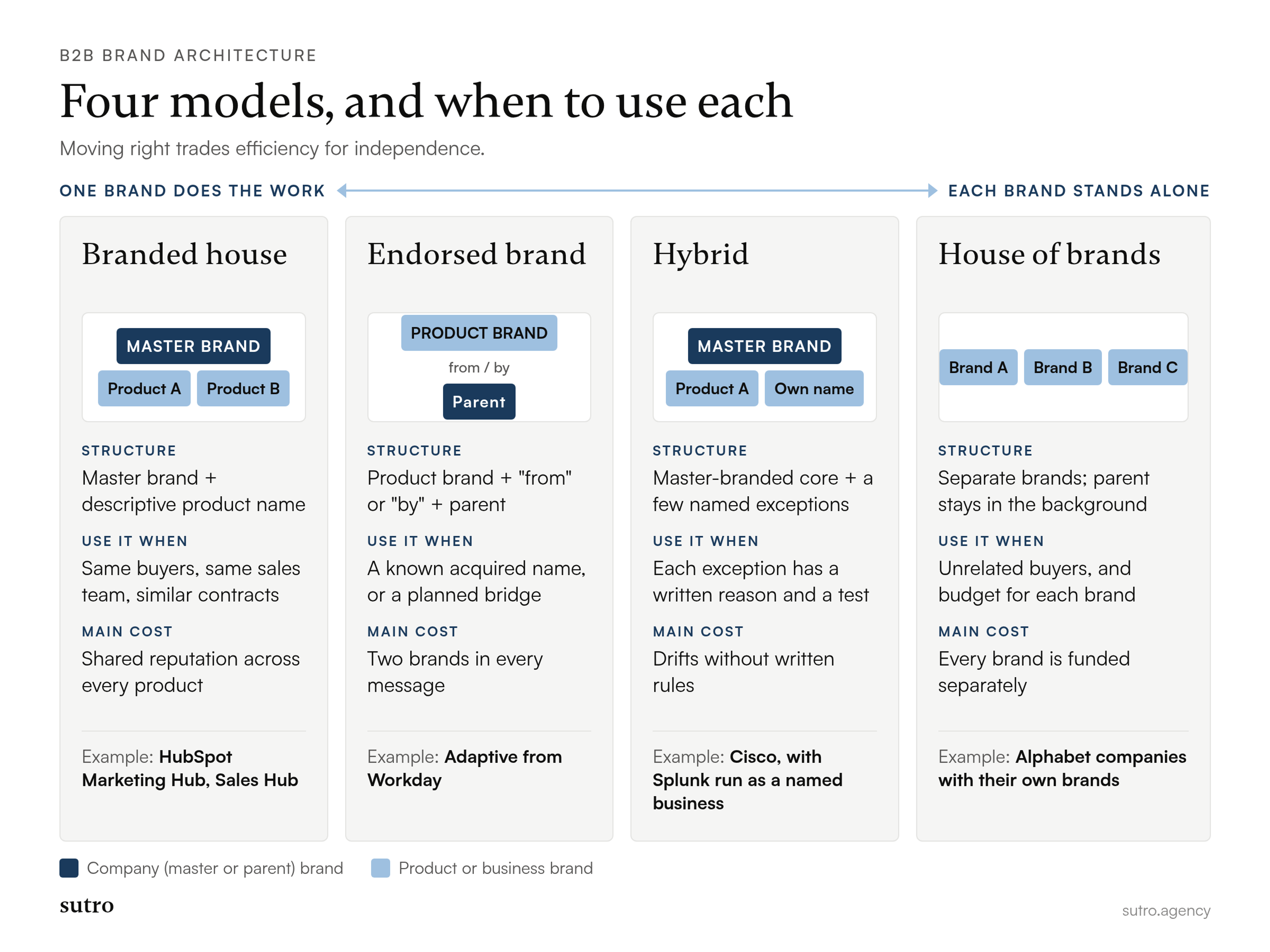
The four models sit on a line from one brand doing all the work to many brands working alone. Moving along that line trades efficiency for independence. A branded house concentrates every dollar and every impression in one name. A house of brands gives each business full freedom and makes each one pay its own way.
Branded house
In a branded house, the company brand is the brand. Products carry the master name plus a plain descriptor, and the descriptor tells the buyer what the product does. HubSpot's product lineup is a clear B2B example: Marketing Hub, Sales Hub, Service Hub, Content Hub and Data Hub, all presented as parts of one platform.
- Structure: Master brand + descriptive product name.
- What it does well: Every campaign, customer story and search result builds one name. New products launch with trust they didn't have to earn. Cross-selling is easier because the buyer already knows the vendor.
- What it costs: Reputation is shared. A security incident or a weak product hurts everything with the same name. A master brand built around one buyer can also struggle to stretch into a very different segment.
- Use it when: Your products go to the same buyers, through the same sales team, under similar contracts.
Endorsed brand
An endorsed brand keeps its own name and identity but carries a visible link to the parent, usually "by Parent" or "a Parent company." The parent lends credibility and procurement comfort. The product brand keeps the recognition it already had. Workday's planning product shows the pattern: it is now called Adaptive from Workday, a new name for what Workday previously sold as Workday Adaptive Planning.
- Structure: Product brand + "from," "by" or "a ... company" + parent brand.
- What it does well: It protects a name buyers already search for, while telling enterprise buyers that a larger, stable company stands behind it.
- What it costs: Two brands in every message. Sales decks, websites and product screens have to balance both, and teams argue about which one leads.
- Use it when: An acquired product has real recognition in its category, or when you need a transition period before folding a product into the master brand.
Hybrid
A hybrid mixes models under one roof: most products carry the master brand, while a few keep their own names, endorsed or standalone. Most companies that have made acquisitions end up here, whether they planned to or not. Cisco is a familiar case: when it completed its acquisition of Splunk in March 2024, the announcement introduced Splunk's leader as executive vice president and general manager of Splunk, keeping the acquired name as a business inside Cisco.
- Structure: A master-branded core plus exceptions with their own names.
- What it does well: It lets you decide case by case, which matters when an acquired brand is worth more than the master brand in its niche.
- What it costs: Without written rules, a hybrid drifts. Every product manager makes a case for a special name, and buyers stop understanding what belongs to whom.
- Use it when: You have a deliberate reason for each exception and a written test that a new product must pass to get its own name.
House of brands
In a house of brands, the parent stays in the background and each brand stands alone, with its own identity, positioning and go-to-market. Buyers may not know the brands are related. Alphabet is the most cited example: in the 2015 Alphabet founders' letter, Larry Page wrote that Alphabet was not meant to be a big consumer brand and that "Alphabet companies should have independence and develop their own brands."
- Structure: Separate brands, with the parent as a holding company.
- What it does well: Each brand speaks to its own buyer with no baggage from the others. Risk stays contained, and selling a business later is cleaner.
- What it costs: Everything is paid for several times: separate websites, teams, campaigns and domain authority. There is little cross-sell lift between brands.
- Use it when: The businesses serve unrelated buyers in unrelated categories, or when one brand would damage another by association.
For a growth-stage technical company, a true house of brands is rare and usually expensive. If you are under a few hundred people and selling into one market, you almost certainly can't fund more than one brand properly.
How to choose the right model
Choose the model by answering five questions about buyers, sales motion, positioning, acquired equity and budget. If most answers point to shared buyers and a shared sales motion, run a branded house. Reach for separate names only where an answer gives you a concrete reason.
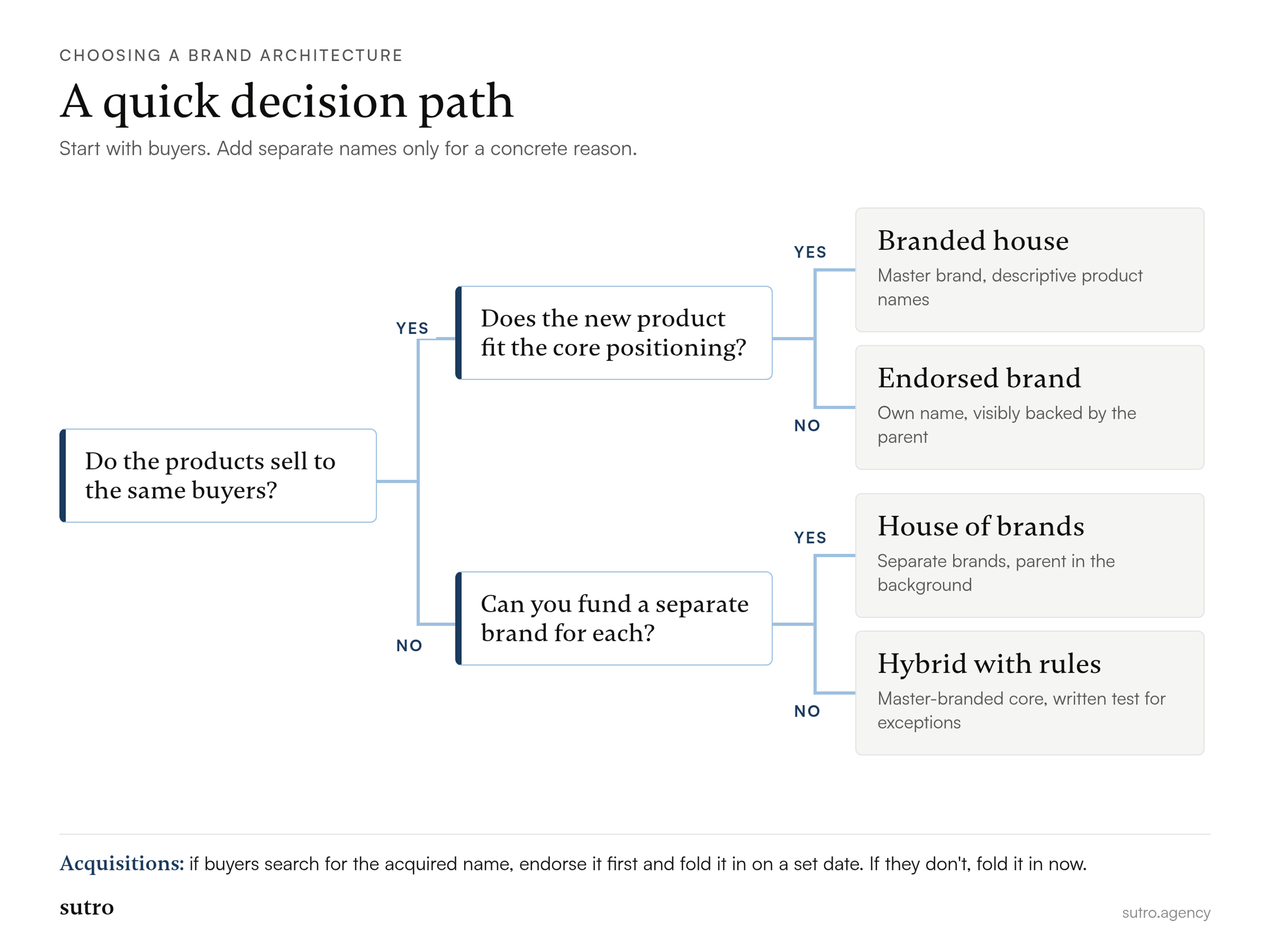
1. Do the products sell to the same people?
Buyer overlap matters most. If the same economic buyer and the same buying committee evaluate your products, separate brands make them do extra work to understand that they are dealing with one vendor. High overlap points to a branded house. Little or no overlap opens the door to separate names.
2. Do they share a sales motion?
Look at how each product is sold. Same sales team, same contract, same onboarding: one brand. A self-serve product bought on a credit card and an enterprise platform that goes through security review can still share a master brand, but the difference in buying experience is a reason to consider an endorsed or descriptive tier rather than one undifferentiated name.
3. Would the new product contradict the core positioning?
If your master brand stands for something specific, a product that pulls in the opposite direction weakens both. A brand known as a lightweight developer tool that launches a heavyweight compliance suite under the same name will face doubt from both audiences. This is the most common legitimate reason for endorsement.
4. Does an acquired brand carry real equity?
Be honest about what an acquired name is worth. Check branded search, community recognition, analyst coverage and whether customers ask for it by name. If the answer is "not much," fold it in quickly. If the name has real pull in its category, use an endorsed period and move it over in steps.
5. Can you afford to build more than one brand?
Every brand you keep needs its own share of budget to stay remembered. Research from the Ehrenberg-Bass Institute on how B2B brands grow finds that growing brands win by expanding their customer base, which depends on mental availability (being thought of in buying situations) and physical availability (being easy to find and buy). Splitting a limited budget across several names thins out both. For most companies at Sutro's typical size, this question alone settles the debate.
Signs your brand architecture is broken
Your architecture is broken when buyers, sales and your own team can't explain how your products relate without a slide. The symptoms are usually visible before anyone names the problem.
- Sales reps invent their own bundles and names on calls because the official ones don't make sense to prospects.
- Customers of one product don't know you sell the others.
- Procurement stalls because the brand name on the proposal doesn't match the legal entity on the contract.
- Several websites or subdomains compete for the same search terms.
- Every new launch reopens the naming debate from scratch.
- Marketing budget is split across names that each get too little to matter.
Product naming rules inside each model
Your architecture decides which kind of product name you use, so set naming rules at the same time. Three types cover most B2B portfolios.
Descriptive names
Descriptive names say what the product does, such as "Analytics" or "Sales Hub." They are instantly clear and need little explanation. On their own they don't differentiate you, which is fine in a branded house because the master brand does that job. Descriptive names should be the default for modules and features in a branded house.
Invented or abstract names
Invented names are distinctive and easier to own, but every one of them is a new brand that buyers have to learn. Reserve them for products that will stand alone in a house of brands or as deliberate exceptions in a hybrid. If a product needs an invented name to be noticed, ask whether it really needs to be its own brand.
Alphanumeric names
Letters and numbers work for technical tiers, hardware lines, versions and API plans, where buyers compare levels rather than ideas. They scale well and carry no emotion, which is exactly what you want for a spec sheet and the wrong choice for a flagship.
Write the rule down: which type of name each kind of offering gets, who approves exceptions, and what a product must prove before it earns its own brand.
How to move between models without losing pipeline
Change architecture in four phases: audit, rules, a visible bridge, then the technical migration. Renaming everything overnight confuses customers, breaks search traffic and gives competitors an opening in sales conversations.
Phase 1: Audit what you have
List every name in use: products, modules, tiers, internal code names that leaked into sales decks, domains, subdomains, trademarks and legal entities. For each one, note revenue, target buyer, branded search demand and inbound links. This is where you find out which names actually carry weight.
Phase 2: Write the rules
Decide the target model and document it before you announce anything. Define the test for a standalone name, the approval path for new names, and a default timeline for retiring acquired brands. Get the CEO, product and sales leadership to sign off, because they are the ones who will be asked for exceptions.
Phase 3: Run a visible bridge
Move buyers in steps they can follow. A common sequence starts with endorsement ("Product, a Parent company"), then shifts to a descriptive name with a reference to the old one ("Parent Product, formerly Product"), then drops the old name. Update the product interface, contracts, invoices and sales materials at each step, and tell customers before they notice.
Phase 4: Migrate the technical layer
Map old URLs to their new homes with 301 redirects, page by page rather than everything to the homepage. Update structured data, business directory listings, review profiles, app marketplace pages and partner listings so the new structure appears consistently wherever buyers look. Watch branded search for both names until the old one fades.
Common mistakes
Most architecture problems come from deciding too late or deciding by politics. These are the ones I see most often.
- Letting every launch name itself. Without a policy, product teams name things for internal reasons, and the portfolio fragments.
- Keeping an acquired name out of respect, not evidence. Founders and deal teams are attached to names. Buyers often aren't.
- Killing an acquired name on day one. The opposite error. If customers search for it, a sudden switch loses demand you paid for.
- Treating it as a design project. New logos for sub-brands won't fix a structure that doesn't match how buyers buy.
- Forgetting the contract and invoice. Procurement teams notice mismatched names faster than marketing does.
Conclusion
Brand architecture decides whether your marketing builds one asset or several smaller ones, and whether buyers understand your portfolio without a guide. For most technical B2B companies, the right answer is a branded house with a clear naming policy, a short list of justified exceptions and a planned bridge for acquisitions. If you are adding a product, absorbing an acquisition or untangling names that grew on their own, tell us what your portfolio looks like today.
Questions
- What is brand architecture in B2B?
- Brand architecture is the structure that defines how a B2B company's master brand, product brands and acquired brands relate to each other. It sets which name leads, how product names are formed and how brands appear together on the website, in the product and in contracts.
- What are the four types of brand architecture?
- The four types are a branded house (one master brand with descriptive product names), an endorsed brand (a product brand backed by a visible parent), a hybrid (a master-branded core with some independent or endorsed exceptions) and a house of brands (separate brands with the parent in the background).
- Which brand architecture model is best for a SaaS company?
- For most SaaS companies selling several products to the same buyers through one sales team, a branded house works best because every campaign builds one name and cross-selling is easier. Separate or endorsed names make sense only when buyers, sales motion or positioning are truly different.
- How long should an acquired product keep its name?
- That comes down to how much equity the name carries. A name with little recognition can be folded into the parent brand quickly. A name customers search for and ask for by name should move through an endorsed period first, with a retirement date set in the architecture rules.
- What is the difference between brand architecture and positioning?
- Positioning defines what a brand stands for, who it serves and why it wins against alternatives. Brand architecture defines how many brands a company runs and how they relate. Positioning comes first, because it shows whether products can share one promise or need separate ones.
Sources
- HubSpot: Products (Marketing Hub, Sales Hub, Service Hub, Content Hub, Data Hub on one platform)
- Workday: Adaptive from Workday (new name for Workday Adaptive Planning)
- Cisco Newsroom: Cisco Completes Acquisition of Splunk (March 18, 2024)
- Alphabet: 2015 Founders' Letter
- Ehrenberg-Bass Institute: Easy to Find, Being Where B2B Buying Happens (Nenycz-Thiel & Romaniuk, 2025)