Strategy
B2B Brand Development: Stages, Deliverables, and Timeline
B2B brand development takes a company from research to a brand its whole team uses. Here are the six stages, what each should deliver, a realistic timeline and who to involve.
Key takeaways
- B2B brand development is the full program from research and positioning through verbal identity, visual identity, a brand system and rollout, not a logo or a website refresh.
- Each of the six stages should end with an approved deliverable that the next stage builds on, so later work isn't based on guesses.
- For a growth-stage technical company, plan on roughly four to seven months from kickoff to launch, with rollout continuing after; scope and decision speed drive the range.
- Keep a small decision group led by the CEO or founder, and get input from sales, product, customer success and customers.
- The work is done when people outside the project use the brand correctly without help, and its effect shows up in pipeline and win rates over the following quarters.
B2B brand development is the full process of building a brand from the ground up or rebuilding it: research, strategy and positioning, verbal identity, visual identity, a brand system, and rollout across the website, sales materials and product. For a growth-stage technical company, plan on several months of focused work before launch, then a rollout that keeps going after it. Each stage should leave behind a concrete deliverable that the next stage builds on.
Most teams that ask me about brand development have already tried a shortcut. They commissioned a new logo, refreshed the homepage, or wrote a new tagline, and six months later sales still tells the old story. The pieces were fine. They just weren't built on decisions anyone had agreed on.
I founded Sutro, our B2B branding studio in San Francisco, to do this work for technical B2B companies at commercial inflection points. I'm also the founder and CEO of Ramotion, a brand and digital product design agency that has been in the industry since 2009 and has completed more than 350 projects. This guide lays out the stages I use, what each one should produce, how long it tends to take, who on your side needs to be involved, and the mistakes that stall the work.
What B2B brand development is (and what it isn't)
B2B brand development is the end-to-end program that turns business decisions into a brand people can use: a strategy, a story, an identity and a system, applied everywhere buyers meet you. It's broader than any one of its parts, and confusing it with one part is the most common reason the work disappoints.
Brand development vs. brand strategy
Brand strategy is the plan. Brand development is the plan plus everything built from it. A strategy document decides who you serve, what you stand for and how the brand should support revenue. Development carries those decisions through naming, messaging, identity, guidelines and launch. If you only need the plan, read my guide on how brand strategy should support the sales team.
Brand development vs. positioning
Positioning is one stage inside brand development. It decides what you are, what you replace and why you win against the alternatives. Everything later in the process expresses those decisions, so it has to come early. I've written a separate piece on the five-step positioning framework we use for that stage.
Brand development vs. a visual refresh
A visual refresh updates how the brand looks while keeping what it says. That's the right call when the story still works and the design has aged. It's the wrong call when the company has changed: new buyers, new category, a platform instead of a point product. A new look on an old story usually makes the gap more visible, not smaller.
When a technical B2B company needs full brand development
You need full brand development when the business has changed faster than the brand can explain. For technical B2B companies, that usually lines up with a commercial inflection point.
The triggers I see most often:
- Moving upmarket. The brand that won startups and mid-market teams doesn't survive an enterprise security review or a procurement committee.
- Launching a product platform. The market still sees one feature, and the brand has no room for the rest.
- Consolidating after an acquisition. Two or more brands need one architecture and one story.
- Raising capital or preparing for an exit. Investors and acquirers need to understand the market and your place in it quickly.
- Losing differentiation. Competitors have caught up on features, and the brand never gave buyers another reason to choose you.
If none of these apply and the problem is mostly visual consistency, a narrower project will do. Brand development is a bigger commitment, and it only pays off when the business needs a new story.
The six stages of B2B brand development
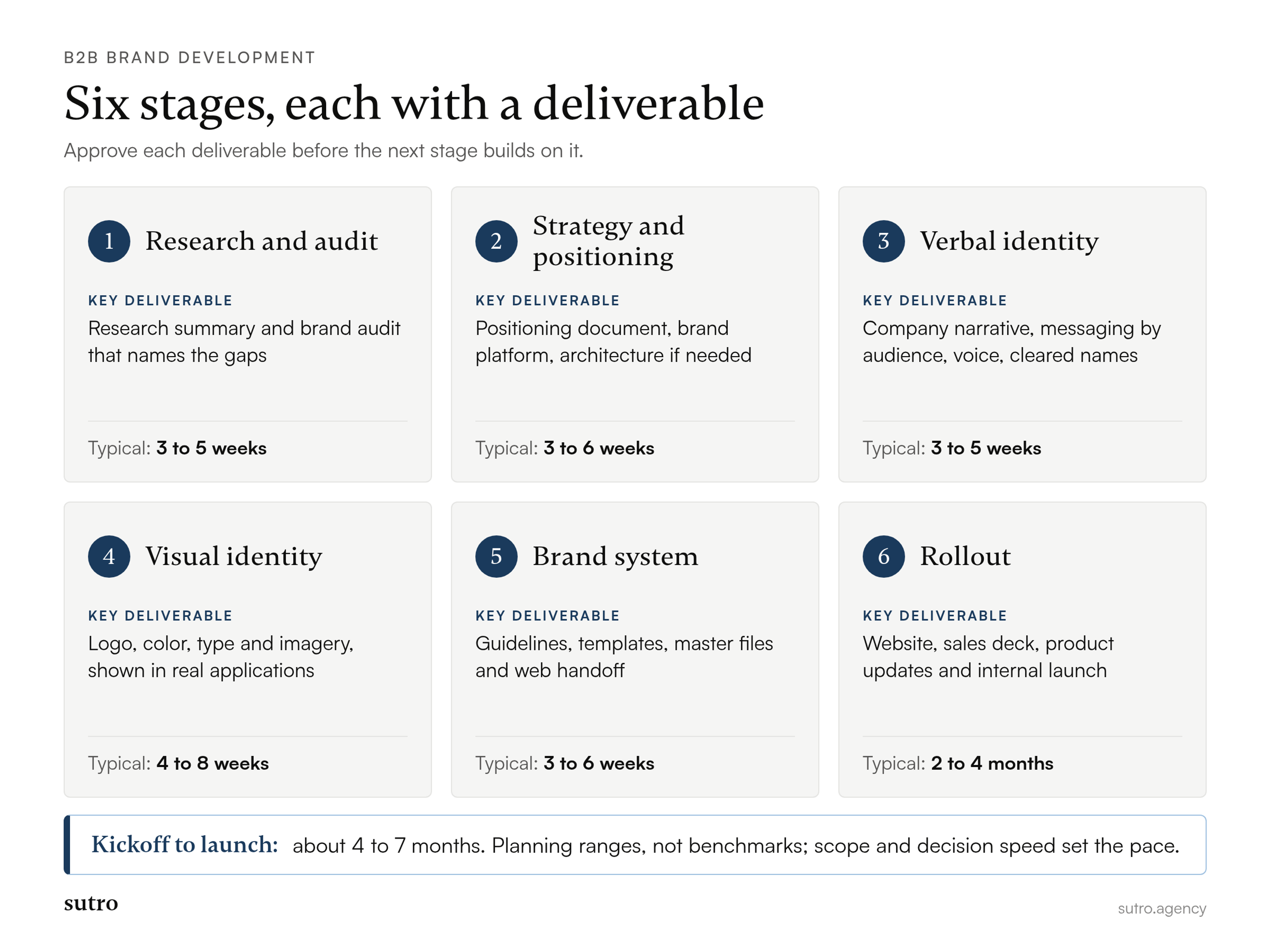
Brand development runs in six stages: research and audit, strategy and positioning, verbal identity and messaging, visual identity, brand system and guidelines, and rollout. At Sutro we group them into four phases: Diagnose, Define, Build and Activate. Each stage ends with a deliverable that gets approved before the next one starts.
Stage 1: Research and audit
The first stage finds out how the market sees you today and where the gaps are. Skipping it means the team builds the new brand on internal opinion.
Research for a technical B2B company usually covers interviews with leadership, sales and customer success, conversations with customers and lost prospects, a review of competitors and alternatives, and an audit of every place the brand shows up: website, decks, product UI, docs, events and recruiting.
Deliverable: a research summary and brand audit that names the problems in plain language. A good one makes leadership slightly uncomfortable. If everyone nods, it probably repeated what they already believed.
Stage 2: Strategy and positioning
This stage turns research into decisions: target buyers, competitive alternatives, the value only you deliver, the market category and the role the brand plays in growth. It's the stage that most often gets rushed, and the one that costs the most when it's wrong.
Deliverables: a positioning document, a brand platform (purpose, promise, personality, proof points) and, when there's more than one product or company, a brand architecture recommendation. These are internal documents. They exist so product, sales and marketing make the same calls without asking.
Stage 3: Verbal identity and messaging
Verbal identity is how the brand sounds and what it says. For technical companies I build it before the visual identity, because buyers read far more of your brand than they look at, and designers do better work with a clear story.
Deliverables: a company narrative, a messaging framework by audience (economic buyer, technical evaluator, end user), voice and tone principles, a short vocabulary list, and a boilerplate. If the work includes a new name or product names, clear them legally before anyone falls in love with them. The USPTO recommends a comprehensive clearance search covering federal and state registrations, international databases, domain names and common-law use on the internet, and notes that a trademark screening service or a U.S.-licensed attorney can run a more in-depth search.
Stage 4: Visual identity
Visual identity makes the strategy visible: logo or wordmark, color, typography, imagery, iconography, data visualization and motion. In B2B tech, it has to work in places consumer brands rarely worry about, like dense product screens, architecture diagrams, technical docs and slides full of numbers.
Deliverables: the core identity, plus applications that prove it works under real conditions: a homepage concept, a sales slide, a product screen, a diagram, a social card. I also test color choices for accessibility early. WebAIM's guide to WCAG contrast requirements explains that normal text needs a contrast ratio of at least 4.5:1 against its background, while logotypes have no contrast requirement. A palette that fails this will fail on your website.
Stage 5: Brand system and guidelines
The system is what lets a brand survive contact with a growing team. It packages the decisions from stages 2 to 4 into rules, templates and assets other people can use without the agency in the room.
Nielsen Norman Group's overview of design systems notes that the most common style guides focus on branding, covering colors, typography, trademarks and logos, and that style guides can also cover content, such as tone of voice and language. That's the right scope for a B2B brand system.
Deliverables: brand guidelines, a library of master files, templates for the assets your team makes every week (decks, one-pagers, case study layouts, social posts, event materials) and handoff files for the web and product teams.
Stage 6: Rollout across website, sales materials and product
Rollout is where the brand meets buyers, and it's where most programs lose momentum. A brand isn't developed until the website, the sales deck and the product all express it.
Deliverables: a launch plan with a sequence and owners, the new website or a website direction for your team, a rebuilt sales deck and core sales collateral, product UI updates, an internal launch for employees, and an external announcement when the change is big enough to deserve one.
A realistic B2B brand development timeline
A full B2B brand development program for a growth-stage technical company usually runs about four to seven months from kickoff to launch, and rollout continues after that. The range is wide on purpose. Scope, the number of products and audiences, naming, and how fast leadership makes decisions move it more than anything the agency does.
These are planning ranges from my own engagements, not industry benchmarks:
- Research and audit: about 3 to 5 weeks
- Strategy and positioning: about 3 to 6 weeks
- Verbal identity and messaging: about 3 to 5 weeks, often overlapping with the start of visual work
- Visual identity: about 4 to 8 weeks
- Brand system and guidelines: about 3 to 6 weeks
- Rollout: often 2 to 4 months for the website and sales materials, longer for product changes
What stretches a timeline: adding a new company name, a merger with several brands to reconcile, a large product surface, or a decision group that changes halfway through. What shortens it: a CEO who blocks time for reviews, existing customer research the team trusts, and a clear deadline such as a funding round, a conference or a launch.
Don't compress strategy to save time. Teams that squeeze positioning into a few workshops usually spend the time they saved later, redoing messaging and design that were built on an unclear story.
Who needs to be involved on your side
Brand development needs a small decision group with real authority and a wider group that contributes input. Without a clear decision owner, every review turns into a debate about taste.
In engagements I run, the roles that matter most are:
- CEO or founder: owns the final call on positioning, narrative and name. Needs to attend the strategy and identity reviews, not just see a summary.
- CMO or head of marketing: runs the project day to day and owns rollout.
- Product leadership: confirms what the product does today and where it's going, so the brand doesn't promise a roadmap it can't deliver.
- Sales leadership and two or three strong reps: test messaging against real objections and own the new deck.
- Customer success: brings the reasons customers stay, which are often different from the reasons sales thinks they buy.
- Design, web and engineering: implement the system in the website and product.
- Legal: clears names and reviews trademark use.
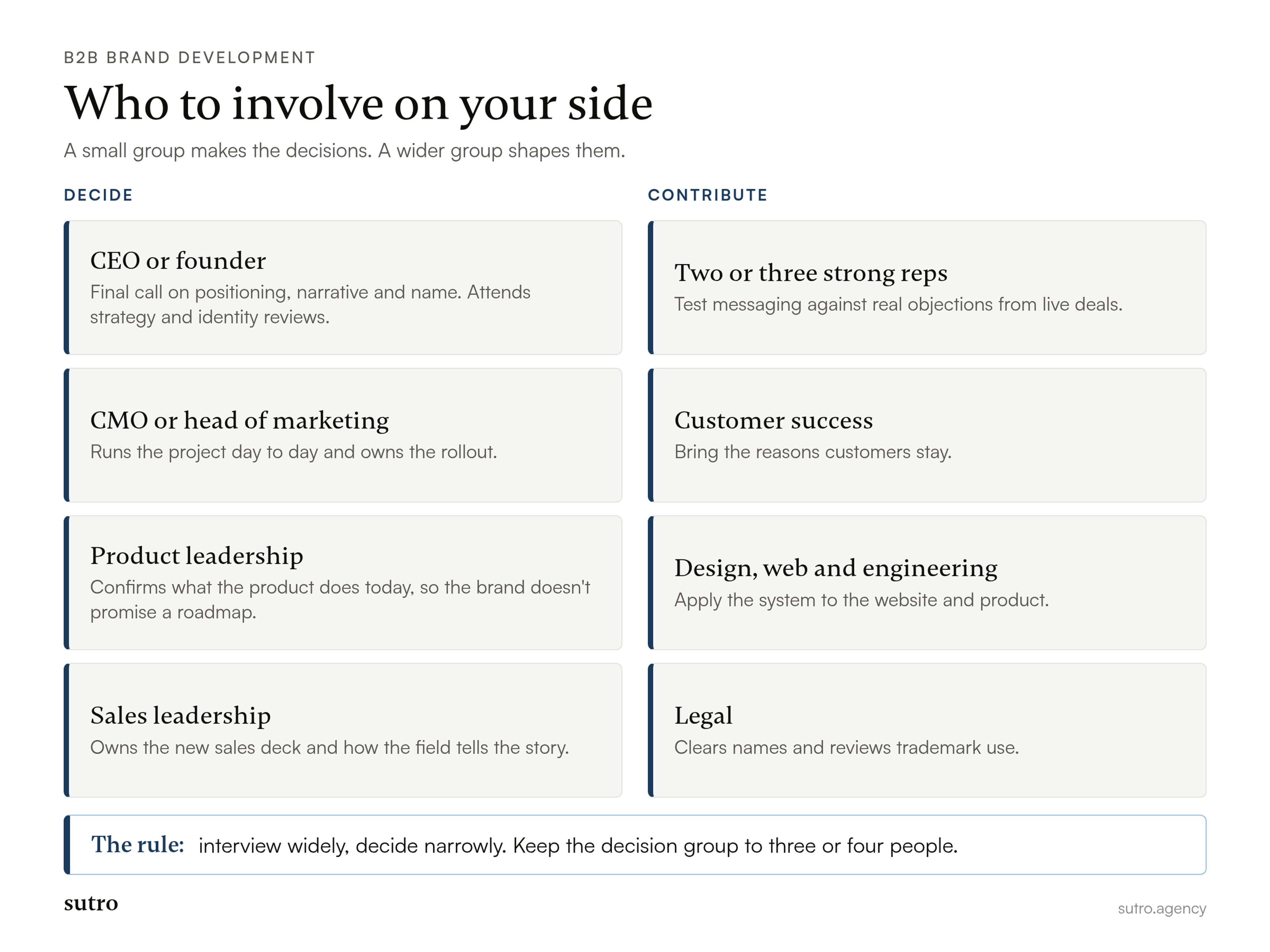
Keep the decision group to three or four people. Interview widely, decide narrowly.
How to know the work is done and adopted
Brand development is done when people outside the project team use the brand correctly without asking for help. Approved guidelines are a milestone, not the finish line.
Signs of real adoption:
- New sales hires pitch the company the same way your best reps do.
- Marketing ships new pages and campaigns using the templates instead of starting from scratch.
- Product and docs use the new vocabulary.
- Prospects repeat your category and key message back to you on calls.
- Leadership stops reopening positioning decisions every quarter.
Measure the commercial effect over the following quarters rather than the following week. At Sutro we look at enterprise conversion, qualified pipeline, win rate, sales-cycle length, pricing confidence, branded search, investor comprehension and recruiting strength. Pick the few that match the reason you started the project, and record a baseline before launch so you can compare.
Common mistakes that stall brand development
Most stalled brand programs fail on process, not on design. These are the mistakes I see most often at technical B2B companies.
Starting with the logo
The visual identity is the most visible deliverable, so teams want to start there. Without positioning and a narrative, designers are guessing, and every review becomes a vote on preferences.
Deciding by committee
Inviting fifteen people to every review feels inclusive. It produces safe work that nobody really owns. Gather input from many people and give the decision to a few.
Treating the website as the launch
A new website is a big moment, but the sales deck, the product, onboarding emails and the recruiting page still carry the old brand. Buyers notice the mismatch during evaluation, when trust matters most.
No owner after the agency leaves
Guidelines without an internal owner decay within months. Someone on your team needs the authority to approve new assets and update the system as the company changes.
Building for the board instead of the buyer
A narrative that impresses investors can confuse a technical evaluator. Test messaging with real buyers and your sales team before you lock it.
Conclusion
B2B brand development works when each stage produces a decision or asset the next stage can build on: research, then strategy, then words, then visuals, then a system, then rollout. The timeline is measured in months because the hard part is agreement inside the company, and that part can't be rushed. Done well, it gives sales, marketing and product one story they can all use.
If you're planning a rebrand or building a brand around a new stage of the company, walk me through what's changed in your business.
Questions
- What are the stages of B2B brand development?
- There are six: research and audit, strategy and positioning, verbal identity and messaging, visual identity, brand system and guidelines, and rollout across the website, sales materials and product. Each stage ends with a deliverable that gets approved before the next one starts.
- How long does B2B brand development take?
- For a growth-stage technical company, a full program usually takes about four to seven months from kickoff to launch, and rollout continues afterward. A new company name, several merging brands or a large product surface extends that. A focused visual refresh can be much shorter.
- What deliverables should a B2B brand development project produce?
- A research summary and brand audit, a positioning document and brand platform, a company narrative and messaging framework, voice guidelines, a visual identity with real applications, brand guidelines with templates and master files, and a rollout plan covering the website, sales deck and product.
- What is the difference between brand development and brand strategy?
- Brand strategy is the plan: who you serve, what you stand for and how the brand supports revenue. Brand development includes the strategy and everything built from it, including messaging, identity, the brand system and rollout.
- Who should own brand development inside a B2B company?
- The CEO or founder should own the final decisions on positioning, narrative and name. The CMO or head of marketing usually runs the project day to day and owns rollout. Sales, product and customer success contribute input, and someone internal must own the brand system after launch.