Go-to-market
B2B Rebranding: When to Rebrand and How to Do It Without Losing Pipeline
When a technical B2B business should rebrand, how to choose between a refresh, an evolutionary rebrand and a new name, and how to launch without stalling deals in flight.
Key takeaways
- Rebrand when the business strategy has changed and the brand now slows sales, not because the team is tired of the logo.
- Choose the smallest scope that solves the problem: a refresh, an evolutionary rebrand that keeps the name, or a full rebrand with a new name and domain.
- Protect pipeline by timing the launch around the sales calendar and preparing sales and customer success before the public announcement.
- If the domain or URLs change, map every old page to its closest new page with permanent 301 redirects and keep the old domain.
- Judge the rebrand on qualified pipeline, win rate, sales-cycle length and branded search over several quarters.
Rebrand a B2B business when the strategy has changed and the current brand now slows sales: you are moving upmarket, the product has outgrown the name, or an acquisition left you with several identities. Protect pipeline by choosing the smallest scope that fixes the problem, preparing sales before the public launch, and handling redirects, customers and timing as one plan.
A rebrand is a commercial project with a design component, not the other way around. If prospects are confused, customers feel abandoned or organic traffic drops for two quarters, the new logo doesn't matter.
I have run Ramotion since 2009, across more than 350 projects, and I have watched teams handle these transitions well and seen others lose months of momentum because they treated the launch as a reveal instead of an operation. I started Sutro to work with technical B2B companies at exactly these commercial inflection points, and much of our brand work for technical B2B teams in transition starts with one question: what is the current brand costing you in deals?
When a B2B company should rebrand
Rebrand when the business has changed in a way the brand can't express. Don't rebrand because the team is tired of the logo. Internal teams get bored with their own materials long before buyers notice them, and boredom is not a business case.
These are the triggers I take seriously.
You are moving upmarket
Selling to a single team lead and selling a platform deal to a buying committee require different brand signals. Enterprise buyers bring security, legal, procurement and finance into the decision, and each of them is looking for risk.
If the site, the deck and the product still look like an early-stage tool, a security reviewer will wonder whether you can handle their data. The brand has to signal stability and operational maturity before anyone asks.
The product has outgrown the name
Technical founders often name the company after the first product or feature. A few years later the company sells a multi-product platform, and the name still tells buyers it does one thing.
A simple test: if your sales engineers spend the first part of every demo explaining that you do more than the name suggests, the brand is limiting growth.
An acquisition left you with several brands
After a merger or a roll-up, companies often keep every legacy brand alive. That splits budgets, confuses buyers about who they are dealing with, and makes the brands compete for the same searches. Consolidating gives the market one company to evaluate. It also needs care, because customers of the acquired business should feel upgraded, not absorbed. Brand architecture decides which names survive; the rebrand is how you get there.
Sales apologizes for the website
The most urgent trigger is what I call the website apology. Listen to a few recorded discovery calls. If account executives tell prospects to ignore the website because it doesn't reflect the current product, the brand is costing you deals right now.
The site should confirm what sales says, not contradict it. When it creates friction, fixing the brand stops being a marketing preference and becomes a revenue problem.
When not to rebrand
Leave the brand alone when the positioning is still right and buyers understand you. Also wait if you are still searching for product-market fit, or if the real problem is a weak product, a pricing issue or a sales process that doesn't qualify well. A new identity won't fix any of these, and it will make them more expensive to diagnose.
Refresh, evolutionary rebrand or full rebrand
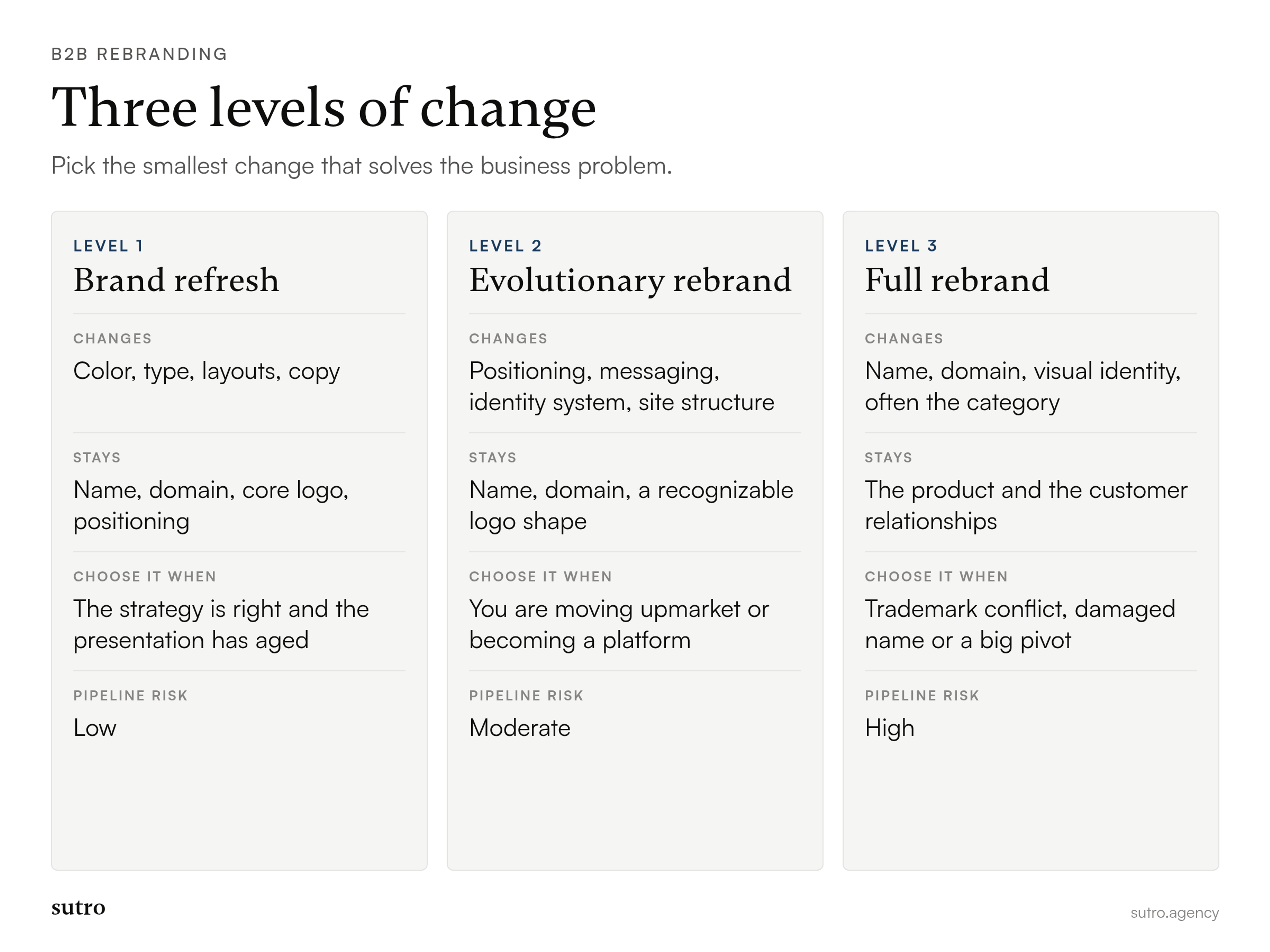
Pick the smallest change that solves the business problem. B2B rebranding happens at three levels, and each carries a different risk to pipeline.
Brand refresh
A refresh keeps the name, the domain, the core logo and the positioning. It updates color, typography, layouts and copy so the presentation catches up with the company.
Choose it when the strategy is right and the presentation has simply aged. It needs little change management and rarely touches live deals.
Evolutionary rebrand
An evolutionary rebrand keeps the name but rebuilds the strategy underneath it: positioning, messaging, the identity system and usually the website structure. The logo is modernized while keeping enough of its shape that customers still recognize it.
This is the right level for most companies that are moving upmarket or expanding into a platform. You keep the recognition you have built and change what the brand says.
Full rebrand
A full rebrand changes the name, the domain and the visual identity, and often the category the company claims. It carries the most risk and the most work: trademark clearance, legal entity changes, a domain migration and a long list of touchpoints.
Reserve it for real cases: a trademark conflict, a reputation the old name can't recover from, or a strategic change so large that the old name actively misleads buyers.
Rename the layer that changed
A name change doesn't have to reach every product. When Square, Inc. renamed itself Block in 2021, the new name applied to the corporate entity, while the Square name stayed with the Seller business it was built for, and Square, Cash App and TIDAL kept their own brands (Block investor news). The company changed the layer that no longer fit and left product brands with customer recognition alone.
For a B2B company the same logic applies at a smaller scale. If the corporate story changed but customers know and trust a product name, consider renaming the company and keeping the product brand, or the reverse.
How to protect pipeline during a rebrand
Treat the launch as an operational rollout with an owner, a sequence and a date chosen around the sales calendar. Most damage happens when the brand goes public before sales, customers and the website are ready for it.
Time the launch against the sales calendar
Don't launch in the weeks when your largest deals close. Changing the website, the deck and the story while reps are in final negotiations adds questions nobody has time to answer.
Pick a quieter period, and look at the open opportunities before you commit to a date. If a large deal is in procurement, the rep should decide when and how that buyer hears about the change.
Prepare sales before the public launch
Sales and customer success should be fluent in the new story before the public sees it. Give them the new deck, updated competitive talk tracks and a short explanation of why the company is changing, with time to rehearse.
Run working sessions where reps practice the new narrative with marketing and product leaders. When prospects ask about the change, the answer should be the same from every rep, and it should take one sentence.
Protect search and the old domain
If the domain or URLs change, map every old page to its closest new page and set up permanent redirects. A 301 status tells browsers and search engines that a page has moved for good, and search engines pass the old URL's ranking signals to the new one (MDN: 301 Moved Permanently). Avoid sending everything to the homepage, which throws away page-level relevance.
Keep the old domain registered and redirecting for the long term. If it lapses, someone else can buy it and the links pointing at it.
Update the places that describe your company on the same day: company profiles on social and review platforms, software directories, code repositories, partner listings and the structured data on your own site. Consistent descriptions help search engines and AI assistants connect the new name to the old entity.
Keep the product and the marketing site consistent
Buyers move from the website to a trial, a demo environment or documentation. If the marketing site looks new and the product looks like it belongs to another company, trust drops at the moment a buyer is evaluating you most closely. Plan at least the visible product surfaces, login screens and documentation into the first release.
A four-phase rebrand process
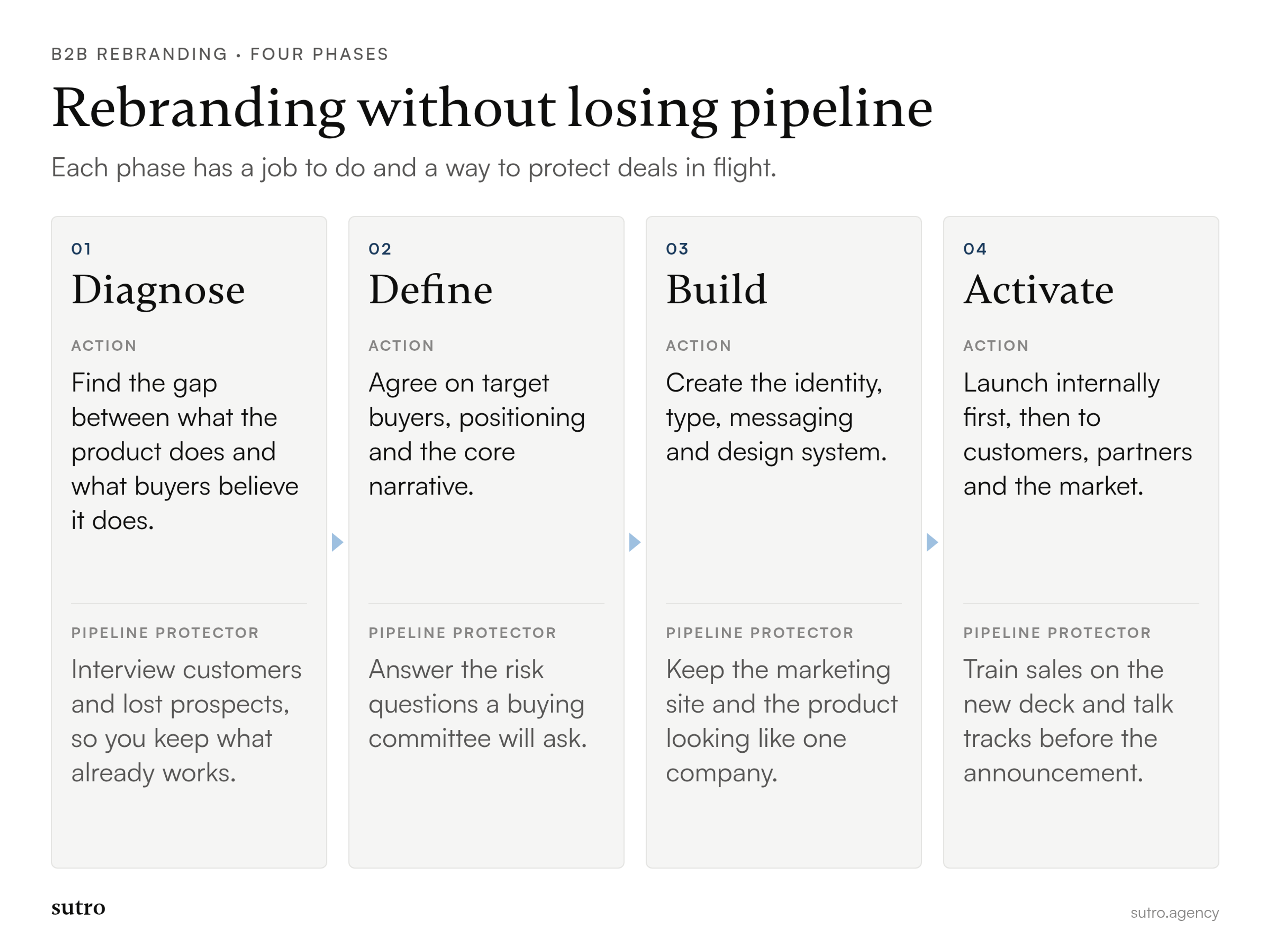
Run the rebrand in four phases: Diagnose, Define, Build and Activate. Each phase produces decisions that the next one depends on, and skipping one moves the argument to a more expensive stage.
Diagnose
Find out where the current brand fails before you design anything. Interview recent customers, prospects who chose a competitor, and your own sales and customer success teams. Review recorded calls, the deck and the website side by side.
You are looking for the gap between what the product does and what the market believes it does. That evidence also tells you what works today, so you don't throw away assets buyers already recognize.
Define
Agree on who you sell to, what you replace and why you win, then write the core narrative. Keep this phase tight and make sure it answers the risk questions a buying committee will raise. If you haven't done this work yet, start with how to set positioning before the redesign. If leadership can't explain the difference from the main alternatives in plain language, don't start design.
Build
Turn the strategy into a system: name if needed, logo, type, color, messaging, and the components your website and product teams will use. For technical companies this includes diagrams, data visualization and product screenshots, which buyers often look at more closely than the logo. Budget depends mostly on research depth and how many touchpoints change, so settle scope before design starts.
Activate
Launch internally first, then publicly. Roll the brand out to sales materials, the website, the product, documentation, partner channels and recruiting, in an order that matches how buyers meet you. Publish clear guidelines and name an owner, so the first quarter after launch doesn't quietly reintroduce the old look.
How to announce a rebrand
Announce the change in terms of what it means for customers, not how it was designed. Buyers care whether the product, support and contracts stay the same, and what the change says about your direction.
Tell existing customers first, shortly before the public launch, so they hear it from you and not from social media. A plain, direct note from the CEO works well: why the company is changing, what stays the same, and who to contact with questions. If contracts, invoices or billing names change, say so explicitly, because finance teams notice.
For open deals, the account owner should send a personal heads-up to the champion. Brief key partners and resellers on the same schedule, and give them updated assets so they don't keep promoting the old brand.
The public announcement comes last: website, press release if the news warrants it, and the leadership team's own channels, all on the same day.
How to measure whether the rebrand worked
Measure a rebrand with commercial indicators over several quarters, not launch-week engagement. Set a baseline before launch so you have something to compare against.
- Pipeline and conversion. Watch qualified pipeline and stage-to-stage conversion, especially in the segment the rebrand targeted.
- Win rate. Track competitive win rates and the loss reasons sales records. If the new story works, the reasons should shift.
- Sales-cycle length. A clearer brand should mean fewer early calls spent explaining what the company is.
- Branded search. Track searches for the new name, and for the old one as it declines. Many of the buyers who will search for you next year are not shopping today, and branded search is how you see whether they remember you.
Also listen to calls again. When prospects start repeating your new positioning back to you, the market has absorbed it.
Common B2B rebranding mistakes
The most common mistakes come from treating the rebrand as a design launch.
- Changing what already works. Dropping a recognizable color, symbol or product name without evidence that it hurts you throws away recognition you paid for.
- Launching to the public first. Sales and customers learn about the change from a press release and spend weeks catching up.
- Splitting the website from the product. A new site with an old product interface tells buyers the change is cosmetic.
- Underfunding the build. Strategy and design get the attention, and the website build goes to whoever is cheapest. Broken redirects, slow pages and missing structured data can undo years of search visibility.
- No owner after launch. Without guidelines and someone responsible for them, old templates and decks come back within months.
Conclusion
B2B rebranding means changing the company's identity while the sales engine keeps running. Decide whether you need a refresh, an evolutionary rebrand or a new name, base that decision on evidence from buyers and sales, and sequence the rollout so sales and customers are ready before the market sees it.
If your brand is creating friction in deals and you are weighing how far to go, tell us what the rebrand needs to protect.
Questions
- What is the difference between a brand refresh and a rebrand?
- A refresh updates the presentation, such as color, typography, layouts and copy, while keeping the name, logo and positioning. A rebrand changes the strategy underneath: positioning and messaging always, and sometimes the name, domain and visual identity too.
- How long does a B2B rebrand take?
- A full engagement from research to launch usually runs several months. The strategy phase sets the pace, because identity and website work can't start until positioning is agreed, and a name change adds trademark and legal steps.
- Will a name change hurt our organic search traffic?
- Expect some volatility after a domain change. You limit it by redirecting every old URL to its closest new page with permanent 301 redirects, keeping the old domain, and updating your company profiles and directory listings on launch day.
- When should we tell customers about the rebrand?
- Tell existing customers shortly before the public launch, so they hear it directly from you. Explain why the company is changing and what stays the same, and give account owners time to brief champions in open deals personally.
- Should we rename the company or the product?
- Rename the layer that no longer fits. If the corporate story changed but customers trust a product name, you can rename the company and keep the product brand, as Square, Inc. did when it became Block in 2021.