Strategy
Benefits of B2B Branding in Long, Multi-Stakeholder Sales Cycles
In a long B2B sale, brand gets you on the shortlist, helps the committee agree, reduces friction, supports price, and makes expansion, hiring and partnerships easier.
Key takeaways
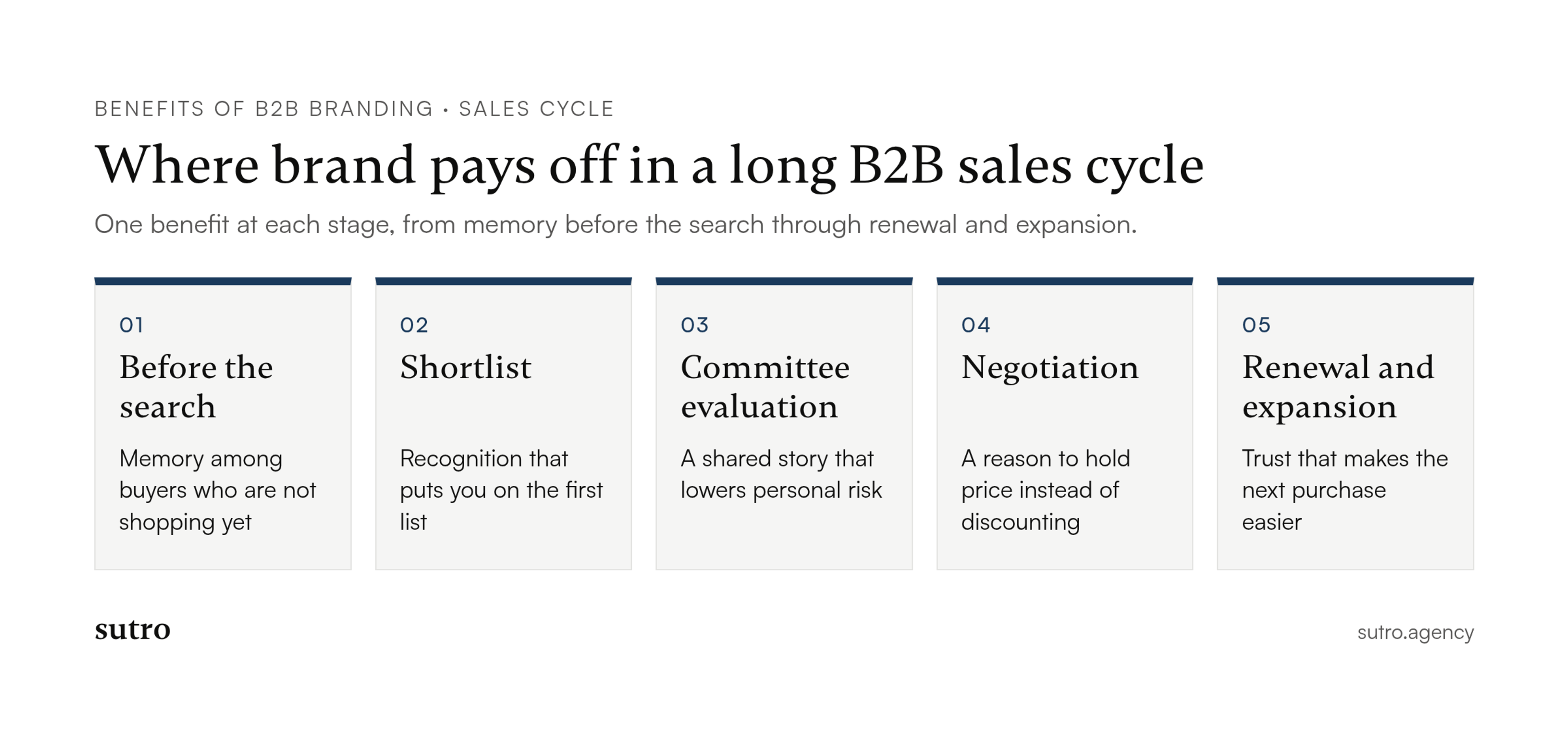
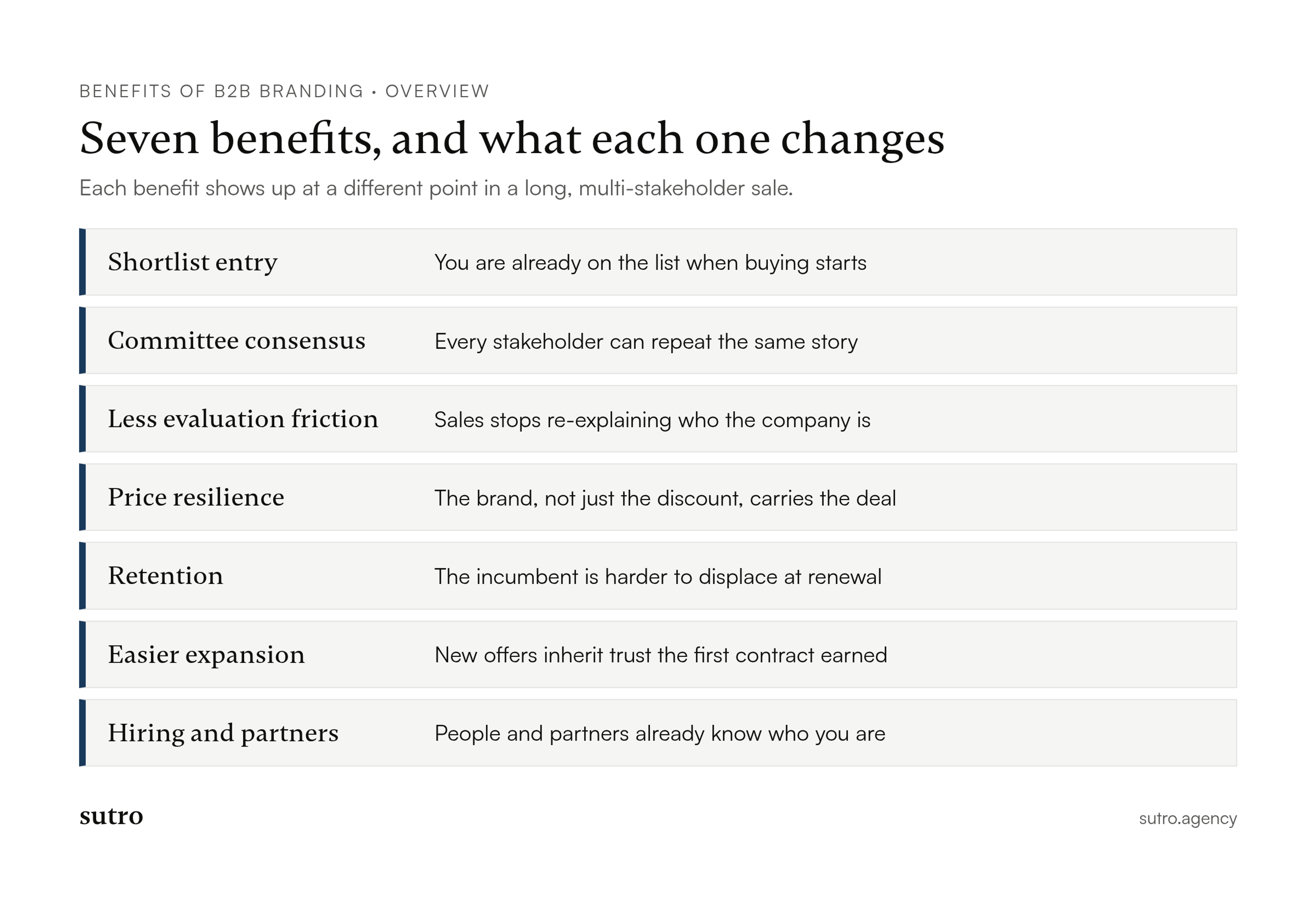
- The main benefits of B2B branding show up in order along a long sales cycle: shortlist entry, committee consensus, less evaluation friction, price resilience, account expansion, then hiring and partners.
- Most future buyers are not in the market now, so getting on the shortlist depends on memory built before the need appears.
- Committees stall without a shared, low-risk story, and stakeholders who never fill in a form can still veto a name they do not recognize.
- Brand is not the constraint when the product, the market choice or the sales process is the actual problem.
- Start by finding the first broken stage in your cycle, then make the story consistent there.
The main benefits of B2B branding in a long, multi-stakeholder sale are getting on the shortlist before anyone talks to sales, giving the buying group a story they can agree on, reducing friction once evaluation starts, holding price in negotiation, expanding the account after the first contract, and making it easier to hire and partner with the people you want. B2B branding is the work of deciding what a company should mean to the people who approve a purchase, and making that meaning consistent and easy to repeat; I covered a practical definition of B2B branding separately.
I see the same pattern in technical companies at $10M to $150M in revenue. The product can win a demo, then the deal slows down because a security lead, a finance reviewer or an executive sponsor does not have a clear, low-risk way to say yes. That is the problem I started Sutro to work on with technical B2B teams at commercial inflection points. I am also the founder and CEO of Ramotion, which has been in the industry since 2009 and has completed 350+ projects. The sections below take each benefit in the order it shows up in a long cycle, with the mechanism and what it looks like in practice.
Getting on the shortlist before sales is in the room
Brand gets you onto the shortlist by building memory in buyers who are not shopping yet, so your name is already in the set they consider when a need appears. If you are not in that first set, sales often never gets a meeting.
Most of the people who will buy from you in the next few years are not in the market today. As the IPA notes, citing Professor John Dawes of the Ehrenberg-Bass Institute, up to 95% of potential buyers are not in the market for a brand's products or services at any given time. Lead generation talks to the small group that is buying now. Brand work is what makes you familiar to the much larger group that will buy later.
When a buyer does enter the market, they do not start from a blank page. The same IPA article cites a BBN study of 850 B2B cases, "The Rule of Three in Every Purchase Decision," which found that the first search engine a buyer uses is their own memory: typically one to three brands come to mind as able to solve the problem, and in 90% of cases the eventual purchase is one of those three.
A later study, reported by Brand Finance in May 2025, found a similar pattern at the start of complex technology purchases: 81% of respondents said "everyone" or "almost everyone" in the buyer group already knew the brand that was eventually selected, and only 4% bought a product or service known exclusively to the recommending function.
In practice this looks unglamorous. A vice president hears a category need in a planning meeting and can name you without opening a tab. An analyst already has a distinct impression of what you do, not a vague sense that you are "one of the tools companies use." A common pattern is a well-qualified account that never replies. In many of those accounts, the shortlist was already formed, and you were not on it.
Helping the buying committee reach consensus
A clear brand helps a buying committee reach consensus by giving every stakeholder the same, easy-to-repeat story and lowering the personal risk of choosing you. In a long B2B sale, the deal is often won or lost in the rooms your salesperson is not in.
The buying group is not one person with a scorecard. An engineer, a security reviewer, a finance lead and an executive sponsor each hold a slightly different picture of you, and they have to arrive at a shared decision they can defend internally. The same Brand Finance article describes this as the need for "collective confidence," and cites research from Matt Dixon and Ted McKenna's book The Jolt Effect that over 40% of B2B deals stall because a group of buyers cannot reach consensus.
That article also reports LinkedIn research with Bain and Newton X on complex technology purchases at large enterprises: "Hidden Buyers" in functions such as security, compliance, legal or procurement held 49% of the decision-making power. They were 70% more likely than "Target Buyers" to reject unfamiliar brands, and 31% more likely to reject brands they did not personally recognize. These people rarely fill in a form, and they can still veto the deal.
What this looks like in practice: the champion can forward a one-page story that still makes sense to a finance lead who missed the demo. The security reviewer has heard of you from peers, so the review starts at "how do they handle this control" instead of "who are these people." I often see the opposite. Five stakeholders leave five meetings with five different explanations of the company, and the deal stalls while they try to reconcile them.
Reducing friction once evaluation starts
Once you are under evaluation, a consistent brand reduces friction by letting sales, marketing and product reuse one clear story, so the buyer does not have to re-learn who you are at every step. Stalled deals are often a comprehension problem as much as a product problem.
In a long cycle the committee will see a website, a deck, a security one-pager, a webinar, a trial and a proposal, often made by different people, over months. If those pieces sound like different companies, the buyer has to do extra work, and that work feels like risk. Brand Finance notes that when buyer groups already recognize and trust a brand, decision cycles shorten, and established brands face fewer objections in procurement, because Hidden Buyers are more influenced by brand than Target Buyers are.
In practice, the sales engineer stops rewriting the opening five slides for every deal. The champion can answer "remind me how you are different" in one sentence. Procurement does not treat you as an unknown vendor that needs a longer justification. When I review stalled opportunities, I look first at whether the company can be explained the same way by the account executive, the sales engineer and the website. If those three versions disagree, brand work will remove more friction than another demo environment will.
Holding price in negotiation
Brand supports price in negotiation by making the offer feel less substitutable, so the buying group has a reason to accept your price instead of defaulting to the cheaper comparable option. This is a short point, because the mechanism sits inside brand equity rather than in a pricing tactic.
Kantar BrandZ data for 2022 and 2023 shows that net worth perceptions of B2B brands are higher than those of consumer-facing brands, which Kantar reads as stronger Pricing Power: B2B brands are better at justifying their prices. Kantar also finds that Difference, meaning how clearly a brand stands apart, is the most important driver of that Pricing Power for both consumer and B2B brands.
In a negotiation this looks like fewer last-minute discounts that exist only because the buyer needs something to take back to finance, and more deals that close near the proposed price because the committee can already explain why you cost more. If you want the fuller picture of how that advantage is built, I wrote what B2B brand equity is and how it is built separately.
Keeping and expanding the account after the sale
After the first contract, brand helps you keep and expand the account because the incumbent that buyers already trust is harder to displace, and new offers inherit some of that trust. The cycle does not end at signature. Renewal, upsell and a second product line all go through a committee again.
Brand Finance describes this as enhanced customer lifetime value: brand trust becomes a foundation for expanded relationships, and incumbent brands become hard to displace.
In practice, the renewal conversation starts from "are we still well served" rather than from a blank re-evaluation against every rival. A new module or a higher tier does not have to reintroduce the company. Expansion still needs a good product and a fair contract. Brand does not invent a reason to renew a tool people have stopped using. It does reduce the chance that a well-run account is re-opened from scratch because a new stakeholder has never heard a clear story about you.
Attracting the people and partners you want
A strong company brand also pulls talent and partners, because people prefer to join and attach themselves to a name they already recognize and can explain. Hiring and partnership conversations use the same memory and risk logic as a buying committee, just with a different contract at the end.
A July 2022 SHRM Executive Network insights forum reported that HR professionals who said their employer brand plays a significant role in their ability to attract top talent were more likely to say their organization's recruitment and hiring strategies had been largely successful in the past six months (65%) than those who said it does not play a significant role (47%).
In practice, a senior engineer already has a point of view about you before the recruiter's email. A candidate can tell a former colleague what the company does in one sentence. Partners, resellers and implementation firms are more willing to put their name next to yours when their own customers will recognize it. If the market brand and the employer story contradict each other, this benefit disappears. People notice the gap quickly, and so do partners.
When brand is not the constraint
Brand is not the constraint when the product cannot do the job, the company is selling to the wrong market, or the sales process itself is broken. Treating those problems as a branding brief wastes time and hides the real issue.
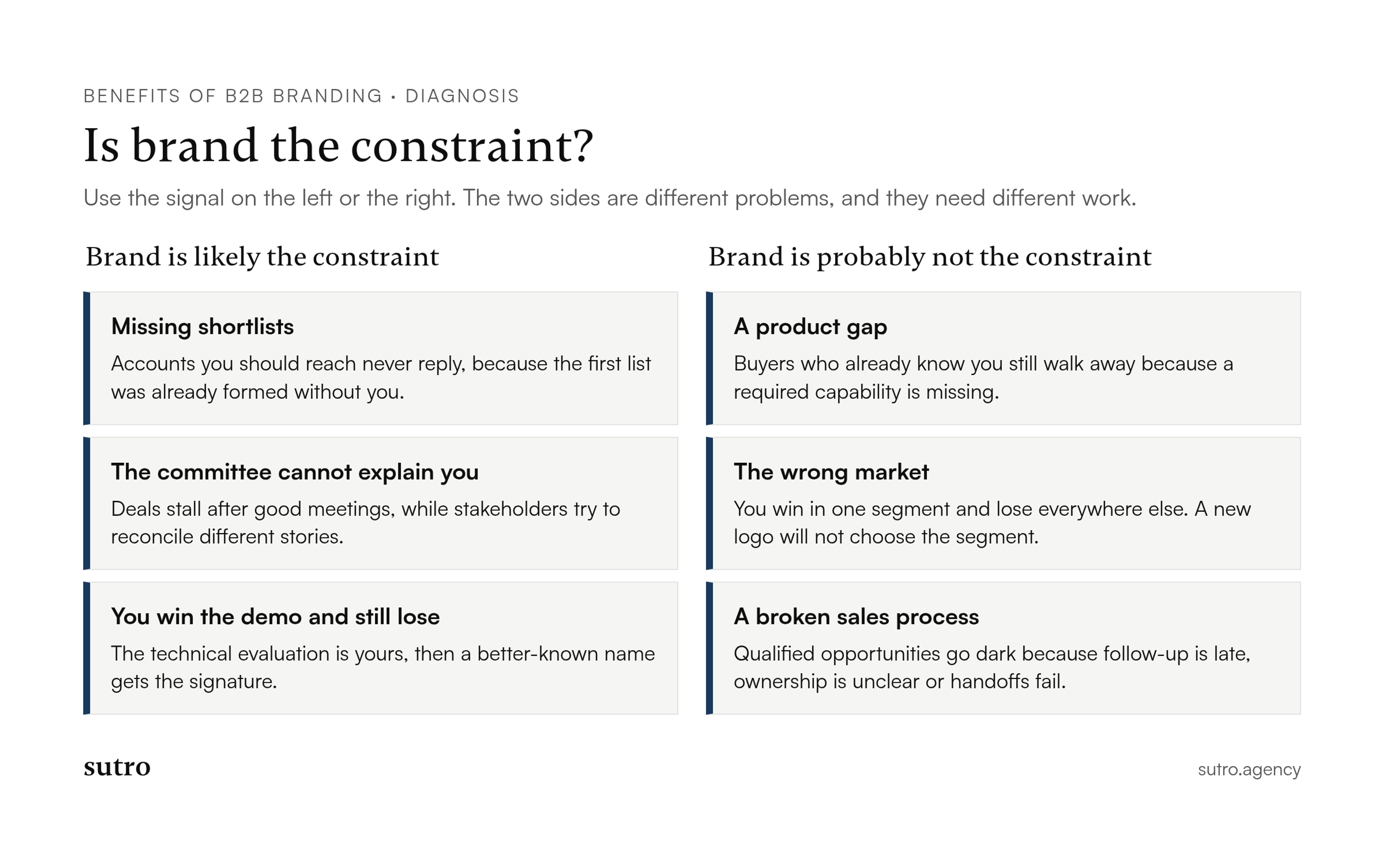
I use a simple split. If buyers who already know you still walk away because the product misses a required capability, fix the product. If you are winning in one segment and losing everywhere else, you may have a market or positioning focus problem, but a visual refresh will not choose the segment for you. If qualified opportunities go dark because follow-up is late, ownership is unclear or handoffs fail, that is a sales-process problem.
Brand is more likely the constraint when you are absent from shortlists you should be on, when deals stall because the committee cannot explain you, or when you win the technical evaluation and still lose to a better-known name. Those are memory, risk and story problems. They are the ones the benefits in this article can address.
How to start capturing these benefits
Start by locating where in the cycle you are losing value, then fix the story and the consistency at that stage, rather than beginning with a new logo. The benefits above show up in sequence, so the first gap is usually the right place to work.
A short self-check I use with leadership teams:
- Can a typical buyer name you before they talk to sales, and can they say what you are for in one sentence?
- Can an engineer, a finance lead and an executive sponsor tell the same story after one pass through your materials?
- Do the website, the deck, the one-pager and the proposal sound like one company?
- In the last few negotiations, did you discount because the product was weaker, or because the committee had no other way to defend the price?
- Do renewals and expansion conversations restart from zero when a new stakeholder joins?
- Would a strong candidate or a potential partner already have a clear, accurate impression of you?
If the first two answers are weak, work on distinctive memory and a committee-ready story before you spend on more demand-generation volume. If the later answers are weak, the brand already has some recognition, and the work is to make it consistent and usable in sales, renewal and hiring. Measuring the commercial return of that work is a separate problem; I covered how to judge the return on B2B brand work in its own guide.
Conclusion
In a long, multi-stakeholder sale, B2B branding pays off at each stage of the cycle: you get onto the shortlist, the committee can agree, evaluation has less friction, price is easier to hold, the account is easier to keep and expand, and the people and partners you want already have a reason to take you seriously. None of that replaces a product that works or a sales process that follows through. It is what gives those two things a chance to add up over time.
If you want to talk through where your own cycle is losing value, tell us which stage of the sales cycle keeps stalling.
Questions
- What is B2B branding?
- B2B branding is the work of deciding what a company should mean to the people who approve a purchase, then making that meaning consistent and easy for them to repeat. The logo and visual identity are part of it, but they are not the point. The point is that a committee can explain why you are a safe, obvious choice. A longer practical definition lives in a separate guide on this blog.
- How is this different from lead generation?
- Lead generation talks to buyers who are already in the market. Brand work builds memory in the much larger group who will buy later, so you are already in their first set of names when a need appears. You still need demand generation for the buyers who are ready now. If that is all you do, you keep arriving after the shortlist has been formed.
- How long before these benefits show up?
- Shortlist memory and committee familiarity take time, because they depend on repeated, distinctive impressions among people who are not shopping today. Friction inside live deals can ease sooner, once sales, the website and the proposal tell the same story. Treat this as a sequence, not a campaign with a single end date.
- Does this only apply to large enterprise companies?
- No. Any technical B2B company that sells through a long cycle with more than one approver will feel these effects, including mid-market teams in the $10M to $150M range. The committee may be smaller than in a global enterprise, but the shortlist, the internal sell and the renewal still happen. The same stages apply.
- Can a better product make up for a weak brand?
- A stronger product can win a demo and still lose the deal if the committee cannot explain you, or if you never made the shortlist. Product quality is required. It is not a substitute for memory and a shared story. If the product is genuinely behind, brand work will not close that gap, and you should not brief it as if it will.
Sources
- IPA, Cos Mingides, "Why now is the perfect time for B2B brands to invest for growth," 16 February 2023
- Brand Finance, Jann Martin Schwarz and Mimi Turner, "Brand's hidden hand in B2B success," 14 May 2025
- Kantar BrandZ, Jenny Peters, "Why Difference matters for B2B marketers," 10 July 2024
- SHRM Executive Network, "Exploring Post-COVID Recruitment and Retention Strategies," July 2022 Insights Forum