Strategy
Brand Personality for B2B Companies: Examples and How to Define It
Two real examples, three illustrative profiles and a method to define B2B brand personality so product, sales and support show it, not only marketing.
Key takeaways
- B2B brand personality is the set of human traits buyers link to a company, proven in product, sales, support and docs, not only in marketing copy.
- Personality is the character, voice is how it sounds in words, identity carries it visually and verbally, and positioning decides what it must support.
- Aaker's five dimensions and the 12 archetypes are useful vocabulary; translate them into plain traits so they do not become costume.
- Atlassian and Microsoft publish their traits, and Atlassian shows how to dial intensity by the user's emotional state.
- My recommendation: three traits, one guardrail each, four proof behaviors each, for 12 written behaviors with named owners.
- Test each trait: a competitor cannot claim it truthfully, a behavior proves it, and employees recognize it.
B2B brand personality is the set of human traits buyers link to a company, shown in how it writes, designs, sells and supports. For a buying committee comparing similar products, it is often what makes one vendor memorable and easier to trust.
Most technical companies already have a personality. They just never chose it. It is whatever the founders sounded like at Series A, plus whatever sales, support and product picked up since. My recommendation is a small, enforceable definition: three traits, one guardrail per trait, and four proof behaviors per trait. That is 12 written behaviors in total, few enough for a sales hire or a support lead to remember in week one.
This guide covers what personality is and is not, the frameworks worth using, two real examples from public guidelines, three illustrative profiles, the Trait Proof Map I use to make traits operational, and a step-by-step process. It is the character layer of the brand platform, the same layer that shows up in Sutro's B2B brand platform work before any identity or website project starts.
Why brand personality matters in B2B
Brand personality matters in B2B because the products in most technical categories look alike on paper, and a buying committee has to agree on one vendor. Feature lists blur. Pricing pages copy each other. Personality is one of the few things a competitor cannot copy by shipping a feature.
A B2B purchase is also a long relationship, not a one-time transaction. The engineering lead checks constraints, finance checks cost, the end user checks the learning curve, and security checks risk. Each of them meets the company in a different place: the docs, the proposal, the trial, the security questionnaire. If the company feels like a different character in each place, nobody on the committee has a clear picture to champion internally.
There is a practical benefit too. A defined personality gives every team a shortcut for thousands of small decisions nobody will ever review: how an error message reads, how a rep opens a call, how support says no. Without it, each team fills the gap with its own defaults. That is how a lively website ends up attached to a cold product and a defensive support desk.
Personality vs. voice vs. identity vs. positioning
Personality is the character, voice is how that character sounds in words, identity is the visual and verbal system that carries it, and positioning is the market space it serves. Teams mix these up in workshops, and the mix-up produces vague output.
- Positioning decides where you compete and for whom. Personality has to fit it, so settle positioning before you pick traits.
- Personality is a short set of human traits with limits. It guides behavior, not only copy.
- Voice translates personality into writing: word choice, rhythm, banned phrases. Voice stays constant and tone shifts with the situation. If you need the writing rules themselves, see a voice guide with say-this and avoid-this lists.
- Identity is the full system of names, type, color, imagery and language that makes the personality visible. For how those parts fit together, read the visual and verbal layers of a B2B identity.
The test for whether you are working on personality: if the output only changes how marketing copy sounds, it is voice work. If it also changes how a sales engineer runs a demo or how support handles an outage, it is personality.
Frameworks for defining B2B brand personality
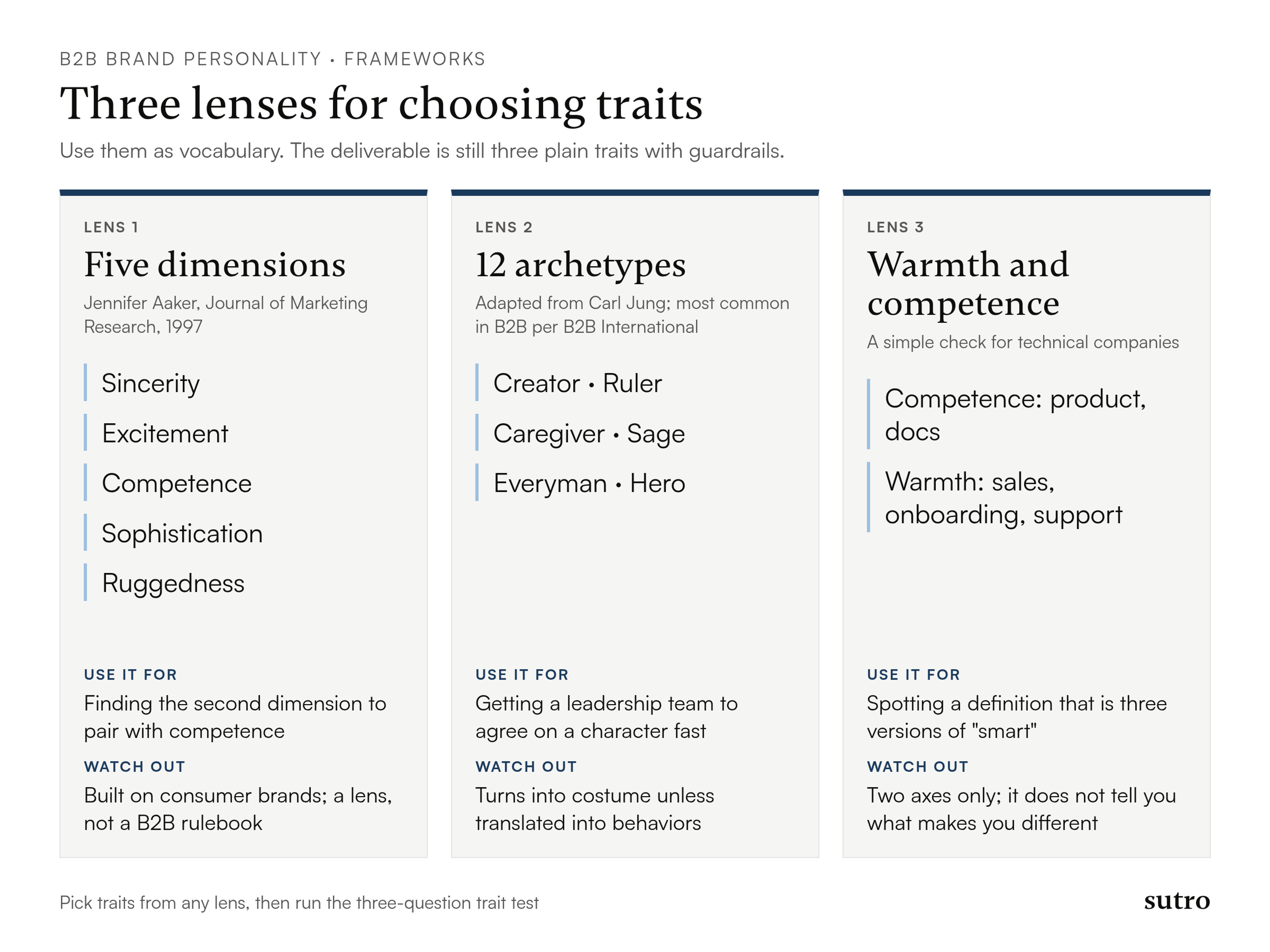
Two frameworks dominate: Jennifer Aaker's five dimensions of brand personality and the 12 brand archetypes adapted from Carl Jung. Both are useful as vocabulary. Neither should be the deliverable.
Aaker's five dimensions
Jennifer Aaker's 1997 paper in the Journal of Marketing Research, Dimensions of Brand Personality, identified five dimensions: Sincerity, Excitement, Competence, Sophistication and Ruggedness, with a scale to measure them. The research was built on consumer brands, so treat it as a lens rather than a B2B rulebook.
In technical B2B, Competence is the entry ticket. Every serious vendor claims it, and buyers assume it until something breaks. That is the useful insight: since everyone must be competent, the difference usually comes from the second dimension you pair it with. Competence plus Sincerity reads very differently from Competence plus Excitement.
The 12 brand archetypes
Archetypes group traits into recognizable characters such as the Sage, the Creator or the Ruler. B2B International notes that the twelve archetypes come from Carl Jung's framework and that B2B brands most often show up as the Creator, Ruler, Caregiver, Sage, Everyman and Hero.
Archetypes help a leadership team agree quickly because the characters are easy to picture. Their limit is that they turn into costume. An infrastructure company does not become a Hero by putting capes in its ads. Use an archetype to start the conversation, then translate it into plain traits and behaviors your team can check.
Warmth and competence
A simpler lens works well for technical companies: competence lives mostly in the product, and warmth lives mostly in the people around it, in sales, onboarding and support. Many engineering-led companies are strong on the first and thin on the second. When a personality definition comes out as three versions of "smart," that is usually the gap to fix.
Real B2B brand personality examples
The clearest real examples come from companies that publish their guidelines. Two of them name their traits directly and show how the traits change with context.
Atlassian: Bold, Optimistic, Practical with a wink
Atlassian's design system states that its voice is "essentially Atlassian's personality" and lists three traits: Bold, Optimistic and Practical, with a wink (Atlassian Design System, voice and tone). The useful part is how it applies them. The guide asks writers to consider the user's emotional state and to be less bold with people who feel apprehension or confusion, such as new users and trial users, while power users and admins get more of it.
That is a dial, and it is the piece most personality definitions miss. Traits are constant. Their intensity is not.
Microsoft: warm and relaxed, crisp and clear, ready to lend a hand
Microsoft's public writing style guide describes its voice as warm and relaxed, crisp and clear, and ready to lend a hand (Microsoft Writing Style Guide). Each phrase pairs a trait with a behavior: warm and relaxed means less formal and more conversational, crisp and clear means writing for scanning first. For a company that sells deep enterprise software, the choice to lead with warmth is deliberate.
Both examples are documented as voice. Read them as personality expressed in writing. The next step, which most public guides do not show, is proving the same traits outside the copy.
Three illustrative B2B personality profiles
The profiles below are illustrative, fictional companies, written to show how traits, guardrails and proof behaviors fit together. They are not clients.
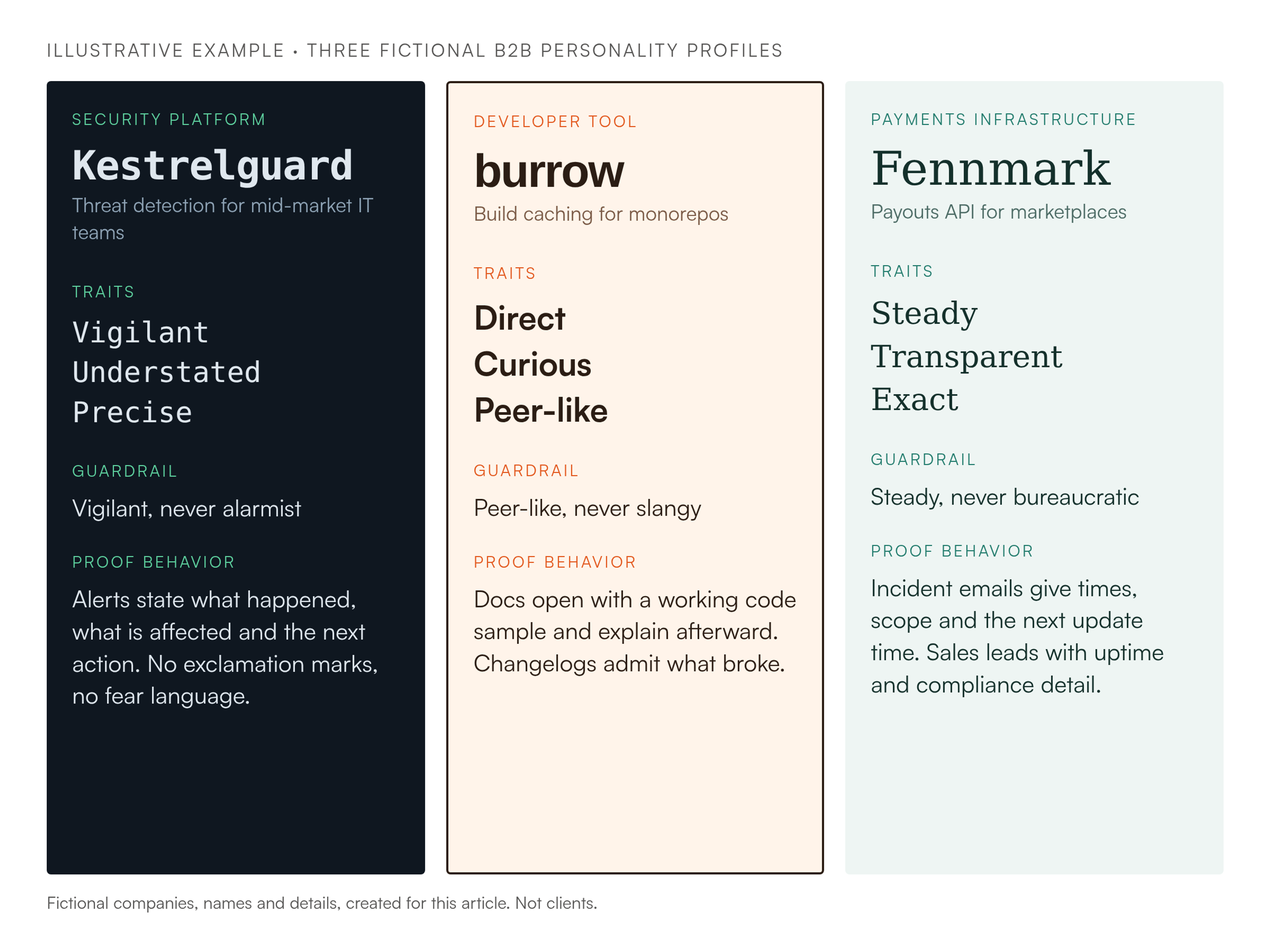
Kestrelguard, a security platform: Vigilant, Understated, Precise. The guardrail is "vigilant, never alarmist." Proof behavior: threat alerts state what happened, what is affected and the next action, with no red exclamation marks or fear language.
burrow, a developer tool: Direct, Curious, Peer-like. The guardrail is "peer-like, never slangy." Proof behavior: docs open with a working code sample and explain afterward, and changelogs admit what broke.
Fennmark, a payments infrastructure company: Steady, Transparent, Exact. The guardrail is "steady, never bureaucratic." Proof behavior: the status page and incident emails give times, scope and the next update time, and sales leads with uptime and compliance detail instead of upsell.
Notice that none of the profiles uses "innovative," "professional" or "customer-centric." Those words fail the first test in the next section.
The Trait Proof Map: how traits show up across touchpoints
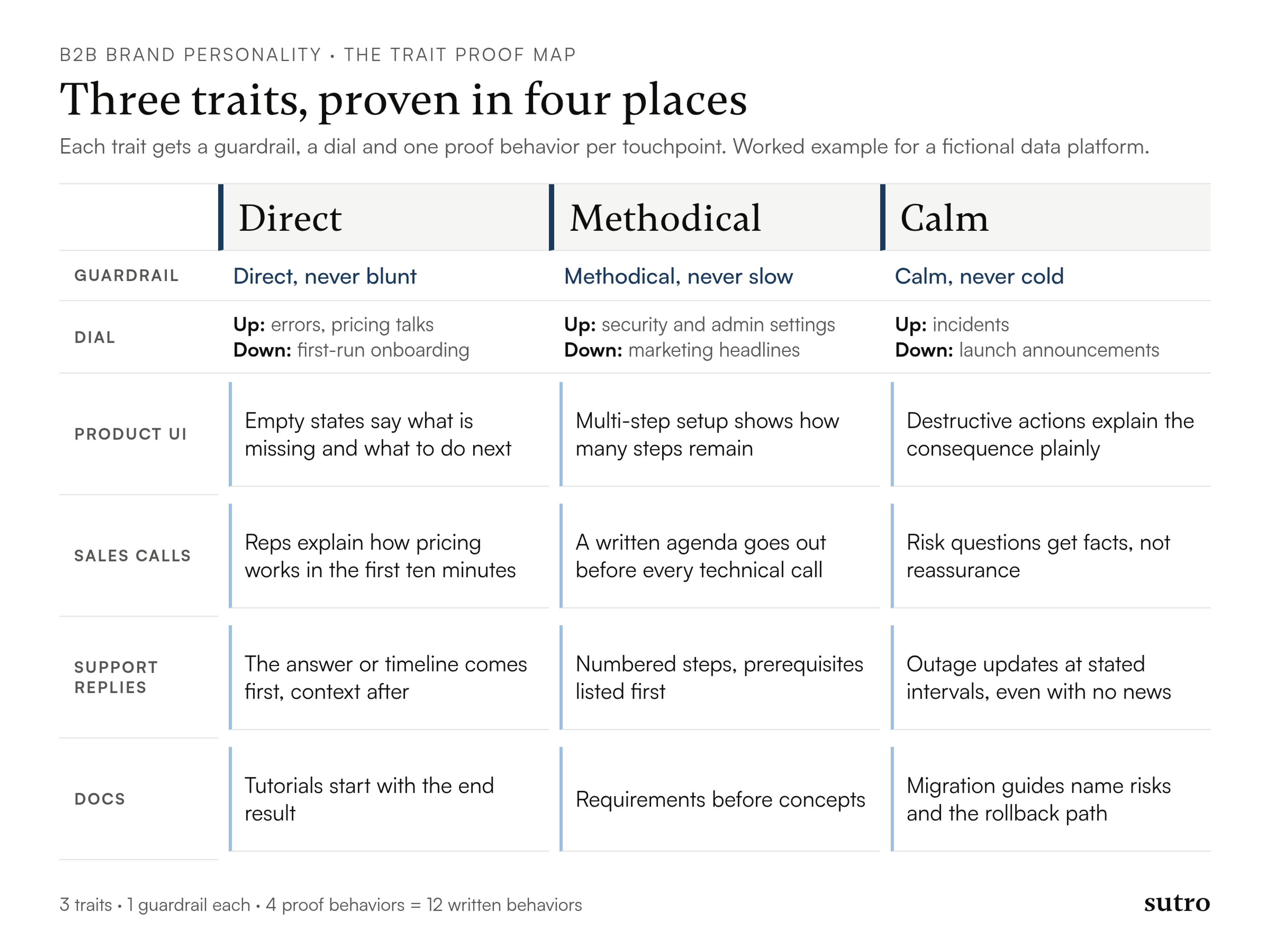
The Trait Proof Map is a one-page document that gives each trait a guardrail, a dial and one proof behavior in four places: product UI, sales calls, support replies and docs. It is my answer to the most common failure I see, a personality that lives in a slide deck and nowhere else.
Here is a worked map for a fictional B2B data platform.
Trait 1: Direct. Guardrail: direct, never blunt. Dial: turn it up in error messages and pricing conversations, turn it down in first-run onboarding.
- Product UI: empty states say exactly what is missing and what to do next, with no jokes.
- Sales calls: reps state how pricing works in the first ten minutes.
- Support replies: the answer or the timeline comes first, the context after.
- Docs: tutorials start with the end result, then walk back through the steps.
Trait 2: Methodical. Guardrail: methodical, never slow. Dial: turn it up in security and admin settings, turn it down in marketing headlines.
- Product UI: multi-step setup shows how many steps remain.
- Sales calls: sales engineers send a written agenda before every technical call.
- Support replies: fixes use numbered steps and list prerequisites first.
- Docs: architecture guides state requirements before concepts.
Trait 3: Calm. Guardrail: calm, never cold. Dial: turn it up during incidents, turn it down in launch announcements.
- Product UI: destructive actions explain the consequence in plain words.
- Sales calls: reps answer risk questions with facts rather than reassurance.
- Support replies: outage updates arrive at stated intervals, even when there is no news.
- Docs: migration guides name the risks and the rollback path.
Twelve behaviors fit on one page. Each one has an owner, which is the point: product owns the UI line, sales enablement owns the call line, support owns the reply line, and whoever runs documentation owns the last one.
The three-question trait test
Before a trait goes on the map, put it through three questions:
- Could a competitor claim it truthfully? If yes, it does not differentiate. "Reliable" and "innovative" fail here, because no one claims the opposite.
- Can you point to a behavior that proves it? If you say "transparent," you should be willing to publish pricing or an honest status page. No behavior, no trait.
- Would employees recognize it? Read the trait to a support lead and a sales engineer. If they cannot say how it changes their week, it is aspiration, not personality.
How to define your B2B brand personality, step by step
Define personality from positioning and research, not from a brainstorm of adjectives. These seven steps take a leadership team from the current, accidental personality to a written, owned one.
- Start from positioning. The traits must support the market space you want to own. A company creating a new category can carry a more challenging character than one replacing an incumbent in a regulated industry.
- Audit the personality you already have. Watch a recorded demo, read twenty recent support tickets, go through onboarding as a new user, and read the last three proposals. Write down the traits a stranger would infer.
- Interview stakeholders and buyers. B2B International recommends in-depth conversations with management, employees, investors and customers to find candidate personalities. Look for the gap between what founders want to project and what buyers describe.
- Shortlist and cut to three. Use Aaker's dimensions or archetypes as a vocabulary, then write plain traits. Run each through the three-question test.
- Write guardrails and dials. One "never" per trait and one sentence on when to turn it up or down.
- Test with buyers. Put two candidate personalities into sample headlines, a mock landing page section and a sample support reply, and ask target buyers which company they would rather work with and why.
- Write the Trait Proof Map and assign owners. Roll it out through the teams that own each touchpoint, and review it when positioning changes, not on a calendar.
Common B2B brand personality mistakes
Most personality projects fail in predictable ways, and almost all of them come back to traits that never left marketing.
- Generic traits. "Professional, innovative, trusted" describes every vendor in the category and guides no one.
- Too many traits. Seven traits become a list nobody remembers. Three can be enforced.
- Marketing-only personality. A playful website attached to a sterile product and a legalistic support desk feels like a bait-and-switch.
- A personality that contradicts reality. A rebel tone does not survive a six-month integration and three rounds of legal review.
- Treating a visual refresh as a personality change. New colors do not change how a rep runs a call.
- No dial. The same intensity in a launch post and an outage notice reads as tone-deaf.
Conclusion
A B2B brand personality is useful only when it changes behavior. Pick three traits that fit your positioning, give each a guardrail and a dial, and write down how each one shows up in the product, on sales calls, in support and in the docs. Then test it with buyers and give every line an owner.
If you are not sure your current character matches the company you are becoming, book a call and tell us which touchpoint feels least like you.
Questions
- What is B2B brand personality?
- It is the set of human traits buyers associate with a company, such as direct, methodical or calm. In B2B it shows up in how the company designs its product, runs sales calls, answers support tickets and writes documentation, not only in its marketing copy.
- What is the difference between brand personality and brand voice?
- Personality is the character itself. Voice is how that character sounds in writing. A personality also guides non-verbal behavior, such as how a rep structures a demo or how support handles an outage, while voice guides word choice and rhythm.
- How many personality traits should a B2B brand have?
- I recommend three. Fewer tends to collapse into a single generic word, and more becomes a list teams cannot remember. Each trait needs a guardrail that says what it is not, so it does not turn into a caricature.
- Can a B2B company have a humorous personality?
- Yes, if humor fits the buyers and the stakes. A developer tool can use dry, peer-to-peer wit in docs and changelogs. A security or payments platform should dial humor down sharply, and never use it in incident communication or risk conversations.
- How do you test a brand personality with buyers?
- Write two candidate personalities into the same sample materials, such as a headline, a landing page section and a support reply, and show them to target buyers. Ask which company they would rather work with and why, then check the answers against your positioning.
- How often should brand personality change?
- Rarely. The traits should hold for years and change only when positioning changes, for example after a move upmarket, a platform shift or an acquisition. Tone and intensity flex every day. The character should not.