Strategy
B2B Brand Voice: How to Define It and Keep It Consistent
B2B brand voice is the fixed way your company sounds in writing and speech. Here is how to define traits, document them, and keep every channel consistent.
Key takeaways
- B2B brand voice is the fixed way you sound; tone flexes by situation; messaging decides what you claim and prove.
- Define three or four concrete traits with counter-traits, not a slide of vague adjectives every competitor shares.
- Pair traits with say-this / avoid-this examples and a short banned-words list writers can apply in minutes.
- Fill a short sample voice-guide structure with real channel lines, a named owner and a freeze date.
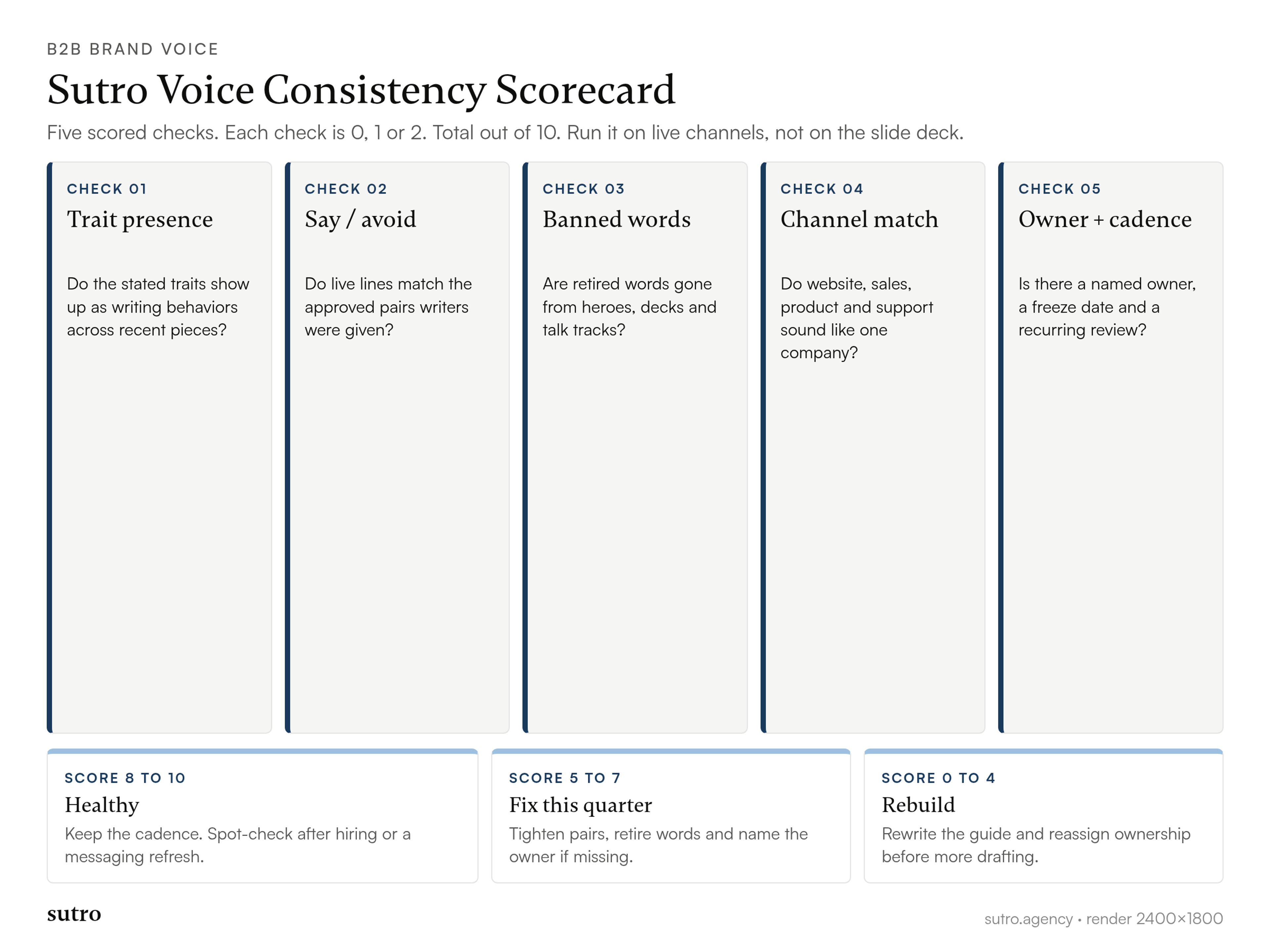
- Run the Sutro Voice Consistency Scorecard (five checks, 0 to 2 each, total /10) to see whether the guide is operating.
- Constrain AI drafts with the same traits and banned list, and keep a human owner scoring channels on a fixed cadence.
B2B brand voice is the fixed way your company sounds in writing and speech, independent of the channel or campaign. It is not the claim you make, and it is not the mood of a single email. It is the set of traits, preferred words, and banned patterns that let a buyer recognize you whether they are on the homepage, in a sales deck, or reading a product error state.
When I review verbal systems for technical B2B teams, the failure I see most often is not a missing adjective slide. It is five channels that each sound like a different company, with no named owner and no review cadence. A voice page that nobody uses is decoration. A short guide that sales, product and support can apply is an operating asset.
That operating asset is part of our approach once positioning and messaging are settled. I also founded Ramotion, which has been in the industry since 2009. The pattern is steady: teams that treat voice as a one-time workshop lose consistency within a quarter. Teams that name an owner, freeze a short guide and score channels keep the same sound as headcount grows.
This guide covers what B2B brand voice is, how it differs from tone and from messaging, how to define three or four concrete traits, how to write say-this and avoid-this pairs with a banned-words list, a sample voice-guide structure you can fill, one worked fictional B2B SaaS voice card, the Sutro Voice Consistency Scorecard, and how to stop AI drafts from drifting off voice.
Voice vs tone vs messaging
Voice is the constant personality of the brand. Tone is how that personality adjusts to the situation. Messaging is what you say and prove.
Mailchimp's public content style guide draws the line cleanly: you have the same voice all the time, but your tone changes with the reader's emotional state and the moment. A launch email can sound warmer than a security advisory. Both should still sound like the same company.
Messaging sits in a different layer. Messaging decides the claims, proof and objections. Voice decides whether those claims sound precise or vague, calm or hyped, technical or diluted. You can have a sharp the messaging framework sales can actually use and still sound like three agencies wrote the website, the deck and the in-app copy. You can also have a consistent voice that repeats weak claims. You need both.
Tone without a fixed voice becomes improvisation. Every writer picks a mood. Voice without tone control becomes rigid: the same punchy cadence in a breach notice and a hiring post. Messaging without voice turns accurate claims into copy that feels interchangeable with the next vendor.
Define three or four concrete traits
A usable B2B brand voice starts with three or four traits that a stranger could test against real copy. Vague adjectives fail that test. "Innovative," "trusted" and "customer-obsessed" describe every competitor on your shortlist. Concrete traits describe how you sound when those claims are written down.
Write each trait as a short definition plus a behavior. Good traits answer: what do we sound like, and what does a writer do differently because of that?
A practical set for many technical B2B products looks like this:
- Precise: Prefer specific nouns and measurable outcomes over slogans. Name the system, the user and the change.
- Direct: Lead with the point. Cut throat-clearing openers and stacked hedges.
- Steady: Stay calm under pressure. Do not spike into hype when a launch is exciting or into panic when an incident is hard.
- Human: Write as a competent colleague, not a brochure and not a chatbot. Use contractions when they help. Skip forced jokes in risk moments.
Three traits are enough when the company is young or the writing team is small. Four is the ceiling I use in most engagements. A fifth trait usually duplicates another or becomes an excuse for inconsistency.
Pair every trait with a counter-trait so writers know what to refuse. Precise is not cold. Direct is not rude. Steady is not bland. Human is not casual to the point of sloppy. Those counter-traits belong in the guide next to the positive ones.
Public writing systems make the same move. GitHub's product content guide states a voice as paired qualities, for example clear but not cold, conversational but not jargon-y. The "but not" clause is doing real work. Without it, writers stretch a trait until it breaks.
Say-this, avoid-this and banned words
Traits alone are too abstract for a busy AE or a product designer shipping UI strings. Give them pairs.
For each trait, write two or three say-this / avoid-this examples in your domain. Keep them short enough to skim in a standup.
Example pairs for a precise + direct voice:
- Say: "We sync inventory across warehouses every 15 minutes." Avoid: "We empower seamless inventory experiences."
- Say: "Your build failed the policy check on ownership labels." Avoid: "Something went wrong with your deployment journey."
- Say: "Three reviewers still need to approve." Avoid: "You're almost there on your collaboration path."
Then build a banned-words list. This is not a morality lecture. It is a short list of words your company overuses when it is nervous: "synergy," "leverage," "seamless," "robust," "next-gen," "AI-powered" as a default adjective, "transform," "unlock," "delight." Ban the ones that appear in your losers' decks and your own outdated homepage.
Government plain-language guidance is blunt about specialized terms that impress instead of inform: jargon is complicated language used to impress, rather than to inform, your audience. Necessary technical terms stay. Fake-technical marketing vocabulary goes. If a term is required for a specialist reader, define it once and keep using the same definition.
GOV.UK's tone guidance pushes the same discipline from another angle: content should stay specific, informative, clear and concise, serious without becoming pompous, and free of spin-heavy adjectives. That is a useful bar for B2B pages that currently read like press releases.
Sample voice-guide structure
A sample voice guide that teams actually fill is short. One to three pages beats a 40-page PDF nobody opens. Use this structure and replace the placeholders with your own language.
1. One-sentence voice summary. How we sound in one line a founder and a support lead can both repeat.
2. Traits (3 to 4). Name, one-sentence definition, one counter-trait, one behavior rule.
3. Say-this / avoid-this. Six to ten pairs drawn from real channels: homepage hero, pricing footnote, sales one-liner, in-app empty state, status page, recruiting note.
4. Banned words and rescue phrases. Ten words to retire and the replacements you prefer.
5. Tone shifts by situation. How the same voice flexes for launch, sales follow-up, incident, support, and legal-adjacent copy. Voice stays. Volume and warmth change.
6. Channel notes. Website, product UI, sales decks, email, social. What stays identical and what may shorten.
7. Owner, review cadence, version. Named person, monthly or quarterly review, date of the freeze.
8. Quick test. Three questions a writer asks before publishing: Does this match a trait? Does it avoid the banned list? Would a buyer recognize us if the logo were removed?
Do not call this document a template in the title or heading on the live page. Call it a sample structure and fill it. Empty frameworks do not change copy. Filled ones do.
Voice also sits inside verbal identity, next to naming and messaging. If you need the wider system around logo, type and verbal assets, read what brand identity includes beyond the logo.
Worked example: a fictional B2B SaaS voice card
Here is a filled mini voice card for a fictional product, Meridian Ops, an inventory sync platform for mid-market manufacturers. The company and lines below are invented for teaching. They are not client results and not research findings.
Voice summary: Meridian Ops sounds like a calm operations lead who respects plant managers' time: precise, direct, steady and human.
Traits:
- Precise: Name the warehouse, the SKU class and the sync window. Counter-trait: not cold.
- Direct: Put the action or the status first. Counter-trait: not curt.
- Steady: Same voice in a launch note and a delayed sync alert. Counter-trait: not flat.
- Human: Write as a colleague on the floor, not a brochure. Counter-trait: not slangy.
Say / avoid:
- Say: "Sync for Warehouse B finished at 14:02 UTC. 12 SKUs need a manual match." Avoid: "Your seamless sync experience completed successfully."
- Say: "We hold outbound orders when on-hand drops below the safety level you set." Avoid: "We intelligently orchestrate inventory outcomes."
- Say: "Connect your ERP in one afternoon with your ops admin." Avoid: "Unlock transformative ERP journeys."
Banned words: seamless, orchestrate, next-gen, AI-powered (unless the feature literally runs a named model the buyer can inspect), delight, revolutionize.
Tone shifts: Launch email can open with a short win. Incident banner stays factual and timed. Sales deck mirrors the homepage claims, not a louder cousin of them.
Owner: Head of Brand, reviewed with Product Marketing on the first Monday each month. Version 1.2 frozen 2026-11-01.
A card this short is enough to brief a contractor, an AE and a designer in fifteen minutes. If your current guide cannot do that, shorten it.
Sutro Voice Consistency Scorecard
The Sutro Voice Consistency Scorecard is a five-check score you can run in under an hour on recent live copy. It is designed for technical B2B teams that already have some voice language and need to know whether it is operating.
Scoring method: Score each check 0, 1 or 2. Total is out of 10. 8 to 10 means the system is healthy. 5 to 7 means fix within the quarter. 0 to 4 means rebuild the guide and reassign ownership before you brief more writers or turn on more AI drafting.
Check 1: Trait presence (0 to 2). Pull the last 10 public pieces across website, product and sales. Do the stated traits show up as behaviors, as slide adjectives alone? 2 = traits visible in most pieces. 1 = traits visible in some. 0 = traits exist only in a deck.
Check 2: Say/avoid compliance (0 to 2). Compare those pieces to your say/avoid pairs. 2 = clear match. 1 = mixed. 0 = writers ignore the pairs.
Check 3: Banned-words hygiene (0 to 2). Search the same set for banned words. 2 = zero hits or only justified technical terms. 1 = occasional hits. 0 = banned words are common in heroes and talk tracks.
Check 4: Cross-channel match (0 to 2). Place homepage hero, a sales one-liner, a product empty state and a support macro side by side. 2 = same company. 1 = close but drifted. 0 = four different brands.
Check 5: Owner and cadence (0 to 2). Is there a named owner, a freeze date and a review on the calendar? 2 = owner + dated freeze + recurring review. 1 = owner but no cadence. 0 = orphan document.
Run the scorecard when you hire a content lead, before a website rewrite, after a messaging refresh, and whenever AI drafting volume jumps. The number is not a brand valuation. It is a maintenance signal.
Keep voice consistent: owner, channels and AI drift
Consistency is an ownership problem before it is a writing problem. Name one owner. Usually that is brand or product marketing, with product design as a partner for UI strings and sales enablement as a partner for talk tracks. "Everyone owns voice" means nobody does.
Set a review cadence. Monthly is right while the guide is new or the team is hiring writers fast. Quarterly is enough once scores sit at 8 or above. Each review should pull fresh samples, rescore the five checks, retire pairs that no longer match the product, and publish a new freeze date. Without a freeze date, every writer assumes the guide is already stale.
Channel rules prevent quiet forks. The website carries the full voice. Product UI stays shorter but keeps the same traits and banned list. Sales may add spoken rhythm and proof, not new personality. Support stays warmer in empathy and still precise in steps. Social can be lighter, not louder than the product.
AI drafting makes drift cheaper and faster. Models default to generic B2B enthusiasm unless you constrain them. Feed the model your traits, say/avoid pairs and banned list before you ask for a draft. Require a human pass against the scorecard checks before anything customer-facing ships. If a channel's AI output repeatedly fails Check 2 or Check 3, stop generating there until the prompt and the review step are fixed.
I treat AI as a first draft assistant, never as the owner of voice. The owner still scores the channels. The guide still freezes. The banned list still wins arguments.
Conclusion
B2B brand voice is the fixed sound of the company: a short set of testable traits, say/avoid pairs, banned words, tone shifts and a named owner. Messaging decides what you claim. Tone flexes for the moment. Voice is what makes both recognizable.
If you only do three things after reading this, do these: freeze three or four concrete traits with counter-traits, fill the sample voice-guide structure with real channel lines, and run the Sutro Voice Consistency Scorecard on the channels that already touch buyers. Then put a review on the calendar so the guide cannot silently expire.
When one channel still sounds like a different company, tell us which channel still sounds like a different company. That single example is usually enough to see whether you need a tighter guide, a clearer owner or a fuller verbal identity pass.
Questions
- What is the difference between brand voice and tone?
- Voice is the constant personality of the brand. Tone is how that personality adjusts to a launch, an incident, a sales follow-up or a support reply. The same company should be recognizable in all four, even when warmth and brevity change.
- How many voice traits should a B2B company define?
- Three or four. Fewer than three leaves writers guessing. More than four usually creates overlap and excuses for inconsistency. Each trait needs a definition, a counter-trait and at least one say/avoid pair.
- How is brand voice different from messaging?
- Messaging covers the claims, proof and objections you repeat. Voice covers how those claims sound: precise or vague, calm or hyped, human or brochure-like. You need a messaging framework and a voice guide; one does not replace the other.
- Who should own brand voice?
- One named owner, usually in brand or product marketing, with product design for UI strings and sales enablement for talk tracks. Shared ownership without a single accountable person is how guides go stale.
- How often should we review the voice guide?
- Monthly while the guide is new or hiring is fast. Quarterly once the Sutro Voice Consistency Scorecard stays at 8 or above. Every review should rescore live channels and publish a new freeze date.
- How do we stop AI drafts from drifting off voice?
- Paste traits, say/avoid pairs and banned words into the drafting prompt, then require a human pass against the scorecard before publishing. If a channel keeps failing banned-words or say/avoid checks, pause generation there until the prompt and review step are fixed.