Strategy
B2B Brand Identity: What It Includes Beyond the Logo
A B2B brand identity is the system that makes a company recognizable and credible to a whole buying group: strategy, language, design and the experience buyers have, not just a logo.
Key takeaways
- A B2B brand identity is a system with four layers: a strategic core, a verbal identity, a visual identity and the experience buyers have with the company. The logo is one small part of it.
- Identity has to stay consistent across sales, the website, the product, the documentation and support, because buyers move between all of them before they sign.
- Buying groups are large, so a B2B identity must give engineers, executives, champions and procurement what each needs while still reading as one company.
- B2B identity differs from B2C in that it is built to reduce risk for a group over months, carries dense technical content and is used daily by people who are not designers.
- Most identity failures are consistency failures: the work stops at the marketing site while the product, docs and proposals keep their old look and vocabulary.
A B2B brand identity is the full system a company uses to present itself to buyers: the strategic core it stands on, the language it uses, the visual system it looks like, and the experience people have with it across sales, the website, the product, the docs and support. The logo is one piece of it, and usually not the piece that decides whether a buying group trusts you.
When leaders say "we need a new identity," they usually mean a new logo and color palette. I understand the instinct. Visual work is concrete, easy to review and easy to show the board. But in my years running Ramotion, which has been in the industry since 2009 and has completed more than 350 projects, I have rarely seen a logo be the reason a deal stalled. Deals stall when the sales deck promises one company, the product shows another and the documentation reads like a third.
That gap is the core problem in B2B branding for technical companies, and it is why I set up Sutro as a branding firm for engineering-led companies at commercial inflection points, such as moving upmarket or entering a new category. This guide covers what a B2B identity actually includes, where it has to hold up, why a buying committee changes the job, how it differs from consumer identity, and the mistakes I see most often.
What B2B brand identity means
B2B brand identity is how you intend to be seen and recognized by every person involved in buying from you. It is a set of deliberate decisions about what you stand for, how you sound, how you look and how you behave, made once and applied everywhere.
Three terms get mixed up here, so it helps to separate them:
- Brand identity is what you control: positioning, language, design and the experience you build.
- Brand image is what buyers actually believe about you. Identity is the input; image is the result.
- Brand guidelines are the documentation that tells your team how to apply the identity. Guidelines describe an identity. They are not the identity.
When identity and image drift apart, the cause is almost always inconsistency, not a weak logo. Buyers form their view from dozens of encounters, and most of those encounters are not designed by the marketing team.
The four layers of a B2B brand identity
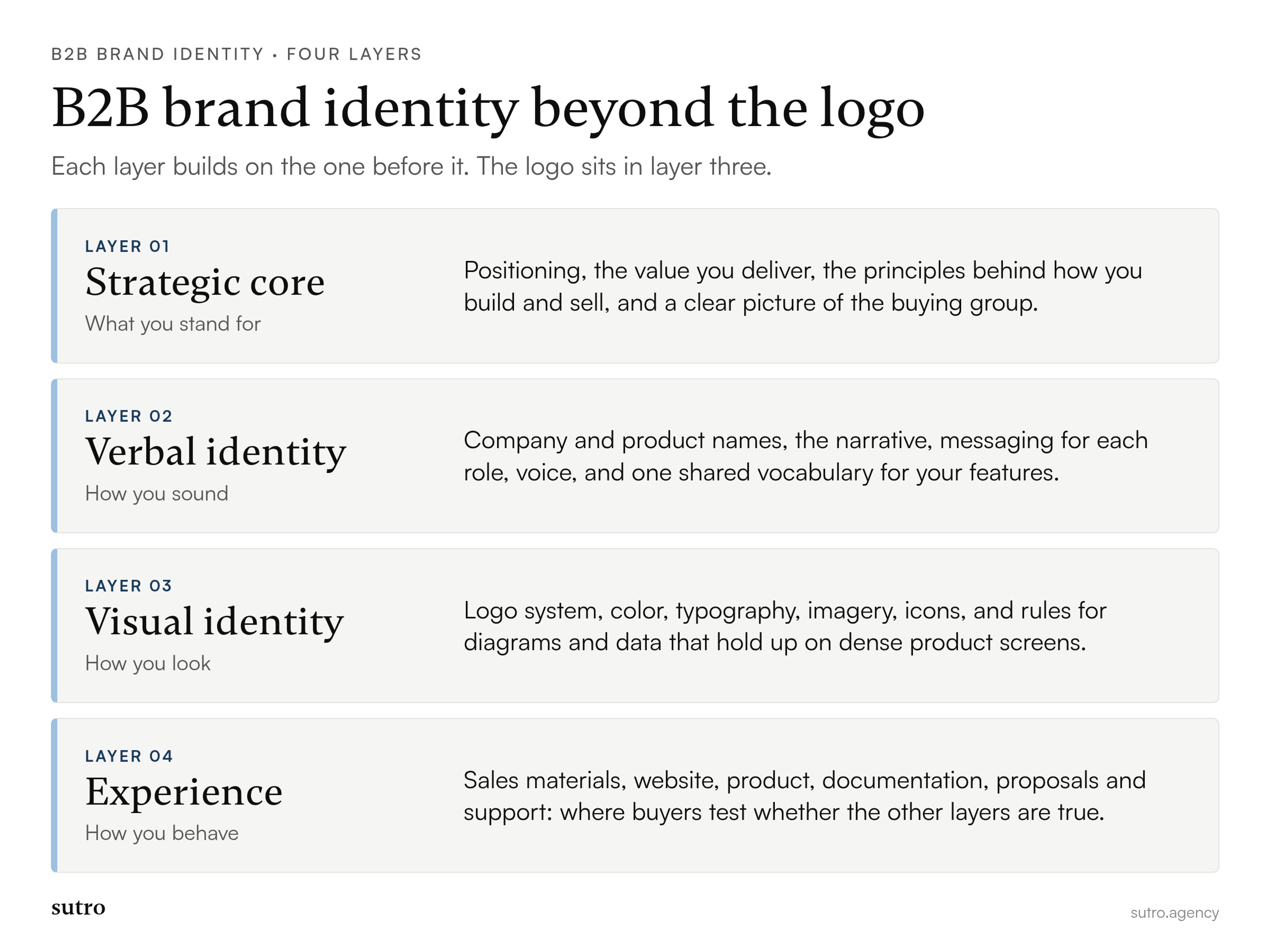
A complete B2B identity has four layers: a strategic core, a verbal identity, a visual identity and an experience layer. Each layer depends on the one beneath it. If the strategic core is vague, the language turns generic, the design turns into a matter of taste and the experience falls apart under pressure.
Strategic core
The strategic core is the set of decisions every visible element expresses. It covers positioning (what you are, for whom, and what you replace), the value you deliver, the principles that shape how you build and sell, and a clear picture of who sits on the buying side. None of it shows up on a slide by itself, yet every slide depends on it.
If the core is unsettled, every identity review becomes a debate about preferences. I would rather spend an extra week on the core than a month on design rounds that cannot converge.
Verbal identity
Verbal identity is how the company sounds and what it says. It includes the company and product names, the narrative that explains why your approach matters now, the messaging for each audience, the voice and the vocabulary you use for your own features.
In technical categories, language carries more weight than most teams expect. Buyers judge competence by precision. If the website calls a feature one thing and the product UI calls it something else, an engineer notices. A shared vocabulary that marketing, product, sales and support all use is one of the cheapest and most effective identity assets a B2B company can have.
Visual identity
Visual identity is the design system that makes the strategy recognizable: the logo system, color, typography, imagery, iconography and the rules for diagrams and data. In B2B tech, it has to work in dense environments, not only on a hero banner. It must hold up on product screens, architecture diagrams, slides full of numbers and code samples in documentation.
The test I use is simple: cover the logo on your homepage and a product screen. If someone could not tell they come from the same company, or could mistake either for a competitor, the visual identity is not doing its job.
Experience layer
The experience layer is where buyers meet the brand, and where the other three layers are proven or broken. It includes the website, sales materials, proposals and contracts, the product, developer documentation, onboarding and support. This is the layer most identity projects skip, because it sits outside the marketing team's direct control.
Where identity has to hold: sales, website, product, docs and support
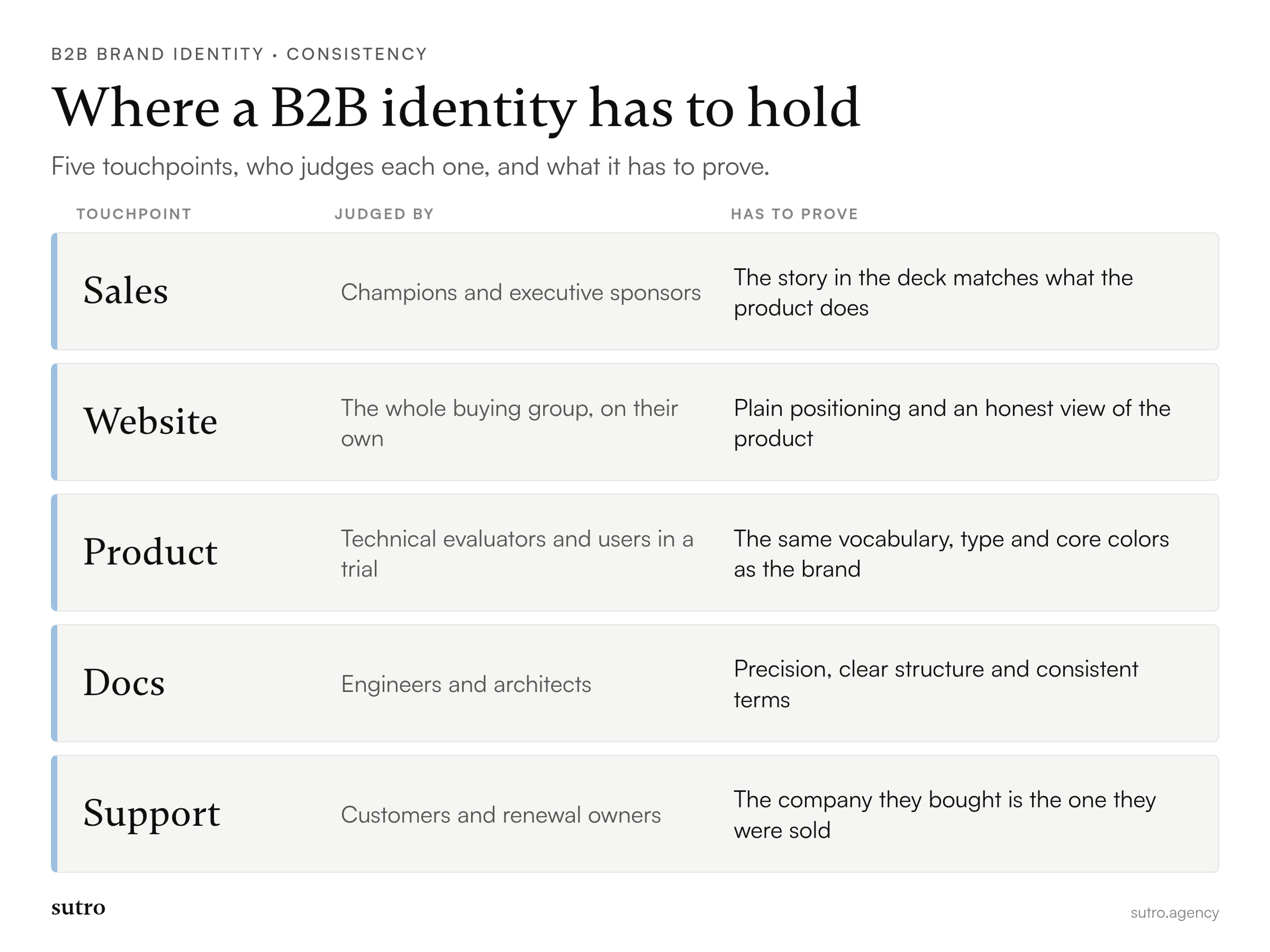
A B2B identity works only if it stays consistent across the five places a buyer evaluates you: sales conversations, the website, the product, the documentation and support. Buyers move between these constantly, and each switch is a chance for the story to change.
- Sales. Decks, one-pagers, proposals and follow-up emails are often the first long-form exposure a buyer gets. If reps build their own slides because the official ones do not answer real questions, the identity has already split.
- Website. The site is where most of the buying group checks you out on their own. It has to state the positioning plainly and show the product honestly.
- Product. Many buyers now try before they commit. Forrester's State of Business Buying 2026 found that more than 60% of business buyers now use some form of trial to evaluate a solution. That makes the product interface part of your brand identity, whether or not the brand team treats it that way.
- Docs. For technical buyers, documentation is often the most trusted page you publish. Typography, structure, terminology and code formatting there say as much about your standards as the homepage does.
- Support. The help center, onboarding emails and renewal reviews are where customers decide whether the company they bought matches the company they were sold.
Keeping all five aligned is mostly an operational problem, not a creative one. One practical help is to put core visual values, such as color and type, in a shared format that both designers and engineers pull from. The Design Tokens Community Group published a stable format for exchanging design tokens between tools in October 2025, which makes it easier for marketing and product to use the same source.
Why the buying committee changes what identity must do
In B2B, the identity has to earn trust from a group, not persuade one person. The same Forrester report says a typical buying decision now involves 13 internal stakeholders and nine external influencers, and that procurement acts as a decision-maker in 53% of buying cycles. Each of those people meets a different part of your identity and judges it for a different risk.
- Technical evaluators read the docs, try the product and look at your architecture diagrams. They want precision and are allergic to marketing language that does not match what they see.
- Executive sponsors look at positioning, the narrative and overall coherence. They want to know you will still be a sound choice in three years.
- Champions have to retell your story internally when you are not in the room. They need clear language and materials they can forward without editing.
- Procurement and legal see proposals, security questionnaires and contracts. Sloppy late-stage documents raise doubts at the worst possible moment.
The practical consequence is that a B2B identity has to give each role what it needs while still sounding and looking like one company. That is why I treat the champion's forwarded deck and the security questionnaire as identity work, not admin.
How B2B brand identity differs from B2C
B2B identity is built to reduce risk for a group over months; B2C identity is usually built to win a single person's choice in a moment. The components look similar on paper, but they do different jobs.
- Audience. A consumer identity can be tuned to one buyer. A B2B identity has to work for an engineer, a CFO and a procurement lead at the same time.
- Time. Consumer brands often have seconds. B2B buyers spend weeks or months with your materials, so inconsistencies have time to surface.
- Proof over mood. Emotion matters in B2B too, but it comes from confidence: clarity, competence and evidence. Atmosphere without proof reads as a warning sign.
- Density. B2B identities have to carry diagrams, data, documentation and long proposals. A system designed only for ads and packaging breaks quickly in those contexts.
- Many authors. In B2B, sales engineers, product managers and support staff produce a large share of what buyers read. The identity must be usable by people who are not designers or copywriters.
How to tell whether your identity is working
Your identity is working when buyers can describe what you do in your words and your materials look like one company across every touchpoint. These are the signs that it is not:
- Sales reps build their own decks because the official ones do not answer the questions buyers ask.
- The website and the product use different names for the same features.
- Prospects spend first calls asking what the product actually does instead of whether it fits.
- With the logo removed, your website could pass for a direct competitor's.
- Documentation and support pages look like they belong to a different company.
- New hires explain the company differently depending on which team onboarded them.
One or two of these can be fixed with tighter guidelines and a shared vocabulary. If most of them apply, the problem sits in the strategic core, and the fix is a proper development effort. I have written up the stages and timeline of a brand development project separately, so I will not repeat them here.
Common B2B brand identity mistakes
The most common mistakes come from treating identity as a design deliverable rather than a system the whole company uses.
Treating a new logo as a new identity
A new mark on top of the same unclear messaging, old sales deck and inconsistent docs changes very little for buyers. They notice the confusion more than the mark.
Designing for internal taste
Founders and executives often choose colors, typefaces and tone based on what they like. The right question is what earns trust from the people who sign, use and approve the purchase. Taste is a reasonable tiebreaker, not a strategy.
Putting decoration ahead of clarity
Abstract graphics and heavy animation can make a technical product harder to understand. If a buyer cannot tell what the product does and how it fits their stack, the visual style is working against you.
Building language and visuals separately
When copy and design are produced by different teams on different timelines, the result reads like two brands stitched together. Words and visuals should be developed together so each reinforces the other.
Stopping at the marketing site
This is the mistake I see most. The identity gets applied to the website and the launch deck, then stops. The product, the docs, the proposal template and the support center keep their old look and vocabulary. Buyers who move from a polished site into an inconsistent product start to wonder which version of the company is real.
Writing guidelines nobody can use
A long PDF that only designers open will not keep a sales engineer or support lead on brand. Guidelines should include ready-to-use templates, the shared vocabulary and plain examples of what to do and what to avoid.
Conclusion
A B2B brand identity is everything that makes your company recognizable and credible to a buying group: a clear strategic core, precise language, a visual system that works in dense technical contexts, and an experience that stays consistent from the first sales call to the support desk. The logo matters, but it is the signature, not the substance.
If your website, sales deck and product currently look like three different companies, start by finding where the story breaks first. Tell us which touchpoint feels least like you, and we can talk through what to fix first.
Questions
- What is the difference between brand identity and brand image?
- Brand identity is what you decide and control: your positioning, language, design and the experience you build. Brand image is what buyers actually believe about you after meeting all of it. A consistent identity is the most reliable way to move your image where you want it.
- Are brand guidelines the same as brand identity?
- No. Guidelines are the documentation that explains how to apply the identity. The identity is the set of decisions behind them. A company can have thick guidelines and a weak identity if the strategic core is unclear or the guidelines only cover the logo and colors.
- Does the product interface belong to the brand identity?
- Yes. Many B2B buyers try the product before they buy, so the interface, its terminology and its onboarding are part of how they judge the company. The product does not have to mirror the marketing site, but it should share the vocabulary, type and core colors.
- How do I know if we need a new identity or just better consistency?
- If buyers understand what you do and the main problem is that teams apply the brand differently, better templates, a shared vocabulary and tighter guidelines usually fix it. If prospects are confused about what you do or who you serve, the strategic core needs work first.
- Who should own brand identity in a B2B company?
- The CEO or founder should own the strategic decisions behind it, such as positioning and the core narrative. Marketing usually owns the identity day to day, but product, sales and support leaders need a clear role, because they produce much of what buyers actually see.