Strategy
Why Brand Image Matters in B2B Purchase Decisions
Brand image matters in B2B because buyers rank a favorite before they talk to sales. See how perception forms, where it decides deals, and how to find your gap.
Key takeaways
- Brand image is what buyers believe about your company; brand identity is what you decide and control, and image is the result of it.
- In 6sense's 2025 research, 94% of B2B buyers ranked their shortlist before contacting any seller, so image often decides who gets the first call.
- In Gartner's 2017 Digital B2B Buyer Survey, buyers spent only 17% of their buying time with potential suppliers, which leaves most of the decision to what they already believe.
- Brand image enters a deal at specific moments: the day-one shortlist, committee members you never meet, security and procurement review, pricing and reference calls.
- Find your identity-to-image gap by comparing the words you want buyers to use with the words they actually use, then fix the touchpoints that cause the mismatch.
Brand image importance in B2B comes from buyers ranking a favorite before they talk to sales: 94% rank their shortlist before first contact, per 6sense research. Brand image is what those buyers believe about your company. It is built from what they have seen, heard and tried, and it decides who gets the first call.
That belief does most of its work in rooms you never enter. By the time a prospect books a demo, the buying group has usually agreed on a preferred vendor, and the sales process mostly confirms or breaks that early view. For a technical B2B company, the practical question is not whether brand image matters. It is whether the image buyers hold matches the company you have become.
Closing that gap is most of what our B2B brand strategy team works on, usually when a company is moving upmarket, entering a new category or preparing for a raise. This article explains what brand image is, why it weighs more in B2B than people expect, where it enters a purchase decision, and a simple method to find the gap between the identity you intend and the image buyers hold.
What brand image means in simple words
Brand image is the overall impression buyers have of your company: what comes to mind when they hear your name. Amazon Ads defines it as the overall impression customers have of a business, including its reputation and the perceived reliability of what it sells. In B2B, that impression is usually a short list of words, such as "solid but slow", "built for startups" or "the safe enterprise choice".
Three terms get mixed up, and the difference matters for what you can change:
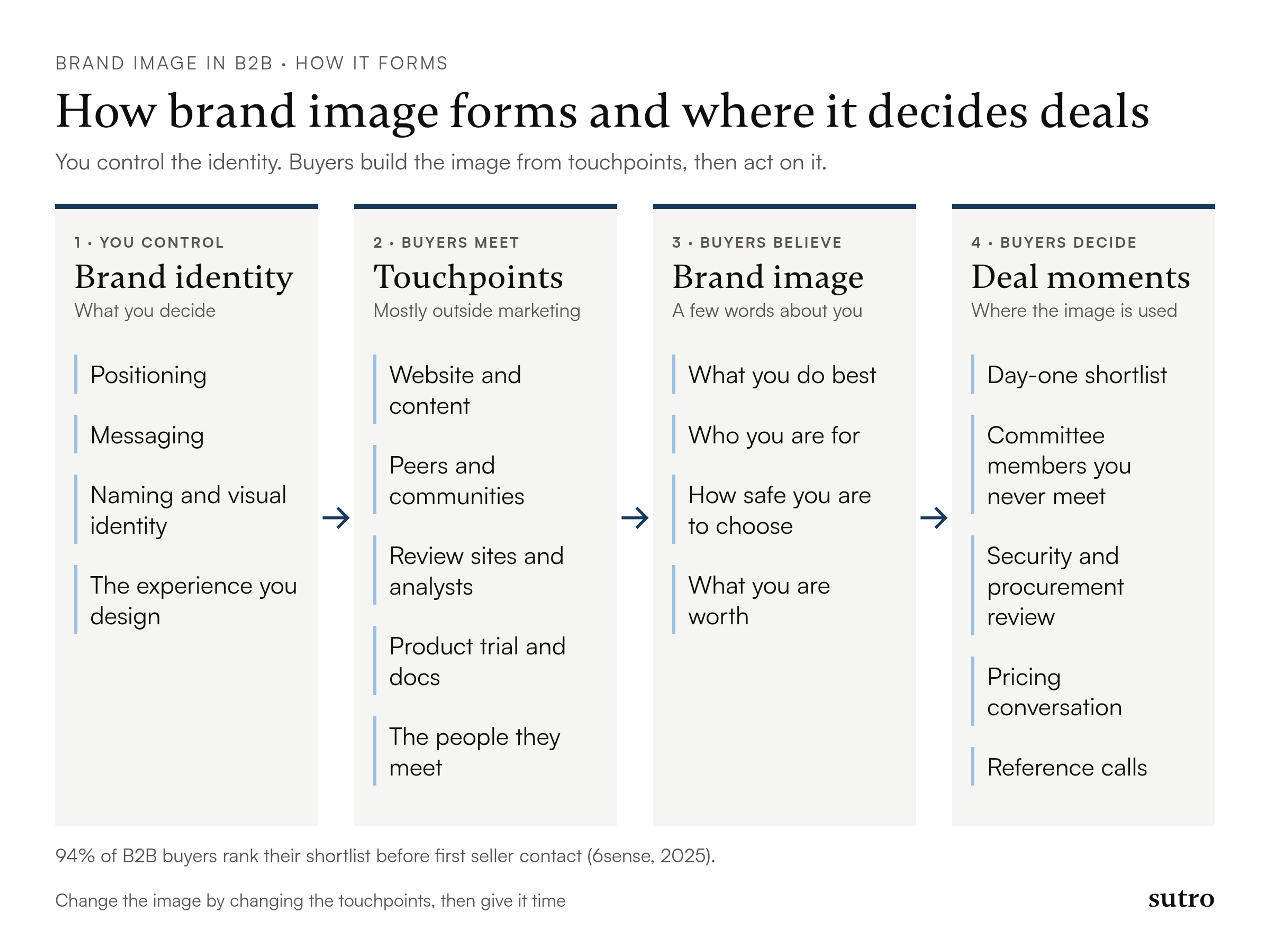
- Brand identity is what you decide and control: positioning, messaging, naming, visual design and the experience you build.
- Brand image is what buyers believe after meeting all of it. Identity is the input. Image is the result.
- Reputation is the track record behind the image: what you have actually delivered, and what people say about it.
You own your identity. The market owns your image. You can only move the image by changing what buyers see, hear and experience, and by giving it time.
Why brand image carries more weight in B2B purchases
Brand image weighs more in B2B because the purchase is risky for the person who recommends it, and most of the evaluation happens without you. A consumer who picks the wrong headphones loses some money. A VP of Engineering who picks the wrong data platform can lose a year of roadmap and some credibility inside the company.
People reduce that risk with shortcuts, and a vendor's image is one of the strongest. A known, respected name is easier to defend in a meeting than a better product nobody has heard of. The champion borrows credibility from your image when they put your name forward.
The structure of B2B buying makes this stronger:
- Buyers spend little time with vendors. Gartner's 2017 Digital B2B Buyer Survey found that B2B buyers spend only 17% of their buying time meeting potential suppliers. When they compare several vendors, any one sales team may get 5% to 6% of that time.
- Decisions are made by groups. The same Gartner survey puts the median buying group at six to 10 decision makers, each with their own research.
- Preference forms early. 6sense's 2025 buyer research found that first seller contact typically happens two-thirds of the way through the journey, and that buyers who ranked their shortlist bought from the first vendor they spoke with 84% of the time.
Put together, the image buyers bring into the process is often the deciding factor, because so little of the process involves you.
Where brand image enters a B2B purchase decision
Brand image shows up at specific moments in a deal, and each one has a different audience. Treating it as one vague "awareness" problem hides where it actually costs you.
The day-one shortlist
When a team realizes it needs a new tool, it starts with names it already knows. 6sense reports that four of the five vendors on an evaluation list are identified at the start of the journey. If buyers do not already associate you with the problem, you are not on the list, and no sales process can fix that.
The committee member you never meet
Your champion may love the product, but the CFO or the head of security often forms a view from your website, a few reviews and what a peer said. They spend minutes, not hours. If what they find reads as "small tool for small teams", they can stall the deal without ever talking to you.
The security and procurement review
Security and procurement teams look for reasons to slow down. An image of a mature, careful company makes them read your documentation with less suspicion. An image of a young or chaotic one invites extra questions, longer questionnaires and more legal review.
The pricing conversation
Perception sets the reference price. If buyers see you as the specialist for their problem, a premium price looks reasonable. If they see you as one of several similar vendors, the first move is a discount request, often before they have seen what makes you different.
The reference call
Late in a deal, prospects call your customers. What those customers say is filtered through their own image of you. A customer who sees you as a reliable partner describes a bug as a fixed issue. One who sees you as a struggling vendor describes the same bug as a pattern.
The wider commercial case, from shortlists to renewals, is covered in how branding pays off in long, multi-stakeholder sales cycles. Here the point is narrower: in each of these moments, the buyer is acting on a belief about you that formed before the meeting.
How brand image forms in the B2B buyer journey
Brand image forms from every encounter a buyer has with your company, and most of those encounters are not created by marketing. A new logo does not change it. Repeated, consistent evidence does.
6sense found that before first seller contact, buyers had spent roughly eight months researching, had a dozen or more content interactions with each vendor, talked with peers, and in over 70% of cases engaged third-party experts such as analysts or consultants. Those are the inputs:
- Your website and content. Buyers look for a clear statement of what you do, who it is for and how it fits their stack. Vague category language reads as a company that has not decided what it is.
- Peers and communities. A comment in a private Slack group or a forum thread can shape the view of many silent readers.
- Review sites and analysts. Buyers read the negative reviews to find where a product breaks. How you respond to them is part of the image too.
- The product and the documentation. For technical buyers, a trial and the docs are the most direct evidence. A polished site that leads to a confusing sandbox teaches buyers to distrust the site.
- The people they meet. Sales engineers, support and founders on stage all add to the picture. A pushy sales process can make a modern product feel like a legacy vendor.
This is why image usually lags behind reality. A company that has rebuilt its product for enterprise customers can still be seen as the startup tool it was three years ago, because peers, reviews and old content still describe that version.
The identity-to-image gap: how to find yours
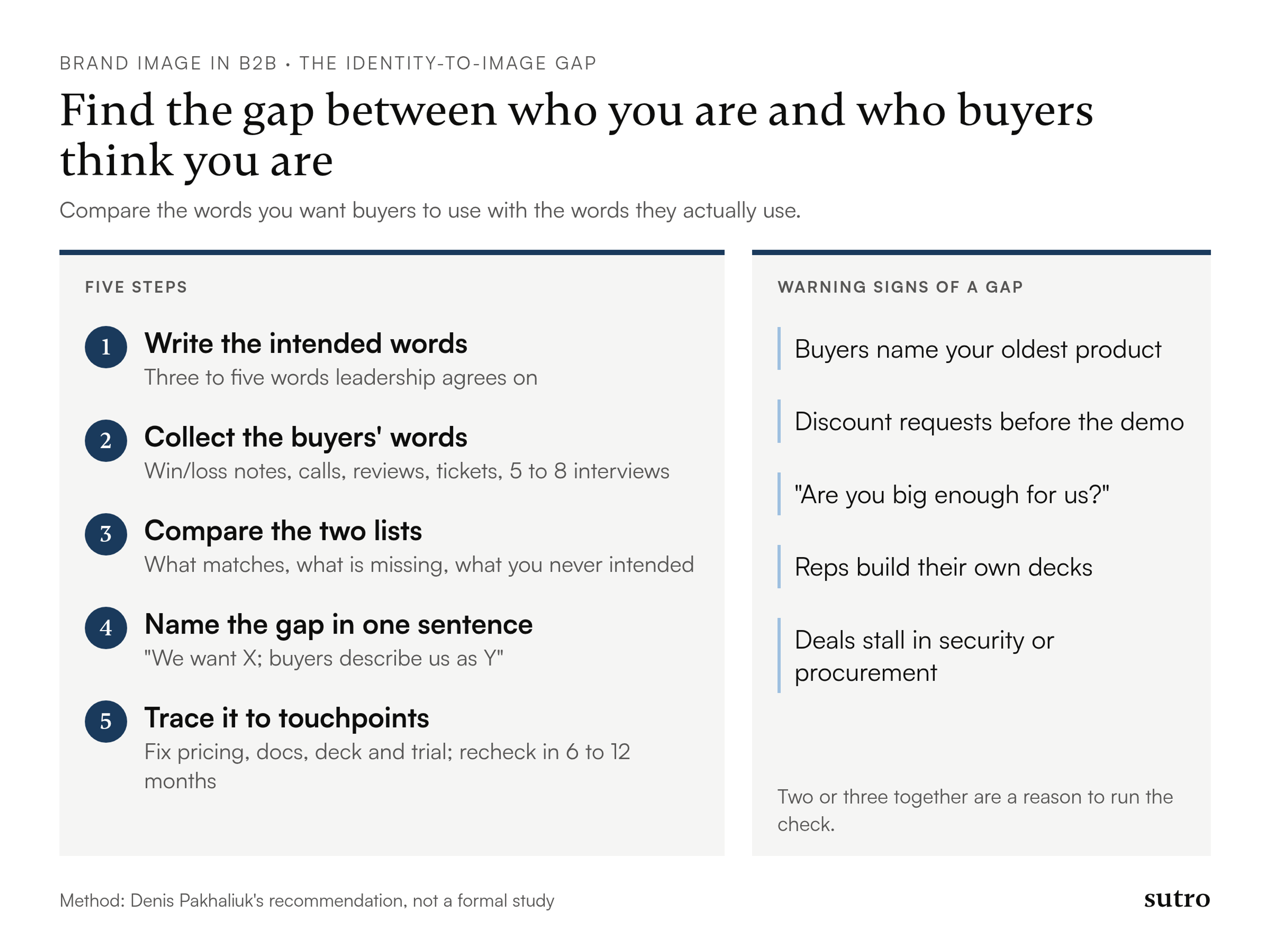
The identity-to-image gap is the distance between the words you want buyers to use about you and the words they actually use. This five-step check is my recommendation for a first pass. It is a working method, not a formal study, and it fits in a few weeks.
- Write the intended words. Leadership agrees on three to five words or short phrases buyers should use about the company, for example "enterprise-ready" or "easy for data teams to adopt". If leaders cannot agree, that is the first finding.
- Collect the words buyers actually use. Pull exact phrases from win/loss notes, sales call recordings, review sites, support tickets and five to eight short interviews with recent customers and lost deals. Keep their wording, not your summary of it.
- Compare the two lists. Put them side by side and mark what matches, what is missing and what is there that you never intended.
- Name the gap in one sentence. For example: "We want to be seen as enterprise-ready; buyers describe us as affordable and quick to start." A named gap is easier to act on than a general feeling that the brand is off.
- Trace it to touchpoints. For each mismatch, find the touchpoints that teach buyers the wrong word: pricing page, docs, sales deck, review responses, the first five minutes of the trial. Fix those first, then check the words again in six to twelve months.
If you want more rigor than a first pass, our guide to research methods that show how buyers see you covers sampling across buying roles, neutral interview questions and how to read small samples.
Warning signs of a gap
You can often see a gap in the sales process before you measure it:
- Buyers describe you by your oldest product, not the platform you built since.
- Prospects ask for a discount before they have seen the product.
- Enterprise buyers ask whether you are "big enough" for them, even when you are.
- Sales reps build their own decks because the official ones do not land.
- Deals stall in security or procurement more often than in technical evaluation.
None of these proves a perception problem on its own. Two or three together are a strong reason to run the check.
Illustrative example: a perception readout for a fictional company
Here is how the check might look for Corvane, a fictional company that sells data pipeline software and wants to move from mid-market teams to enterprise data platforms. Corvane and all its data are invented to show the method.
Corvane's leadership picks three intended words: "enterprise-ready", "reliable at scale" and "governed". The team then reads a quarter of call notes and reviews and runs six interviews. The words buyers repeat are different: "affordable", "fast to set up" and "great for small teams", with "hard to audit" appearing in two lost-deal interviews.
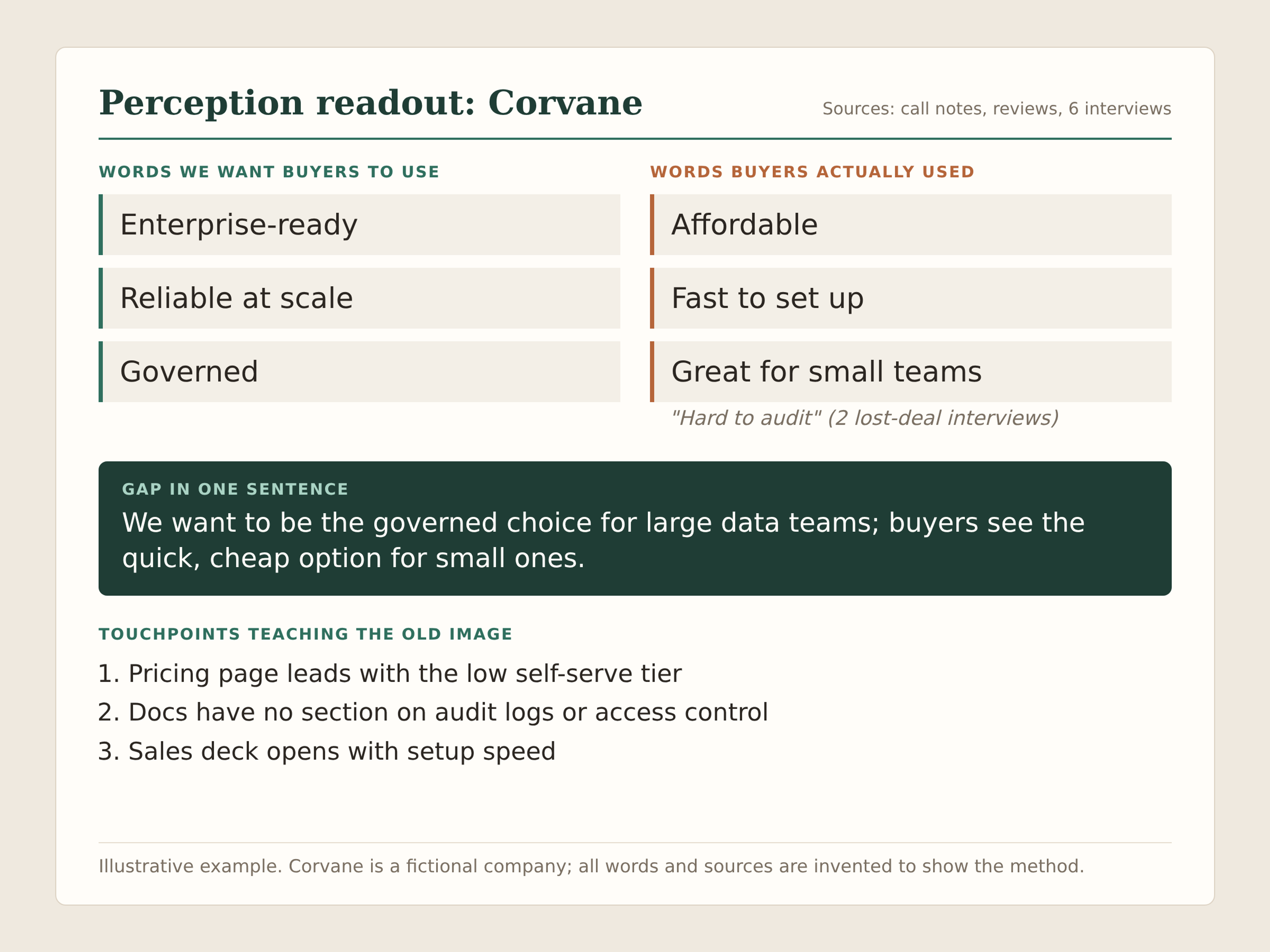
The gap in one sentence: Corvane wants to be seen as the governed choice for large data teams, and buyers see it as the quick, cheap option for small ones. The useful part is the trace. The pricing page leads with a low self-serve tier. The docs have no section on audit logs or access control. The sales deck opens with setup speed. None of that is wrong, but all of it teaches buyers the old image.
In a typical project, the fixes would start with those touchpoints rather than the logo: an enterprise section in the docs, a pricing page that leads with the plan enterprise buyers need, and a deck that opens with governance. The words buyers use would then be checked again after a few quarters, because image moves slowly.
What a strong B2B brand image looks like
A strong B2B brand image is specific, shared and true. Specific means buyers can say what you are best at in a few words. Shared means the engineer, the CFO and the procurement lead describe you in similar terms. True means the product, the docs and the people confirm what the website says.
A weak image is usually not negative. It is vague ("one of the data tools"), split (engineers love you, finance has never heard of you) or outdated (accurate three years ago). Each needs a different fix: a sharper position for vague, more consistent presence across roles for split, and changed touchpoints plus time for outdated.
Common mistakes when working on brand image
- Starting with the visual identity. A redesign changes how you look, not what buyers believe about your product, price or support. Change the evidence first.
- Asking only happy customers. They confirm the image you want. Lost deals and noncustomers show the image you have.
- Ignoring the product. If the trial or the docs contradict the website, buyers believe the trial.
- Copying the category leader. If the leader owns "the safe choice", saying the same thing gives buyers no reason to switch.
- Expecting quick results. Image is built from many encounters over months. Measure the gap again in six to twelve months, not after one campaign.
Conclusion
Brand image matters in B2B purchase decisions because buyers form a preference long before they meet you, and that preference usually wins. You cannot control the image directly, but you can control the identity and the touchpoints that shape it. Write down the words you want, collect the words buyers use, name the gap and fix the touchpoints that cause it.
If buyers still describe the company you were rather than the one you are, book a call and tell us where the gap shows up.
Questions
- What is brand image in simple words?
- Brand image is what people think of when they hear your company's name. In B2B, it is usually a few words a buyer would use to describe you to a colleague, such as "reliable but expensive" or "great for startups".
- What is an example of a brand image?
- A data software company may describe itself as enterprise-ready while buyers call it "cheap and quick to set up". The buyers' words are its brand image. That mismatch is an identity-to-image gap, and it often shows up as stalled enterprise deals.
- What are the 5 C's of branding?
- There is no single standard list. Different authors use different sets, often including clarity, consistency, credibility, connection and content. For a technical B2B company, clarity comes first: if buyers cannot tell what you do and who it is for, consistency only repeats the confusion.
- What is the 3-7-27 rule in branding?
- It is an informal marketing rule of thumb. One common version says a brand gets about 3 seconds to make a first impression, needs about 7 exposures to be remembered and about 27 to build trust. Versions vary and there is no authoritative research behind the exact numbers. The useful idea is that image builds through repeated, consistent encounters.
- How do you measure brand image in B2B?
- Collect the exact words buyers use about you from win/loss notes, call recordings, review sites and short interviews with customers and lost deals, then compare them with the words you want. For tracking over time, repeat the same questions every six to twelve months.