Go-to-market
B2B Brand Awareness: How to Build It and Measure It
B2B brand awareness is being recalled by the right buyers when a need appears. How to build it across target accounts and buying committees, and how to read it.
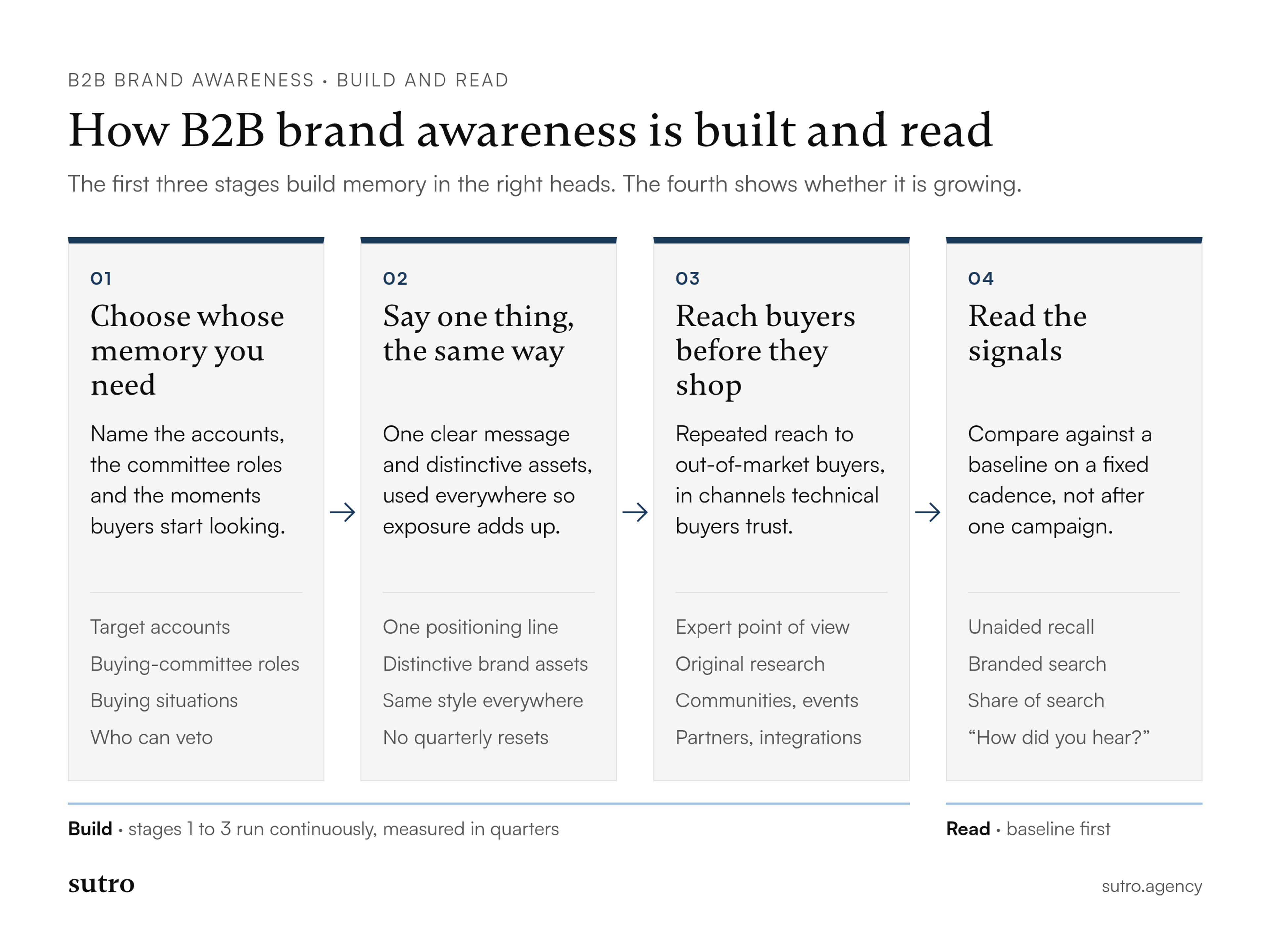
Key takeaways
- B2B brand awareness is unprompted recall and recognition inside your target accounts and across the whole buying committee, not mass reach.
- Recall gets you onto the first list, and recognition makes the rest of the committee comfortable when your name appears.
- Build awareness by choosing whose memory you need, repeating one message with distinctive assets, and reaching buyers before they are in market.
- Link your brand to the specific buying situations in which buyers start looking, because those moments decide who comes to mind.
- Measure with a short scorecard (unaided recall, aided recognition, branded search, share of search and "how did you hear about us"), starting from a baseline.
B2B brand awareness is the degree to which the people in your target accounts think of you, unprompted, when the problem you solve comes up, and recognize your name when it lands on a shortlist. You build it in three moves: decide whose memory you need, say one clear thing with assets people can spot every time, and keep reaching those buyers long before they start shopping.
When I checked Google's top five results for "b2b brand awareness" on November 12, 2026, three of them were Reddit threads where marketers were asking each other where to start. That matches what I hear from founders and marketing leads. Most agree awareness matters. Few can say whose awareness they need, or how they would know it is growing.
When I approach this work as a tech company branding agency, the first question is never "how do we get more impressions." It is "which people, in which accounts, need to remember us, and in which situations." I founded Sutro to work with technical B2B companies between Series A and pre-IPO, and I am also the founder and CEO of Ramotion, which has been in the industry since 2009 and has completed 350+ projects. This guide reflects how I approach awareness for technical companies: mostly how to build it, then a short scorecard for reading it.
What B2B brand awareness actually means
In B2B, brand awareness means memory inside a defined set of accounts and across the whole buying group, not reach across a mass audience. A company with a few thousand target accounts does not need the general public to know its name. It needs the people who will sign, evaluate, use and approve the product to know it.
That group is larger than most teams plan for. Forrester reports that today's B2B purchases involve an average of 22 stakeholders: 13 internal buying group members and nine external buying network members. If only your champion knows you, your awareness is one person deep.
Recognition versus recall
Recognition is aided awareness: the buyer knows your name when they see it. Recall is unaided awareness: the buyer names you when someone asks "who does this?" Both matter, at different moments.
Recall decides whether you make the first list. Recognition decides whether the rest of the committee feels safe when your name appears on a list someone else built. A security reviewer who has never heard of you starts from suspicion. One who has seen your name in a talk, an integration directory and a colleague's message starts from neutral, which is all you need.
Mental availability and buying situations
The Ehrenberg-Bass Institute frames this as mental availability, which it defines as "being easily thought of in buying situations." In its report on category entry points in B2B, Jenni Romaniuk describes category entry points as the cues buyers use to search their memory when a buying situation appears, and notes that these cues shape which brands form the initial "go to" list.
For a technical B2B company, those cues are concrete. "Our cloud bill doubled this quarter." "We failed part of an audit." "The data team can't trust the dashboards." Awareness that is linked to those moments is worth far more than awareness of the logo alone.
A quick note on scope: awareness is only the first layer of brand equity. Equity adds what people believe about you and whether they prefer you. This article stays with the first layer.
Why familiarity matters so much to B2B buyers
Familiarity matters in B2B because buying is a group decision made under career risk, over a long cycle. A known name is easier to defend in a meeting, easier to pass through procurement and easier to remember six months after the first touch.
I see three B2B realities shape awareness work again and again:
- Credibility is borrowed before it is earned. Before a trial or a reference call, the committee judges you by whether credible people and places already know you.
- Cycles are long. Memory has to survive months between a first impression and a buying situation, so one campaign rarely carries it.
- Stakeholders differ. A CFO, a staff engineer and an IT admin remember different things for different reasons. One message must stay consistent while the proof changes by role.
How to build B2B brand awareness in four steps
The short answer to "how do you build brand awareness in B2B" is: choose whose memory you need, give them one message and a set of distinctive assets, reach them repeatedly before they are in market, and keep doing it long enough for the memory to stick. Each step below fixes a failure I see often.
1. Decide whose memory you need
Start with a written list, not a persona deck. Name the account segment you want to win, the roles inside those accounts that touch the decision, and the three to five buying situations in which you want to be the first name that comes up.
The buying situations matter most. "Mid-market fintech" is a segment. "We just hired our first platform team and need to stop building internal tooling" is a situation a buyer actually walks into. If you cannot write your situations in the buyer's own words, talk to buyers first. I usually recommend a buyer perception study with unaided questions first, because it shows which names come up before you prompt with yours.
2. Say one thing, with assets people can spot
Exposure only adds up if buyers can tell it is the same company each time. That needs one clear positioning line you repeat for years, and a small set of distinctive brand assets: a color system, a type style, a diagram style, a recurring format or phrase that is yours.
Technical companies often undercut themselves here. Every launch gets a new tagline, every conference gets a new booth look, and the founder's talks use a third set of words. Each piece may be good. Together they produce three faint memories instead of one strong one. Pick the line and the assets, then protect them from well-meaning variation.
3. Reach buyers before they are in market
B2B contracts usually run for a year or more, so most accounts on your list are not shopping in any given quarter. Awareness work has to reach people who will not reply yet. That is the job of brand building, as opposed to activation, which targets buyers who are ready now.
Les Binet and Peter Field's analysis of B2B cases in the IPA databank, as summarized by Marketing Week, found that B2B marketers should on average invest 46% of spend in brand and 54% in sales activation, with brands in their first year investing about 35% in brand building and leader brands about 72%. Treat those as directional averages, not a formula for your budget.
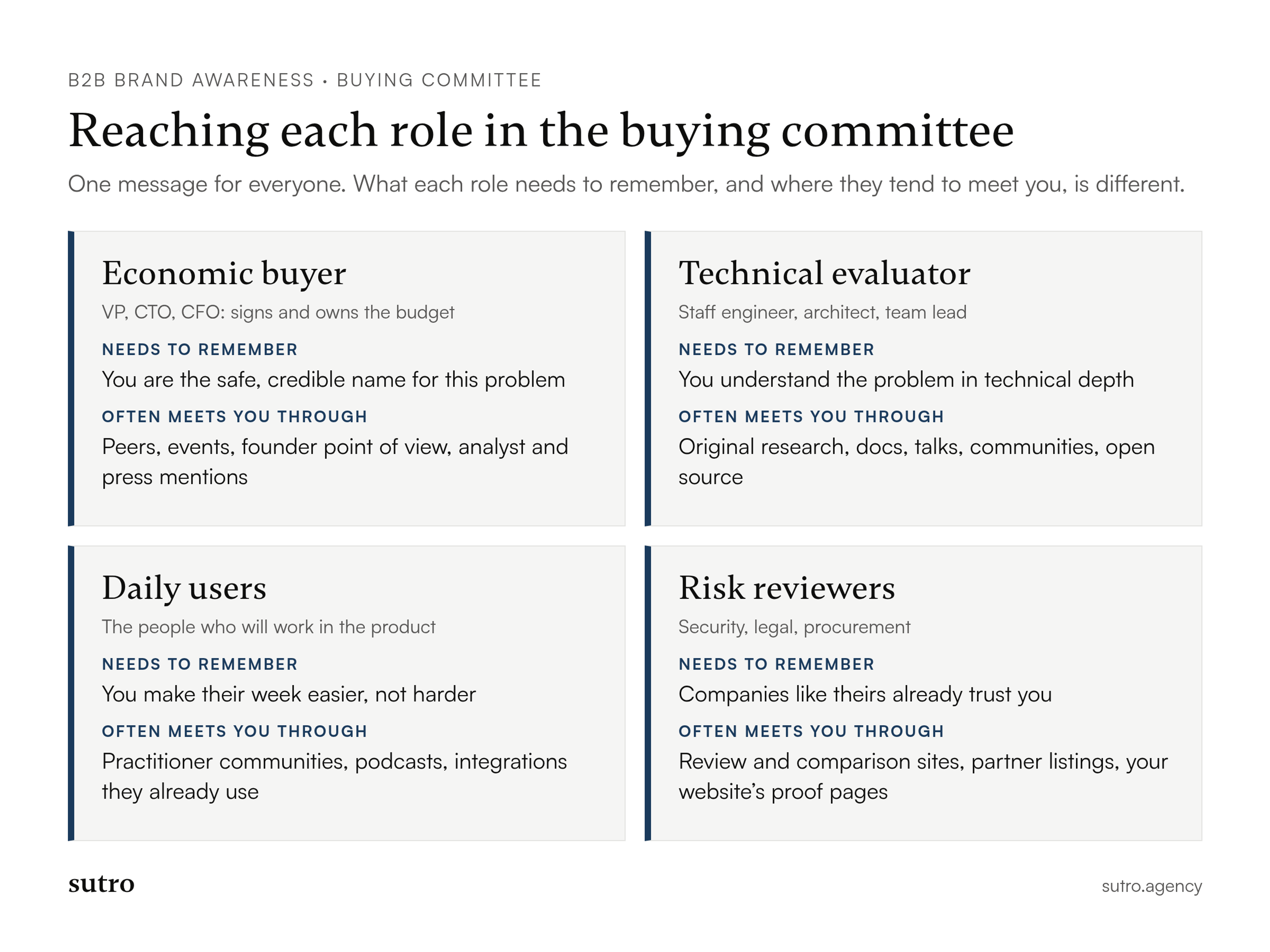
The channels that build memory with technical buyers tend to be the ones where they already learn:
- Founder and expert point of view: talks, essays and posts that take a clear position on the buying situations you chose.
- Original data or research: a recurring benchmark or report that engineers and operators cite to each other.
- Communities: the Slack groups, forums and open-source spaces where practitioners ask for recommendations.
- Podcasts and events: fewer, better appearances in front of the exact roles on your list.
- Partners and integrations: listings and co-marketing with tools your buyers already trust.
- Review and comparison sites: where risk reviewers check whether peers use you.
- Your website as proof: the place every stakeholder lands to confirm what they heard.
4. Stay consistent long enough for it to compound
Consistency and frequency beat bursts. A launch campaign that disappears after six weeks leaves a short memory. The same message, in the same style, showing up every week in the right places, leaves a lasting one.
Expect the signals to move in order. Branded search and "a colleague mentioned you" answers react first, because a few engaged people are enough to move them. Unaided recall across target accounts moves last, because it needs repeated exposure among many people who are not buying yet. Plan budgets and patience in quarters, not weeks, and judge recall on a yearly view.
What about the rule of 7?
The "rule of 7" is an advertising rule of thumb that says a buyer needs to see your message about seven times before acting. I have not found research that supports seven as a specific number for B2B. The broader idea, called effective frequency, is genuinely contested: the Wikipedia overview of the concept notes that Thomas Smith's 1885 guide Successful Advertising described twenty exposures, while Herbert Krugman at General Electric argued that three may be enough. The useful part of the rule is the direction: one touch is not enough, and repetition across the whole committee is the work.
How to measure B2B brand awareness: a short scorecard
Measure B2B brand awareness by setting a baseline before you start, then reading the same few signals on a fixed cadence. Use signals that reflect memory among target buyers, not reach. I use five, and I keep this to awareness only; the full method for proving what brand work returns is a separate topic.
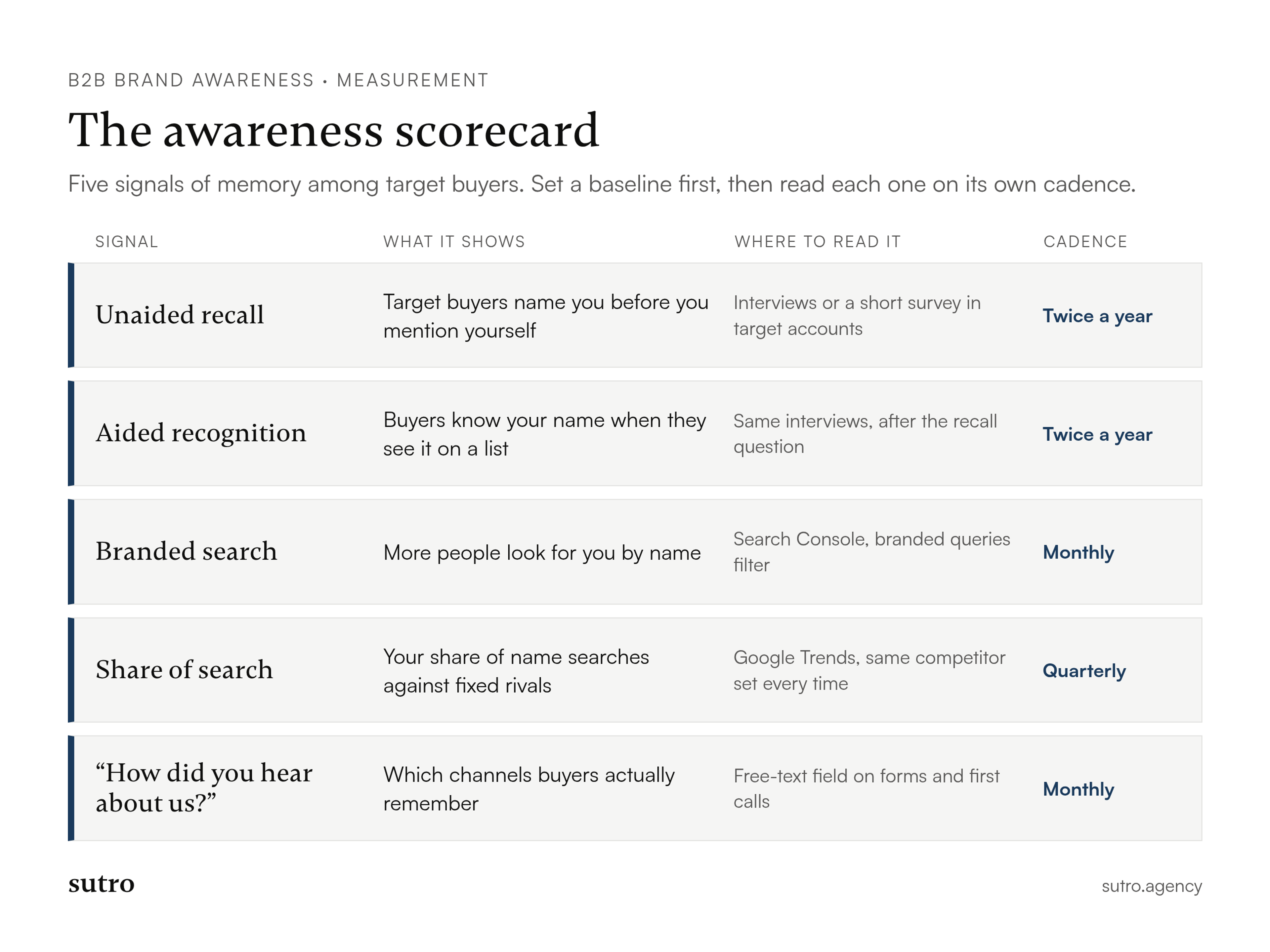
- Unaided recall among target buyers. In interviews or a short survey with people from target accounts, ask "which companies come to mind for this problem?" before you mention yours. Read it twice a year.
- Aided recognition. Then show a list of names and ask which they know. Read it with the recall question.
- Branded search. Search Console's Performance report can now separate branded from non-branded queries. Search Engine Journal's summary notes the filter is available to all eligible sites, not to sites with a low number of impressions. Read it monthly.
- Share of search. Your branded search volume as a share of the total for you and a fixed set of competitors. Keep the set fixed, or the trend means nothing. Read it quarterly.
- Self-reported attribution. A free-text "How did you hear about us?" field on demo and contact forms, and the same question asked on first calls. Read it monthly and tag the answers.
Set the baseline in the first two to three weeks. Without it, every later number is just a number.
A worked example: a fictional 90-day awareness plan
This is a fictional example, built to show the method. The company, numbers and channels are invented for illustration and are not a client.
The company: a data observability platform at roughly $30M ARR, selling to mid-market and enterprise data teams. The target list is 1,500 accounts. The roles: head of data engineering (technical evaluator), VP of data or CTO (economic buyer), analytics engineers (users), and security and procurement (risk reviewers). The buying situations it wants to own: "the CFO stopped trusting the dashboards," "a pipeline broke and nobody noticed for days," and "we're moving warehouses."
Weeks 1 to 3, baseline:
- 20 short interviews with people in target accounts. In this fictional case, 3 of 20 named the company unprompted and 9 of 20 recognized it from a list.
- Search Console branded clicks for the last 90 days, recorded as the starting line.
- Share of search against three fixed competitors, using Google Trends, recorded the same way.
- A free-text "How did you hear about us?" field added to the demo form.
Weeks 4 to 12, build:
- One positioning line tied to the three buying situations, used on the site, in sales decks and in every talk.
- One diagram style and color system applied to every chart the company publishes.
- A monthly founder essay on one buying situation, published on the site and in two practitioner communities.
- One original dataset on pipeline incidents, released as a short report.
- Two talks at events where data engineering leads attend, and one integration listing with a warehouse partner.
Day 90, first read: branded search and the "how did you hear" answers are read for direction only. The interview round is repeated at month six and month twelve, with the same questions and the same roles. Nobody calls the plan a success or a failure at day 90.
Common mistakes that waste awareness budgets
The most expensive awareness mistakes come from measuring the wrong thing or changing course too early.
- Chasing impressions and followers. Big reach numbers among people who will never buy look good in a report and do nothing for recall in target accounts.
- Building awareness among the wrong audience. Developers love the brand, but the security and finance reviewers have never heard of it. The committee is only as aware as its least aware member with a veto.
- Changing the message every quarter. Each new campaign resets memory. Buyers can't remember a company that keeps introducing itself differently.
- Measuring too early. Judging recall after six weeks almost guarantees the program gets cut right before it would have started to work.
A quick self-check
Before you spend more on awareness, try answering these five questions honestly:
- Can you name the accounts and the roles whose memory you need?
- Can you write the three buying situations you want to own in the buyer's own words?
- Would a technical evaluator recognize your content without seeing the logo?
- Has your positioning line stayed the same for at least two quarters?
- Do you have a baseline for recall, branded search and "how did you hear about us"?
If two or more answers are no, fix those before adding channels.
Conclusion
B2B brand awareness is memory in the right heads: the whole buying committee in the accounts you want, linked to the moments they start looking. Build it by choosing those people and situations, repeating one message with distinctive assets, and reaching buyers well before they are in market. Set a baseline, read a short scorecard on a steady cadence, and give it the quarters it needs. If you want a second opinion on where your awareness stands, tell us which buyers still don't know your name.
Questions
- How do you build brand awareness in B2B?
- Start by naming the accounts, committee roles and buying situations whose memory you need. Then repeat one clear positioning line with distinctive brand assets everywhere you show up, and reach those buyers through channels they already trust, such as expert content, original research, communities, events and partner listings. Keep it consistent for several quarters before judging recall.
- What is the rule of 7 in B2B?
- It is an old advertising rule of thumb that a buyer needs to see a message about seven times before acting. There is no research I know of that supports seven as a specific number for B2B, and the wider idea of effective frequency is contested. The practical lesson is that single touches don't build memory, especially across a committee.
- How long does it take to build B2B brand awareness?
- Longer than most teams budget for. Branded search and "a colleague mentioned you" answers tend to move first, while unaided recall among target buyers moves last because it needs repeated exposure across many people who are not buying yet. Plan in quarters, judge recall on a yearly view, and keep a baseline so you can see the change.
- Should B2B awareness target the whole market or only target accounts?
- For most technical B2B companies, start with the target accounts and the roles inside them, because that is where memory turns into pipeline. As the company grows, widen to the full category so the next generation of buyers already knows you. Awareness among people who will never buy is the least valuable kind.
- Does brand awareness still matter if we sell through outbound or account-based marketing?
- Yes. Outbound and account-based programs work better when the people they reach already recognize the name, because a familiar sender gets more replies and less suspicion from risk reviewers. Awareness work and account-based selling target the same list, at different moments.
Sources
- Forrester, "A B2B CMO's Imperative To Drive Growth: Champion Revenue Process Transformation" (22 stakeholders, 13 internal, nine external)
- Ehrenberg-Bass Institute, Jenni Romaniuk, "Category Entry Points in a Business-to-Business (B2B) world" (July 2022)
- Marketing Week, "Effectiveness in B2B, online sales, activist teens: 5 killer stats to start your week" (Binet and Field B2B budget split)
- Wikipedia, "Frequency (marketing)": effective frequency, Thomas Smith and Herbert Krugman
- Search Engine Journal, Roger Montti, "Google Answers Questions About Search Console's Branded Queries Filter" (March 12, 2026)