Strategy
Brand Alignment: Keeping Marketing, Sales, and Product on One Story
Brand alignment means marketing, sales, product and support tell buyers one story. How to spot misalignment, fix it in five steps and check it.
Key takeaways
- Brand alignment means marketing, sales, product and support tell buyers the same story about the customer, the problem, the difference and the proof.
- It's different from brand consistency, which applies guidelines to assets, and from marketplace price enforcement, which uses the same name.
- Misalignment is the default in growing technical companies because each team is measured on a different number and nobody owns the story.
- Align with five steps: a signed one-page narrative, a touchpoint audit, one owner with decision rights, working sessions for customer-facing teams and a review rhythm.
- Measure it by asking every team the same five questions and comparing their answers with how clients describe you.
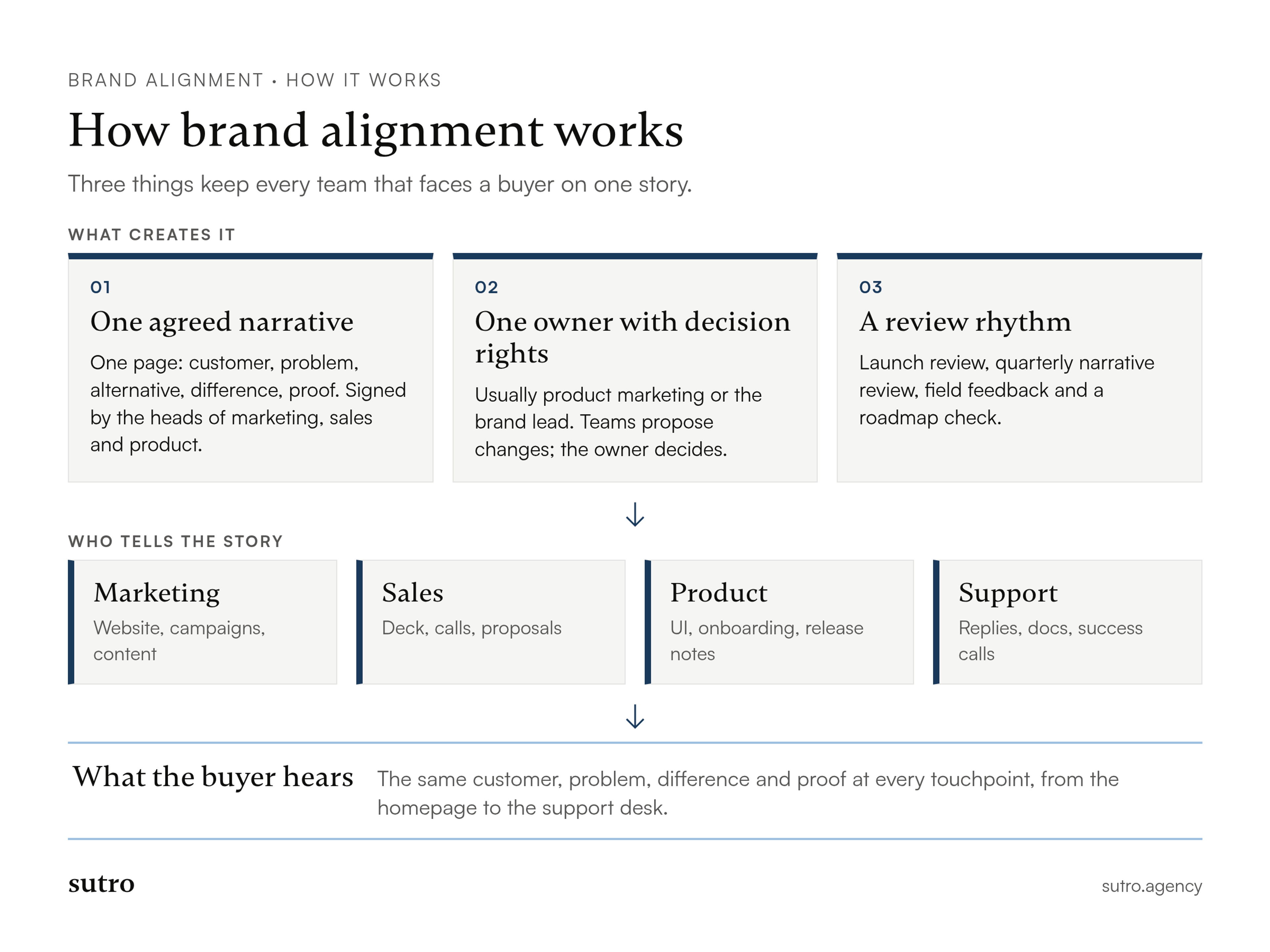
Brand alignment is when marketing, sales, product and support tell buyers the same story about who you serve, what you solve and why you're different, which goes deeper than a consistent logo and is unrelated to the marketplace price-enforcement (MAP) work that shares the name. It comes from three things: one agreed narrative, one owner with decision rights, and a working rhythm that keeps the story current.
When I checked Google's first page for "brand alignment" on November 13, 2026, two of the six results were a marketplace price-enforcement vendor and its LinkedIn page. The four guides were written for brands in general or for professional-services firms. None of them dealt with the place where technical B2B companies most often lose the thread: the gap between what marketing says, what sales pitches and what the product actually does on day one.
When we start narrative and identity work for B2B tech companies, the first deliverable is rarely a deck. It's one paragraph that the heads of marketing, sales and product all agree to. I founded Sutro to work with technical B2B companies between Series A and pre-IPO. The pattern below is what I see when a growing company's story starts to split.
What brand alignment means, and what it isn't
Brand alignment is agreement between the teams that face buyers on four things: the customer, the problem, the difference and the proof. When those four match, a buyer hears compatible words from your homepage, your account executive, your onboarding screens and your support team.
The broader definition you'll find elsewhere, internal values and employee behavior matching external messaging, still holds. In a B2B tech company, though, it gets concrete fast. The "internal" side is mostly four teams: marketing, sales, product and customer success. Each one shapes what buyers believe, and each one is measured on something different.
It helps to separate alignment from its neighbors:
- Brand consistency is applying rules and guidelines so every asset looks and sounds the same. Alignment comes first: a perfectly consistent deck can still tell the wrong story.
- The messaging framework is the document that holds the story. If you don't have one yet, start with a messaging framework built from buyer language. Alignment is the agreement and the process that keep teams using it.
- Brand compliance is checking that assets follow the guidelines. It's an audit of outputs. Alignment is about decisions made before anything gets produced.
- Marketplace brand alignment means enforcing minimum advertised price (MAP) policies and removing unauthorized sellers on Amazon or Walmart. Same words, different problem.
Why brand alignment matters in B2B
Brand alignment matters because B2B buyers compare what they read with what they hear, and they notice the gaps. In a Gartner survey of 632 B2B buyers, 69% reported inconsistencies between the information on a vendor's website and what its sellers told them. Gartner warned that when sellers' information doesn't match the company's messaging elsewhere, it can create mistrust and put the deal at risk.
A committee buying technical software has plenty of reasons to slow down already. A mismatch gives the security reviewer or the CFO one more. If the site says "for platform teams" and the rep pitches "for data analysts," someone on the buying side will ask which one is true.
The internal cost is just as real. Crossbeam and Pavilion's 2025 survey of 400+ go-to-market leaders found that teams reporting full alignment across functions were 67% more likely to meet or exceed revenue targets than misaligned teams. That's a correlation from self-reported data, so I read it as direction, not proof. It matches what I see: misaligned teams spend their energy on internal translation.
Signs your brand is out of alignment
Most misalignment is visible if you know where to look. The common signs:
- The homepage, the first slides of the sales deck and the product onboarding describe the product in three different ways.
- Reps rebuild or reorder the official deck before most calls.
- Two people from your company give a prospect different answers in the same deal.
- Product ships features the positioning never mentions, or the positioning promises things the roadmap doesn't deliver.
- Support tickets start with "I thought it would" more often than "how do I."
- Ask five employees what the company does and you get five different customers.
Why it happens in growing technical companies
Misalignment is the default state of a growing technical company, not a failure of discipline. Each team is rewarded on a different number: marketing on pipeline, sales on bookings, product on shipping and adoption, support on resolution time. Nobody is measured on the story.
A Mural press release on its 2025 survey with The Martec Group of 350 marketing, sales and R&D professionals gives a sense of how common this is. 85% said they felt confident about how they collaborate, yet the same share said they frequently work toward different goals. Decision makers were twice as likely as individual contributors (43% vs 22%) to blame a lack of clear strategy and goals. It's a vendor survey, but the finding rings true.
Four other causes come up again and again in the companies I talk to:
- Product ships before the narrative exists. The feature is live; the story about why it matters gets written later, by whoever needs it first.
- Sales improvises to close. A rep who hears the same objection three times writes a new answer. It works, spreads, and nobody updates the official story.
- No single owner. When everyone owns the story, the loudest team does.
- Decisions stay in one room. A pricing or packaging change gets made in a product meeting and reaches marketing a month later.
Product marketing is often supposed to bridge these teams, but it's frequently misunderstood. In Product Marketing Alliance's research on product marketing and product management, just 4% of product marketers said their stakeholders fully understood product marketing.
How to align your brand in five steps
You align a brand by agreeing on the story once, giving it one owner and checking it on a schedule. These five steps work in that order.
1. Define the promise and positioning on one page
Write one page that answers five questions: who the customer is, what problem they have, what they do today instead, how you're different and what proves it. Then get the heads of marketing, sales and product, plus customer success if it exists, to sign it. The signatures matter more than the prose. A page that one team wrote and others "reviewed" isn't an agreement.
Keep it to decisions, not taglines. "We sell to platform engineering teams at companies with more than 200 engineers" is a decision. "Built for builders" isn't.
2. Audit the touchpoints against it
Put the one-pager next to the homepage, the first five slides of the sales deck, the product onboarding, the last three release notes and the most common support replies. Mark every place where the customer, problem, difference or proof doesn't match. You're looking for contradictions, not wording differences. A product page can use other words than the deck, as long as it makes the same claim.
3. Set one owner and one shared story
Name one owner for the narrative, usually the head of product marketing or the brand lead, and write down who may change what. Sales can propose new proof points; only the owner changes the target customer or the core claim. This works best inside a governance loop with one owner and scheduled updates, so changes have a path instead of piling up in side channels.
4. Train and enable the teams that face buyers
Roll changes out as working sessions, not file uploads. Walk sales through the story with real objections, show support how the new language maps to common tickets, and give product managers the one-pager before they write release notes. The practical side of putting the brand strategy into the tools sales uses every day belongs here too.
Don't stop at sales. Solutions engineers, onboarding specialists and account managers often spend more hours with customers than anyone in marketing. They need the story and the reasons behind it, so they can answer questions the one-pager didn't anticipate. Deeper culture work, getting every employee to live the brand, is a larger project; for alignment, the people who face customers come first.
5. Review on a rhythm
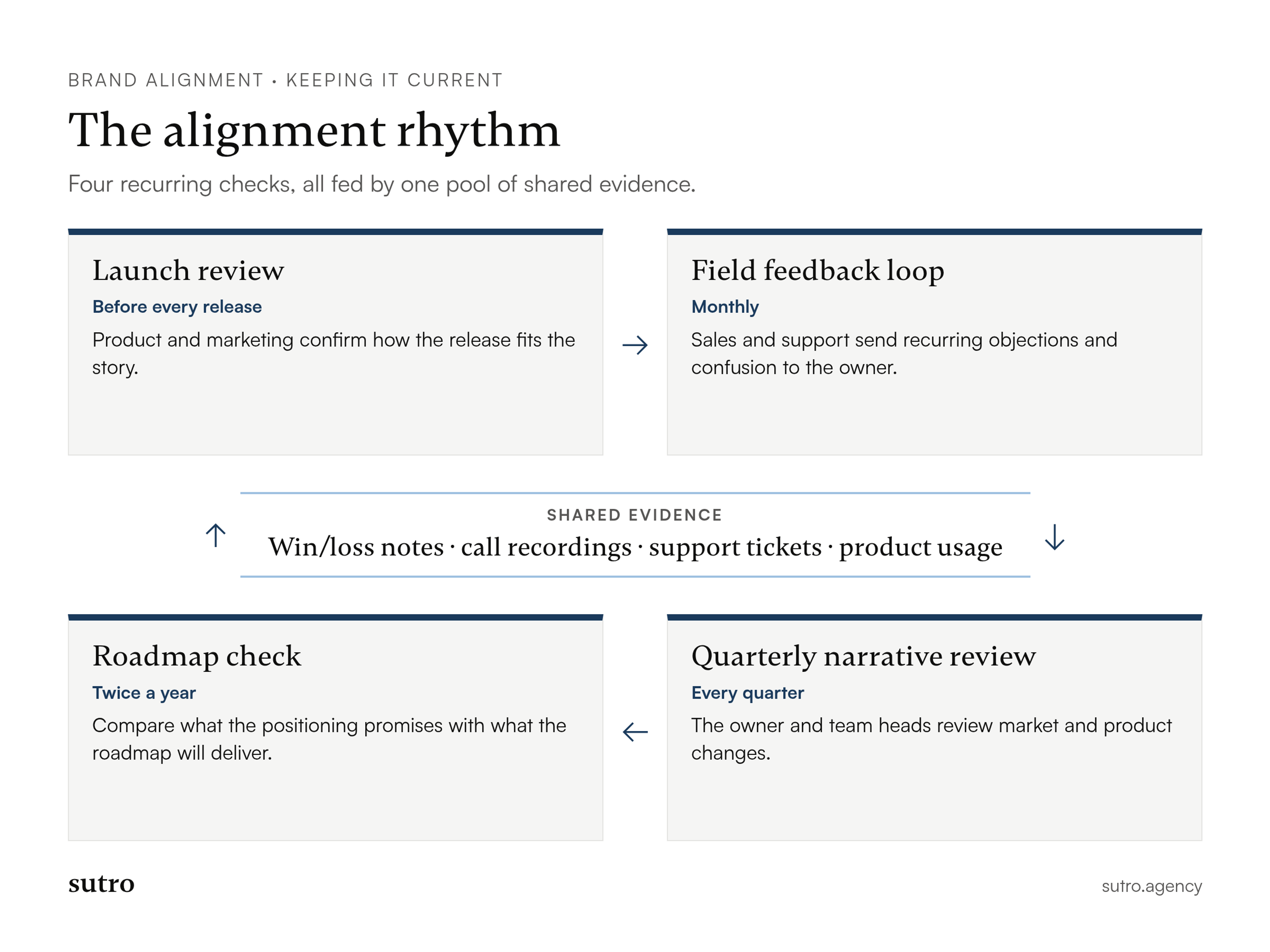
Alignment decays the week after you finish it, so build four recurring checks:
- Launch review: before anything ships, product and marketing confirm how it fits the story.
- Quarterly narrative review: the owner and the heads of each team look at what changed in the market and the product.
- Field feedback loop: sales and support send recurring objections and confusing moments to the owner every month.
- Roadmap check: twice a year, compare what the positioning promises with what the roadmap will deliver.
Feed every check with the same evidence: win/loss notes, call recordings, support tickets and product usage. When teams argue from shared evidence instead of their own anecdotes, the reviews get much shorter.
How to measure brand alignment
You measure brand alignment by comparing how each team describes the company with how clients describe it. The gap between those answers is the measurement; no single dashboard metric captures it.
Ask every team the same five questions
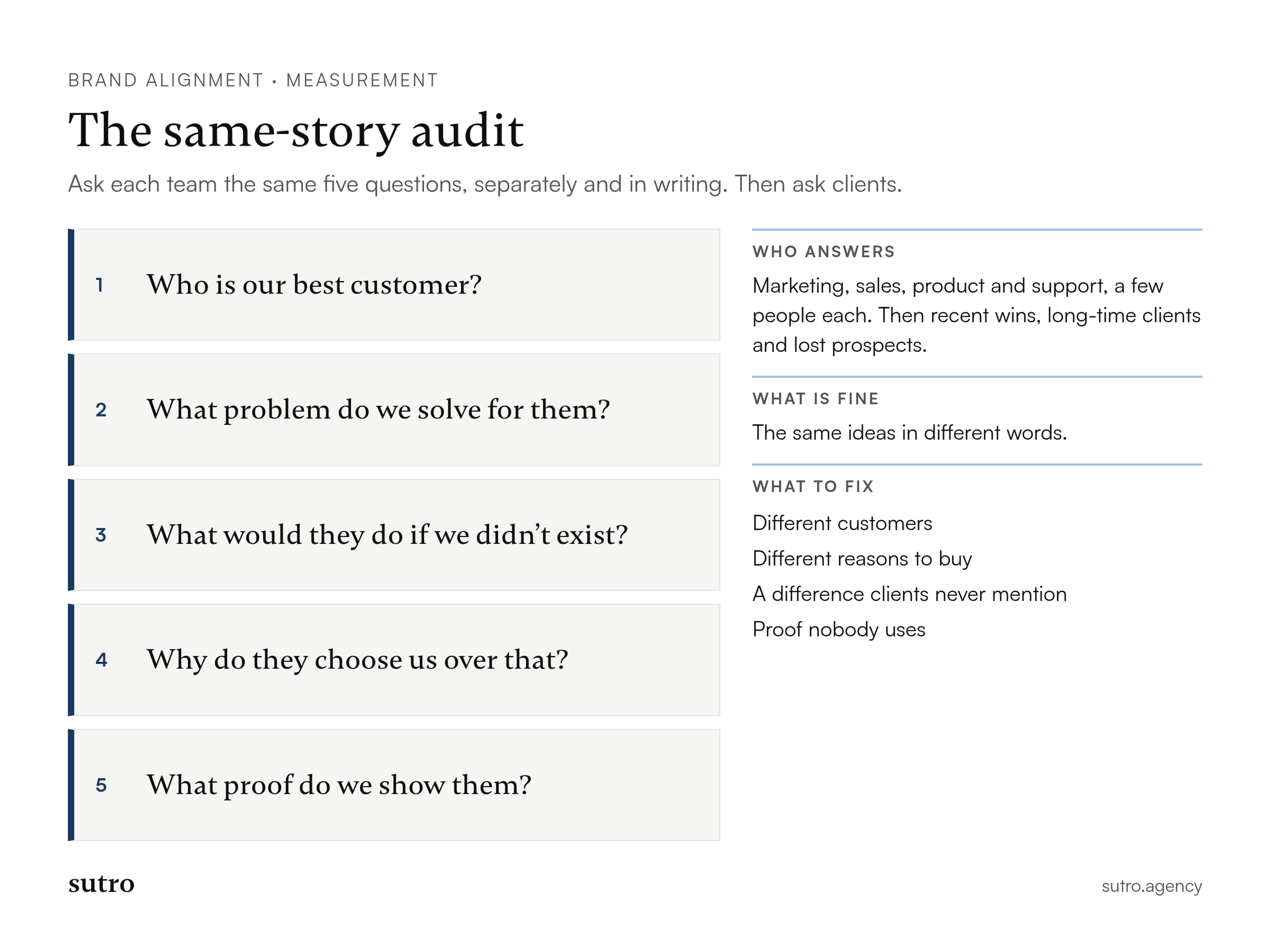
Ask a few people from marketing, sales, product and support the same five questions, separately and in writing:
- Who is our best customer?
- What problem do we solve for them?
- What would they do if we didn't exist?
- Why do they choose us over that?
- What proof do we show them?
Put the answers side by side. Matching ideas in different words is fine. Different customers or different reasons to buy is the problem you're looking for.
Compare internal answers with client perception
Then ask clients the same questions in short interviews or a brief survey: a few recent wins, a few long-time customers and, if you can reach them, a few lost prospects. Clients rarely use your language, which is useful. If they all describe a difference your teams never mention, that's a story worth adopting. If none of them mention the difference your teams lead with, it isn't landing.
Watch the signals from sales and support
Between audits, a few signals tell you whether alignment is holding:
- How often reps edit or replace the official deck.
- Which objections keep coming back and whether the story answers them.
- Where deals stall because the buyer is confused, not because of price or timing.
- How many support tickets come from expectations set before the sale.
These are diagnostic, not financial. Measuring the commercial return of brand work is a different exercise with its own baseline.
Worked example: a 30-day same-story audit (fictional)
This example is fictional. The company, the teams and the findings are invented to show the method.
Ferrolane is a fictional data-pipeline company with about 120 people. Its homepage says it helps "data teams ship reliable pipelines faster." The first slides of the sales deck pitch "cutting cloud data costs" to finance leaders. The in-product onboarding welcomes "analytics engineers" and pushes them straight to a dashboard builder.
Week 1. The product marketing lead sends the five questions to three people in each team and collects the answers. Marketing names data engineers. Sales names VPs of data and CFOs. Product names analytics engineers. Support says most tickets come from people who expected cost reports.
Week 2. She interviews six customers. Most describe Ferrolane as the tool that stopped pipelines from breaking at night. Cost savings come up as a side effect. Nobody mentions dashboards.
Week 3. The heads of marketing, sales and product meet with the evidence and sign a one-page narrative: data platform teams, broken pipelines, reliability first, cost as proof. Product marketing becomes the owner. Sales can add proof; only the owner changes the customer or the core claim.
Week 4. Marketing rewrites the homepage hero. Sales replaces the first slides of the deck in a working session where reps practice the new opening. Product reorders onboarding to start with pipeline monitoring. Support adds a reply that explains where cost reporting fits. The first quarterly narrative review goes on the calendar.
Nothing in this example required a new logo or new guidelines. It required a decision about the customer and the main claim, made once and shared.
Common brand alignment mistakes
The most common mistakes come from treating alignment as a document instead of a habit:
- Treating it as a kickoff event. One offsite produces energy and a slide. Without the rhythm in step 5, the story splits again within a quarter.
- Letting the loudest team own the story. Usually sales during a tough quarter or product after a big launch. One owner with clear rights fixes this.
- Aligning on taglines instead of decisions. Teams can agree on a phrase and still disagree on who the customer is.
- Leaving product and customer success out. They shape what buyers experience after the pitch, which is where broken promises become churn.
- Never revisiting after a launch. Every major release changes the story a little. Skip the launch review and the drift starts on day one.
Conclusion
Brand alignment is less about how a company looks and more about whether its teams agree on what they're promising. Write the story on one page, get the heads of marketing, sales and product to sign it, name one owner and check it on a rhythm. Then measure the gap between what your teams say and what clients hear, and close it. If you're seeing that gap in your own deals, tell us where your teams tell different stories.
Questions
- What is brand alignment?
- Brand alignment is the match between what a company says about itself and what its teams and products actually deliver. In a B2B tech company, it means marketing, sales, product and support describe the same customer, problem, difference and proof, so a buyer hears one story from the website to the support desk.
- What does brand compliance mean?
- Brand compliance means assets follow the brand guidelines: correct logo use, colors, type, voice and any legal or trademark rules. It's a check on outputs after they're made. Brand alignment comes earlier and goes deeper: teams agree on the story before anything is produced, so a compliant asset can still be misaligned if it tells the wrong story.
- Is brand alignment the same as sales and marketing alignment?
- No. Sales and marketing alignment usually covers lead definitions, handoffs and shared pipeline targets. Brand alignment covers the story every team tells buyers, and it includes product and customer success, which shape what buyers experience after the sale.
- Who should own brand alignment in a B2B company?
- One person should own the narrative, most often the head of product marketing or the brand lead, with the heads of marketing, sales and product signing off on major changes. Ownership means decision rights: others can propose changes, but only the owner changes the target customer or the core claim.
- How often should you review brand alignment?
- Run a launch review before every major release, a narrative review each quarter and a monthly field-feedback loop from sales and support. Repeat the full same-story audit about once a year, or after a funding round, a new market or a major product change.
Sources
- Gartner survey of 632 B2B buyers (August-September 2024), reported by Mediabrief: "B2B buyers prefer digital research as 61% opt for rep-free experience, says Gartner"
- Crossbeam and Pavilion, "The Future of Revenue 2025" (PDF, survey of 400+ go-to-market leaders)
- Mural, press release on the 2025 GTM Alignment Gap Index with The Martec Group (May 28, 2025)
- Product Marketing Alliance, "Bridging the gap between product marketing and management"