Positioning
Internal Branding: How to Get Employees to Live the Brand
Internal branding is helping employees turn the brand promise into daily behavior, so customers meet the same brand in every conversation. Here is a five-step method to do it.
Key takeaways
- Internal branding turns a brand promise into behavior that customer-facing employees can show and managers can observe.
- It is not a poster campaign, a values wall or a launch party. If nobody can see it on a call or in a ticket, it is still a slogan.
- The one study I cite surveyed hotel frontline staff in Pakistan. It shows an association in hotels, not proof for B2B tech.
- GitLab's public page writes behaviors as first-person statements in two of its three lists. That format is easy to copy and easy to check.
- The promise-to-behavior ladder is my recommended method: three promises, role behaviors, hiring and onboarding, a 15-minute weekly routine, and customer-facing evidence.
- Marketing owns the promise, people or HR owns the systems, and leaders have to model the behaviors themselves.
Internal branding helps employees understand the brand promise and turn it into daily behavior, so customers meet the same brand in every conversation.
A positioning project changes the website, the deck and the ads. It does not change what a support engineer writes on a late-night ticket, or what a sales lead says when a buyer asks a hard question. Internal branding covers that part.
Story comes first. If marketing, sales and product still tell different stories, start with how to align teams around one brand story. This article assumes the story exists and asks a narrower question: what do people do with it?
What internal branding is (and what it is not)
Internal branding is the translation of a brand promise into behavior that people in customer-facing roles can show. External branding tells customers what to expect; internal branding makes sure the people they meet deliver it. If nobody can see it on a call or in a ticket, it is still a slogan.
It is not a poster campaign, a values wall, a launch party with branded merchandise or a careers-page project. Those can support the work. None of them changes how a person handles a difficult customer moment.
Positioning is only one part of brand building for B2B tech companies. In my view, technical buyers often test the brand by talking to the people behind it. They ask engineers hard questions, and they compare what the site promised with what support delivers.
Three parts make internal branding work:
- A promise customers should feel.
- A behavior that proves the promise, written for a specific role.
- A routine that keeps the behavior visible after the launch.
Remove one and the effort drifts back into messaging. It is also not training that ends. A one-hour session can explain a promise. Repeated practice, with feedback, is usually what turns it into habit.
Why employees are the brand in B2B tech
In B2B tech, customers often experience the brand through people, over a long buying and usage cycle. A buyer meets sales, solutions, onboarding and support, and often the product team. Each conversation either confirms the promise or contradicts it.
That gives a brand many chances to break. A site that promises speed and a security review that stalls for weeks send two different messages. My view is that buyers tend to believe the second one, because a person delivered it and it cost them time. That is my opinion, not a finding.
I read one study that tests a related idea, which it calls internal brand management. In a March 2022 PLOS ONE study, Qureshi et al. report: "A survey-based quantitative data was gathered from 390 non-managerial frontline staff working in 3-, 4-, and 5-star hotels of Pakistan." The abstract adds: "The results revealed that internal brand management positively impacts brand commitment, brand citizenship behavior, and sustainable competitive advantage."
Read that with care. It is a survey of hotel frontline staff in Pakistan. It is not B2B tech, and it is not a meta-analysis. One survey shows an association in one industry. It does not prove that internal branding drives results in software.
I cite it for a narrow reason. It points the same direction as common sense in any work where staff are the product. My read is that B2B tech sits closer to that than to packaged goods, but that is my judgment, not a finding.
What I found on two public culture pages
I read two public culture pages on Nov 21, 2026, to see how tech teams put behavior into words. GitLab writes behaviors as first-person statements in two of its three lists. HubSpot's page, in the part I read, treats culture as something to keep working on.
This is a reading of two public pages, not research into how either organization runs inside.
GitLab
The page at GitLab's handbook values URL now shows "Operating Principles" and says it was last modified November 2, 2026. The URL is /handbook/values/. The principles are Speed with Quality, Ownership Mindset and Customer Outcomes, on a base of Culture of Excellence. Each has a "What this looks like:" list. The Ownership Mindset and Customer Outcomes lists use first-person "I" statements, while Speed with Quality uses "we."
The Ownership Mindset tagline is "Act because it’s yours." Other lines from the page:
- "It is never someone else’s problem"
- "I can explain how my work connects to a customer outcome" (the line continues by contrasting this with a roadmap item or task)
- "When a customer is stuck, I treat their time like it’s more expensive than mine"
Three things stood out.
First, these lines are observable. A manager can ask someone to explain how their work connects to a customer outcome, or read a ticket to see how a stuck customer was treated. That is the test I use for the ladder below.
Second, the page ties the principles to recognition. It tells staff to use the principle emoji, for example in thank-you posts and discretionary bonus nominations.
Third, the page has a section on acknowledging CREDIT. It says CREDIT (Collaboration, Results, Efficiency, Diversity & Inclusion, Iteration, Transparency) "was the right framework for the era that put GitLab on the map" and adds: "We aren’t retiring CREDIT because those values were wrong."
My read is that GitLab treats its principles as something it revises, and that is a useful habit. A public page cannot tell me how the principles are applied day to day.
HubSpot
I also read HubSpot's Culture Code page. Each Culture Code link on it says it was updated on September 29, 2025. Two lines caught my attention:
- "we have to walk the walk."
- "We have to not just build culture, but iterate on it over time."
I did not read the full Culture Code, so I will not say how HubSpot uses it inside the business. To me, these two lines frame culture as practice and revision, not a one-time announcement. That is my reading of two lines, not a claim about HubSpot's intent.
What I take from both
Three habits worth copying, in my opinion:
- Write behaviors in the first person, so a person can adopt them.
- Attach recognition to the behaviors, so people see them rewarded.
- Expect to revise. A promise that never changes is probably not being tested against real customer moments.
The promise-to-behavior ladder
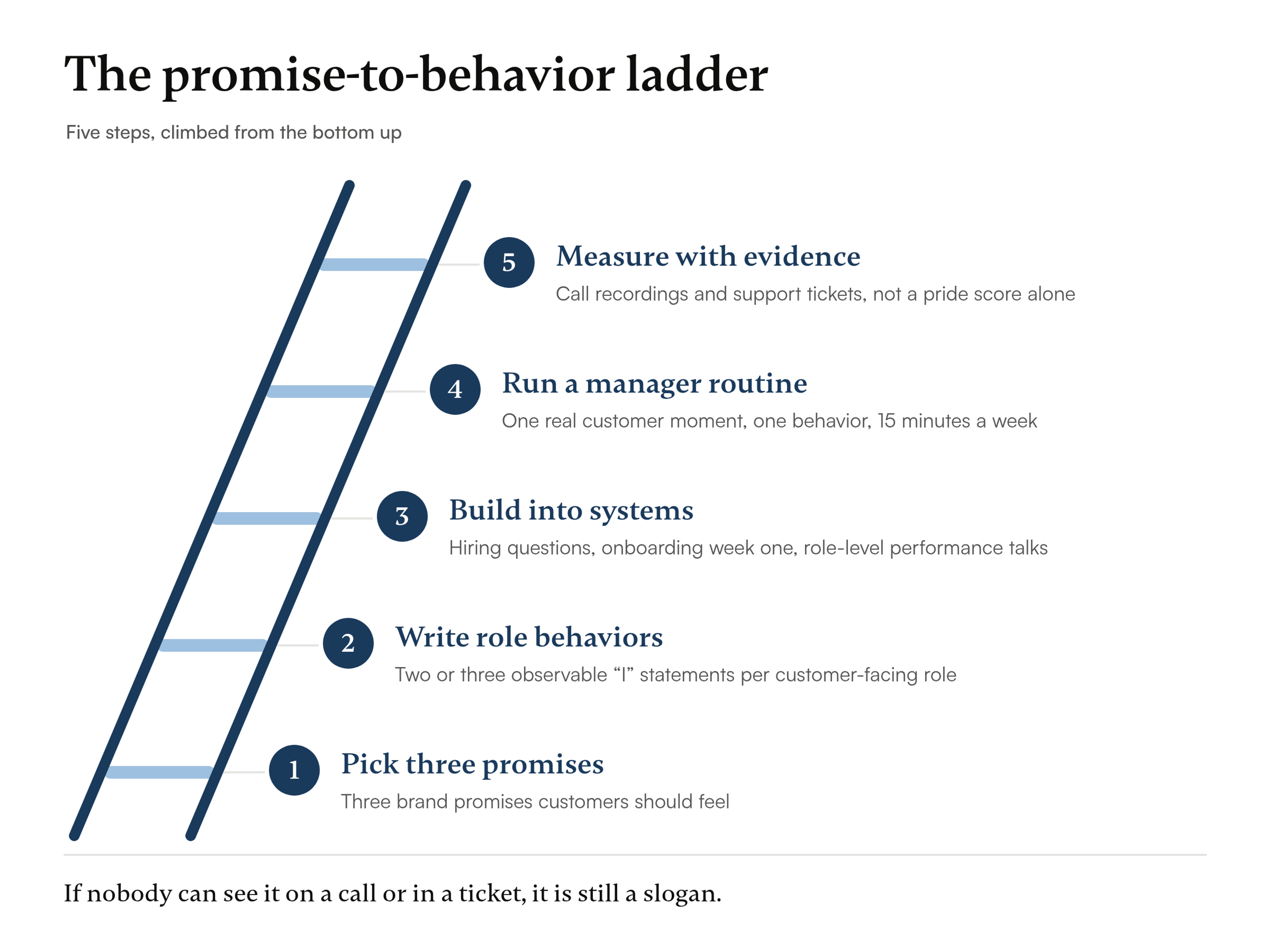
The promise-to-behavior ladder is the method I recommend for internal branding. It is my own framework, not a study or a published standard. Five steps move a brand promise down to what a person does on a call.
Step 1: Pick three brand promises customers should feel
Three, not eight. Take them from your positioning: what should a customer feel after any conversation with you? For instance, that answers are direct, or that problems get owned. If you cannot say how a customer would notice a promise, drop it.
Step 2: Turn each promise into two or three observable behaviors per role
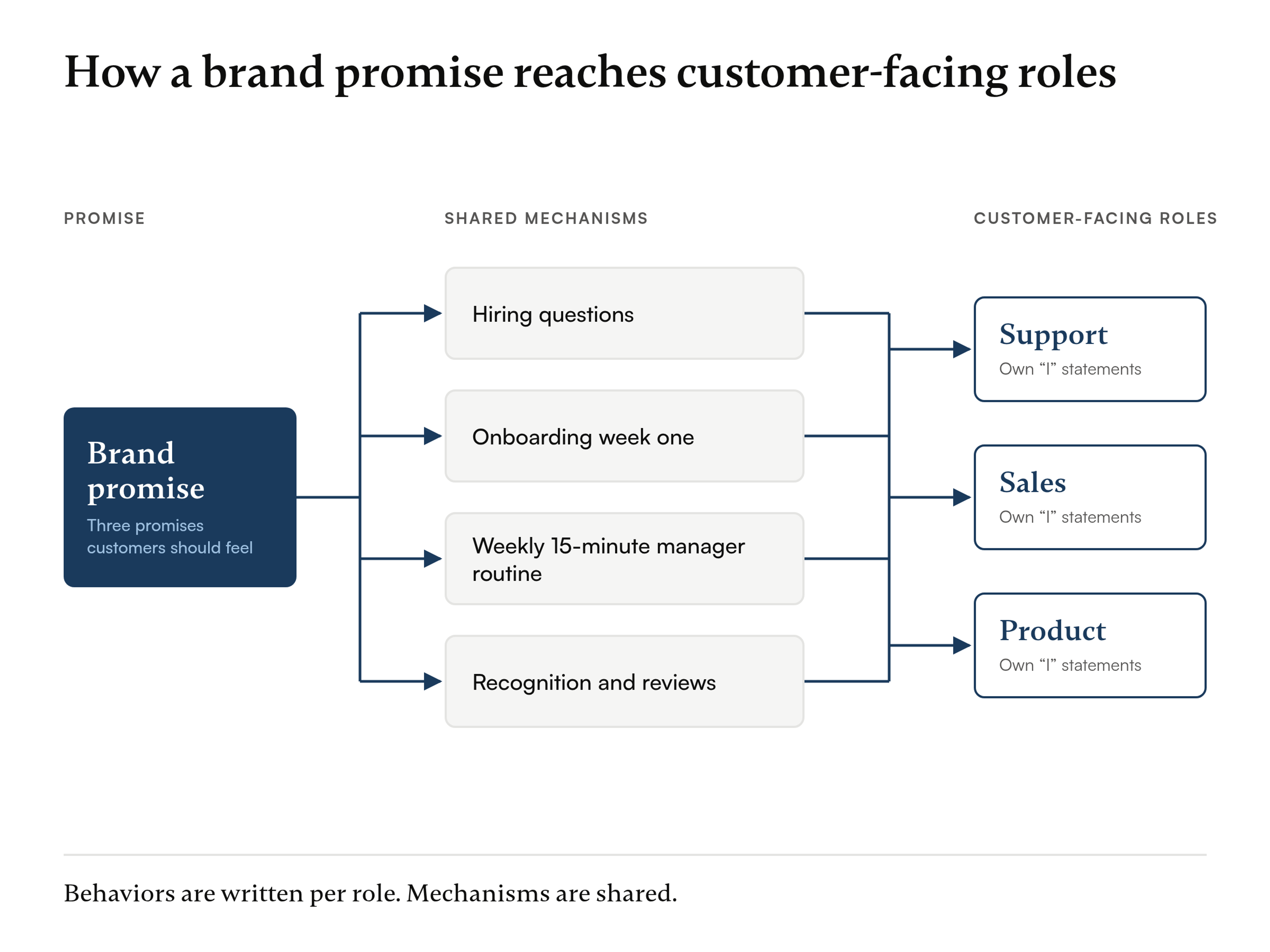
Write for each customer-facing role, such as support, sales and product. Use first-person "I" statements, as GitLab does in two of its three lists. One promise produces different behaviors in different roles.
Test every line: could a manager see it in a call recording or a ticket? Behavior covers what people do. Voice covers how they sound, and for that, see writing a voice guide people actually use.
Step 3: Build the behaviors into hiring, onboarding and performance
- Hiring: ask candidates for a past example of the behavior.
- Onboarding: week one introduces the promises and the role behaviors using real customer moments, not a slide deck.
- Performance: role-level conversations cover the behaviors next to the usual goals.
If the brand is absent from all three, I doubt it will survive a busy quarter.
Step 4: Give managers one 15-minute weekly routine
Each week the manager and employee pick one real customer moment: a call, a ticket, a demo. They review it against one behavior. What worked, what to repeat, what to change.
One moment, one behavior, 15 minutes. Longer routines tend to get skipped.
Step 5: Measure with customer-facing evidence
Review call recordings and support tickets for the behaviors you wrote down. An employee brand-love score can sit beside that evidence, but it should not replace it. People can feel proud and still behave inconsistently.
Then drop any behavior nobody can observe. If it cannot be checked or coached, it turns the sheet back into a slogan.
Illustrative example: Kelmarr Cloud
Kelmarr Cloud is fictional, an invented infrastructure software vendor. Every detail below is made up to show the format.
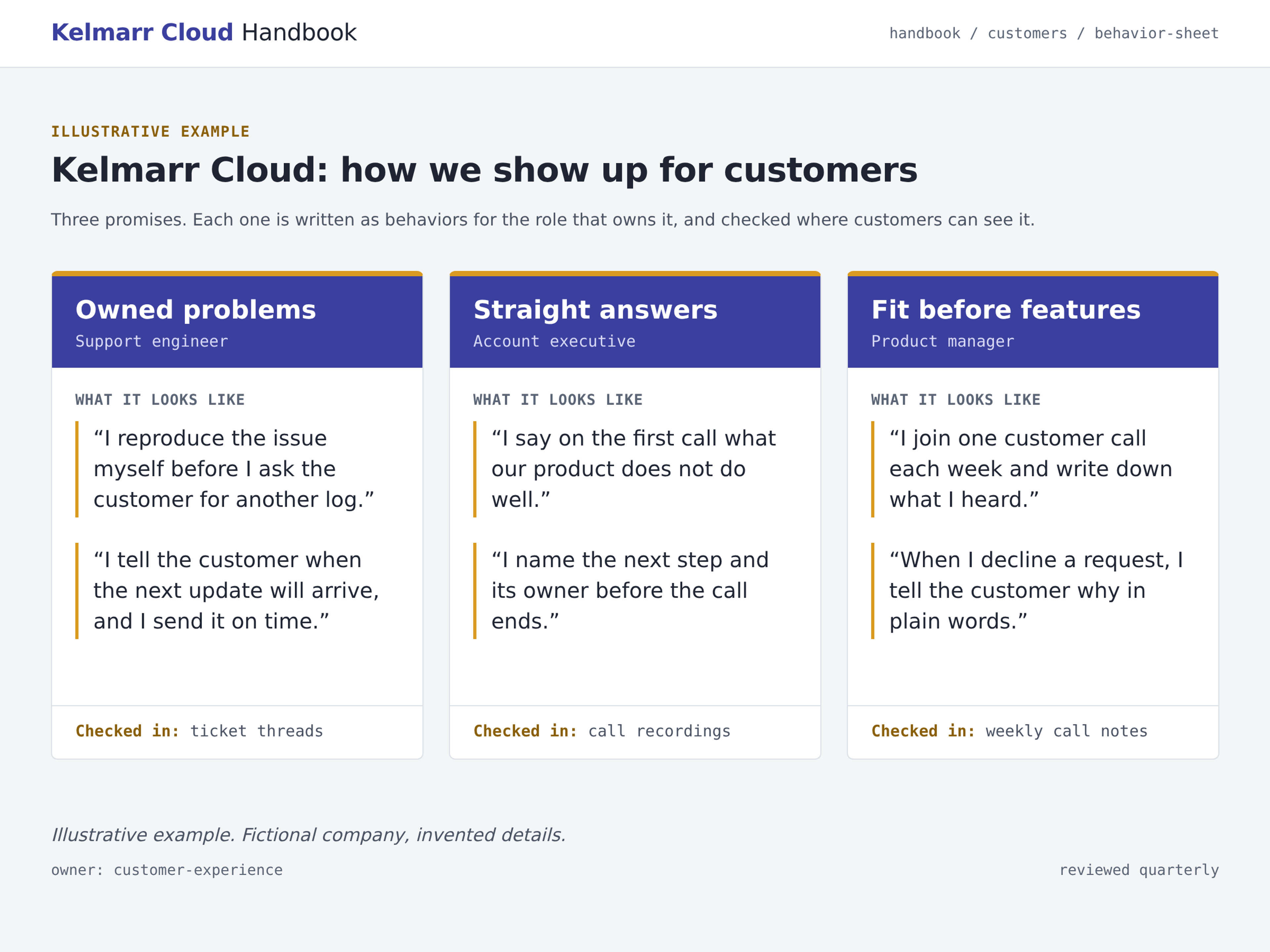
Step 1 gives Kelmarr three promises: straight answers, owned problems and fit before features. Step 2 writes behaviors for three roles:
- Support engineer (owned problems)
- "I reproduce the issue myself before I ask the customer for another log."
- "I tell the customer when the next update will arrive, and I send it on time."
- Account executive (straight answers)
- "I say on the first call what our product does not do well."
- "I name the next step and its owner before the call ends."
- Product manager (fit before features)
- "I join one customer call each week and write down what I heard."
- "When I decline a request, I tell the customer why in plain words."
Step 3 puts these into systems. The account executive interview includes: "Tell me about a time you told a buyer your product was not the right fit." Week one for new support engineers includes watching a senior colleague hand over a ticket.
Step 4 is the routine. A support lead picks one ticket from the week and checks whether the promised update arrived on time.
Step 5 is the evidence. Kelmarr reviews call recordings for the line about what the product does not do well, and ticket threads for update timing. A behavior nobody can check, such as "I embody straight answers," gets cut.
Who owns internal branding
Marketing owns the promise, people or HR owns the systems, and leadership owns the example. Managers carry the weekly routine.
Marketing sets the promise and the language, because it holds the positioning. People or HR builds the behaviors into hiring questions, onboarding and review templates. Managers run the 15-minute routine, since they are the ones who see the customer moments.
Leadership models it. This is opinion: if leaders are exempt from the behaviors they ask for, employees notice, and the behavior sheet becomes decoration. A leader who wants fast replies to customers should reply fast to colleagues.
I'd also name one person to own the ladder itself. In my opinion, shared ownership with no owner stalls.
Mistakes that make internal branding fail
Internal branding fails when it stays a message and never becomes a routine. These are the mistakes I'd check for first.
- A launch event with no follow-through. Excitement fades. A weekly routine is built to last.
- Slogans instead of behaviors. "Innovate daily" tells a support engineer nothing about the next ticket.
- One message for every role. An implementation engineer and an account executive keep a promise in different ways.
- Training for marketing only. Product, sales and support usually meet customers more often than marketing does.
- Measuring pride alone. A survey of how employees feel does not show what customers experienced.
- Behaviors nobody can observe. If a manager cannot see it, the manager cannot coach it.
- Exempt leaders. One visible exception teaches everyone the sheet is optional.
Conclusion
Internal branding works when a promise becomes a behavior someone can see, a manager can coach and a customer can feel.
Start small: three promises, one role, a few weeks of the 15-minute routine. Then check real calls and tickets, and keep what shows up there. If you want a second opinion on where to begin, tell us which behaviors your customers should feel first.
Questions
- What does internal branding mean?
- Internal branding is the work of helping employees understand the brand promise and turn it into daily behavior. The goal is that customers meet the same brand in sales, onboarding and support. It focuses on what people do, not on posters or slogans.
- What is an example of internal branding?
- A good example is a behavior written as a first-person statement. The GitLab page I read on Nov 21, 2026 lists lines of this kind under its Operating Principles. The fictional Kelmarr Cloud, used in this article for illustration only, writes "I reproduce the issue myself before I ask the customer for another log" for its support engineers.
- Why is internal branding important?
- It closes the gap between what marketing promises and what customers experience. In B2B tech, buyers talk to many people before and after purchase, and each conversation confirms or contradicts the brand. One hotel-staff survey in PLOS ONE found an association between internal brand management and brand commitment, but it is not proof for B2B tech.
- How do you build internal branding?
- Pick three brand promises customers should feel. Turn each into two or three observable first-person behaviors per customer-facing role. Build them into hiring questions, onboarding week one and performance conversations, give managers a 15-minute weekly routine, and measure with call reviews and support tickets.
- Is internal branding the same as employer branding?
- No. Employer branding is aimed at candidates and how the organization appears as a workplace. Internal branding is aimed at current employees and how they behave with customers. The two overlap in hiring, but they answer different questions.
- How do you measure internal branding?
- Measure behavior that customers can feel, using evidence such as call reviews and support tickets checked against the behaviors you wrote. An employee brand-love score can sit beside that, but it should not be the only measure. Drop any behavior that nobody can observe.