Positioning
Emotional B2B Branding: Why Tech Buyers Aren't Purely Rational
Emotional B2B branding shapes how tech buyers feel about choosing you: safe, confident, proud. People decide with emotion and defend the choice with proof, so a brand has to supply both.
Key takeaways
- Gartner's 2023 survey ties regret among technology buyers mostly to buying-team behavior and buying experience, not the product itself.
- Binet and Field's B2B principles, as summarized by the LinkedIn B2B Institute, say emotional messaging works better long-term and rational messaging works better short-term.
- Each role on a buying committee wants a different feeling: confidence, predictability, control, certainty or relief.
- The four homepages I read pair a feeling with the product, the crowd, ratings or a promise. That is my reading, not the companies' stated intent.
- The feeling-to-proof map is my recommended method: one role, one fear, one feeling, one proof a buyer can forward.
- Hype, fake warmth and emotion with no proof make emotional B2B branding backfire.
Emotional B2B branding shapes how tech buyers feel about choosing you, because people decide with emotion and defend the choice with proof.
The feelings to aim for are safety, confidence and pride. A buyer who feels them moves forward. A buyer who also holds evidence can defend that move to a committee, a finance lead and a security team.
This is how I think about B2B branding for technical products, and it frames the work of Sutro's brand team for B2B tech companies: settle the feeling first, then hand over the proof. Below I cover why emotion matters in tech buying, which feelings matter by role, how to pair each feeling with evidence, and what I saw on four public homepages on Nov 20, 2026.
Why B2B tech buying is not purely rational
B2B tech buying is not purely rational because the buyer carries personal risk. A bad pick wastes budget, and it also costs the person who proposed it standing with colleagues.
Gartner's data points the same way. In its June 14, 2023 press release, Gartner reported that "60% of technology buyers involved in decisions to renew or expand “as-a-service” agreements regret nearly every purchase they make, a 6% increase from 2020."
Scope matters here. The survey ran in February and March 2023, with 1,503 respondents at organizations with at least $50 million or equivalent in annual revenue. It covers technology buyers involved in renew or expand decisions on as-a-service agreements. It says nothing about every buyer or every purchase.
The cause is not mainly the product. Gartner's Hank Barnes said, "Regret is a known issue with enterprise technology purchase decisions," and "This usually has little to do with the provider or the products themselves, but rather is driven by ineffective or dysfunctional behaviors within the buying team."
Gartner also says negative attitudes "are shaped by frustrating buying experiences, poor communication and an overwhelming number of options to consider." Its recommended action: "Expand buyer enablement content to build buying confidence."
My read: confidence is a feeling, and a brand starts building it before the buyer reaches a spec sheet. A feature matrix alone leaves the buyer to answer the emotional question: is choosing you safe? That conclusion is my opinion, not something the Gartner release says.
The emotions behind a tech purchase, by role
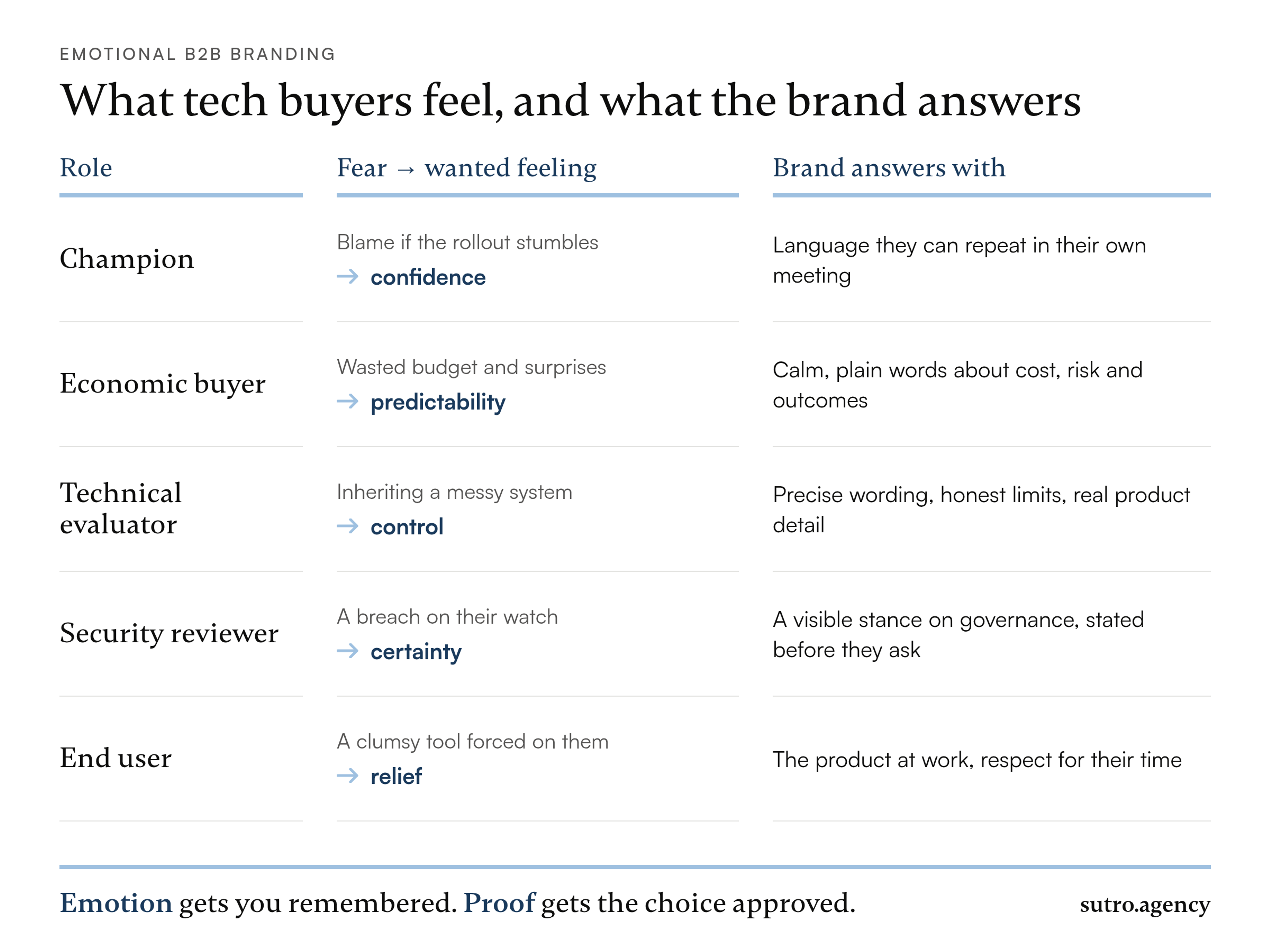
Each role on a tech buying committee wants a different feeling, and most of those feelings are about avoiding blame rather than gaining delight. This is my working model of a typical committee, not research, and your committee will differ.
Consumer emotion runs on different triggers. I compare the two in how B2B emotions differ from consumer ones, so here I stay with tech buying.
The champion
The champion proposes you internally. Their fear is blame if the rollout stumbles. They want confidence and recognition. The brand answer is to make the recommendation feel safe and smart, with language they can repeat in their own meeting.
The economic buyer
This is often a finance lead or a business owner. Their fear is wasted budget and surprises. They want predictability. The brand answer is calm, plain language about cost, risk and outcomes, with no jargon to decode.
The technical evaluator
This person fears inheriting a messy system and the support load that follows. They want control and respect for their craft. The brand answer is precise wording, honest limits and real product detail shown early.
The security reviewer
Their job often includes finding reasons to say no. They fear a breach on their watch and want certainty. The brand answer is a visible, steady stance on governance and safety, stated before they have to ask.
The end user
The end user fears a clumsy tool forced on them by management. They want relief from busywork and pride in their tools. The brand answer is to show the product at work and respect their time.
How emotion and proof work together
Emotion gets a vendor remembered and shortlisted, and proof gets the choice approved. They do different jobs at different moments, so a brand needs both.
On Nov 20, 2026 I read the LinkedIn B2B Institute's landing page for "5 Principles Of Growth In B2B Marketing," written by Les Binet and Peter Field. The page shows no date, and its charts cite IPA Databank B2B cases from 1998 to 2018. I did not open the PDF report.
The page states: "In B2B, emotional messaging is more effective in the long-term, and rational messaging is more effective in the short-term." A chart description on the page says the data supports rational messaging for in-market customers and emotional messaging for out-of-market customers.
My reading for tech brands: on any given day, most buyers are not shopping. Emotion builds the memory that makes you an easy name to say when a trigger arrives. Once a buyer is in market, proof does the closing work.
The same page adds: "In B2B, brands should balance the budget between long-term brand building and short-term sales activation with a 50/50 split." That is a budget principle from the Binet and Field work. It is not a rule for how to divide the words on your homepage.
Proof also has a job after the decision. The buyer must show others that the choice was sound. I cover proof types in how B2B buyers come to trust a brand, so here I keep to one point. A feeling you cannot back up reads as hype, and evidence with no feeling attached gets skimmed.
What I saw on four B2B tech homepages
Each of the four homepages pairs a feeling with a different kind of proof: the product, the crowd, ratings or a promise. On Nov 20, 2026 I went through the first screen of Linear, PagerDuty, Rippling and Retool, and compared which feeling each headline speaks to and what sits beside it.
The emotional readings are my interpretation, not a statement of what these companies intend. Hero copy changes often, so treat this as a snapshot of Nov 20, 2026. I did not talk to buyers or test any product.
Linear
The H1 reads "The product development system for teams and agents," with the subhead "Purpose-built for planning and building products. Designed for the AI era." The first lines carry no logos or numbers. The hero shows the product itself, an issue thread.
My read: it speaks to craft and professional pride, the feeling of working with a sharp tool. The proof is the product on screen.
PagerDuty
The page opens with a banner for AWS re:Invent, then the H2 "Operations in the AI Era." Above a logo strip (FOX, Zoom, Spotify, Twilio, TUI, Cox Automotive) sits the line "Trusted by 70% of Fortune 100," according to PagerDuty's own homepage as read on Nov 20, 2026. I did not verify that figure.
My read: safety through social proof. The message is that others like you already chose this.
Rippling
The H1 is "Manage your entire workforce on one system." The subhead promises to "Increase savings and automate busy work with global HR, Payroll, IT, and Finance in one place" and adds that AI that understands your business powers it. Nearby are rating badges: Software Advice and Capterra, each showing a 4.9 star rating, and a Fast Company "Next Big Thing in Tech" badge.
My read: relief and control, backed by third-party ratings.
Retool
The H1 is "Secure your vibe-coded apps." Further down I read "Ship safely, with governance built in" and "enterprise security and governance built in."
My read: Retool names a fear, unsafe apps built with AI, and offers safety as the answer. I only read the first screen and a few lines below it, so I can't say what backs the claim further down.
The pattern
Each headline names a feeling or a fear, and each puts something beside it that a skeptical buyer can point at. Linear shows the product, PagerDuty shows the crowd, Rippling shows ratings, and Retool shows a promise. The weak version of this pattern is a feeling with nothing next to it.
The feeling-to-proof map
The feeling-to-proof map is my recommended method for pairing each feeling you want a buyer to have with one piece of evidence they can show to others. It is a working method I recommend for structuring messaging. It is not a study and not a published standard.
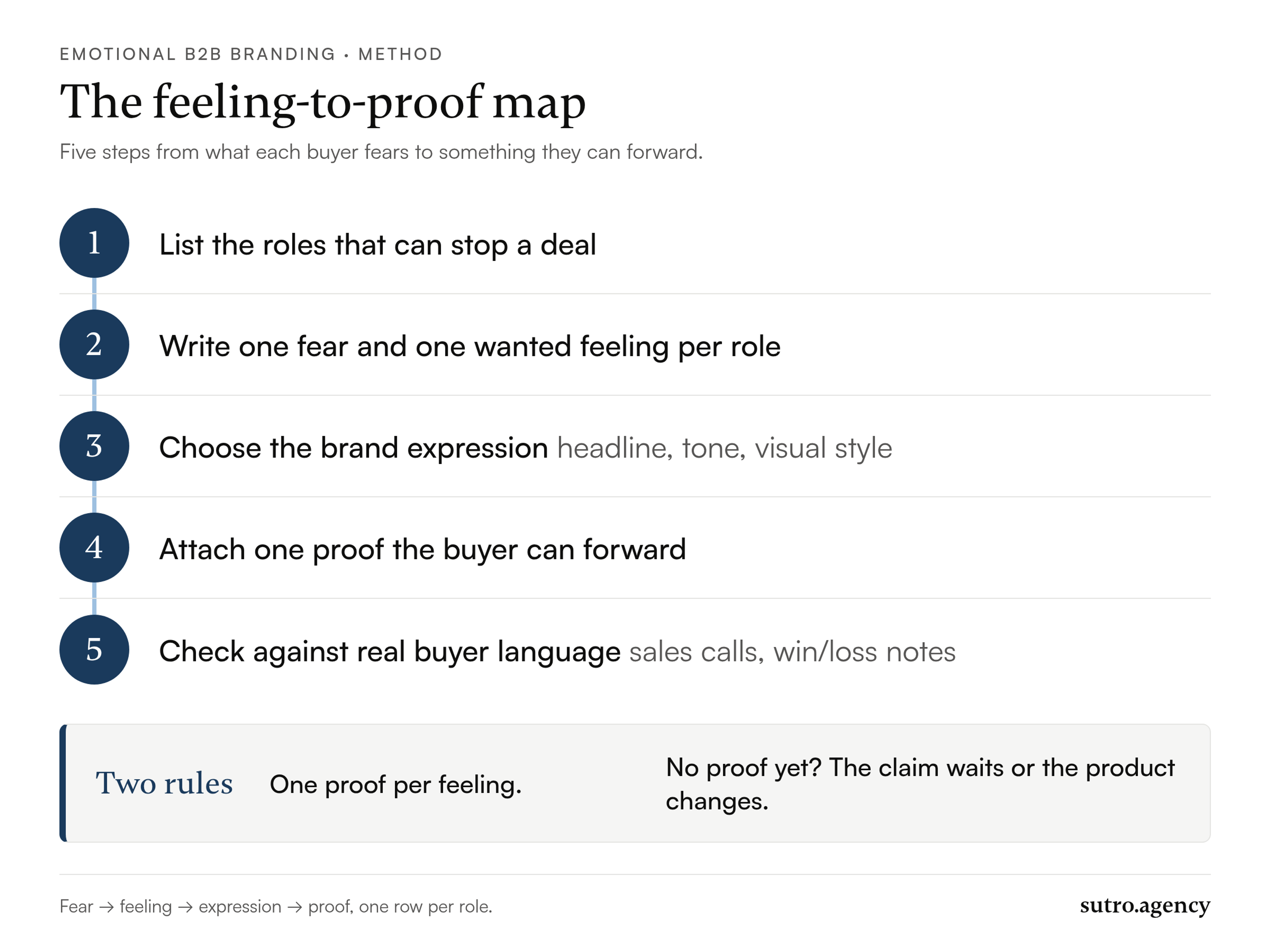
Here are the steps:
- List the roles in your buying group. Start with the three or four that can stop a deal.
- For each role, write the main fear and the feeling you want in its place. One of each.
- Choose the brand expression that carries that feeling: the headline, the tone, the visual style.
- Attach one piece of proof that makes the feeling safe to act on. The buyer should be able to forward it.
- Check the result against real buyer language, such as sales call notes and win/loss notes. Drop any phrasing your buyers never use.
Two rules keep the map honest. First, one proof per feeling. A pile of evidence blurs the message. Second, if a feeling has no proof, either the claim waits or the product has to change. I'd rather ship a quieter claim than one the buyer cannot check.
Illustrative example
Vexmoor Data is a fictional company that sells data pipeline monitoring software. Every name, figure and detail below is invented to show how the map reads.
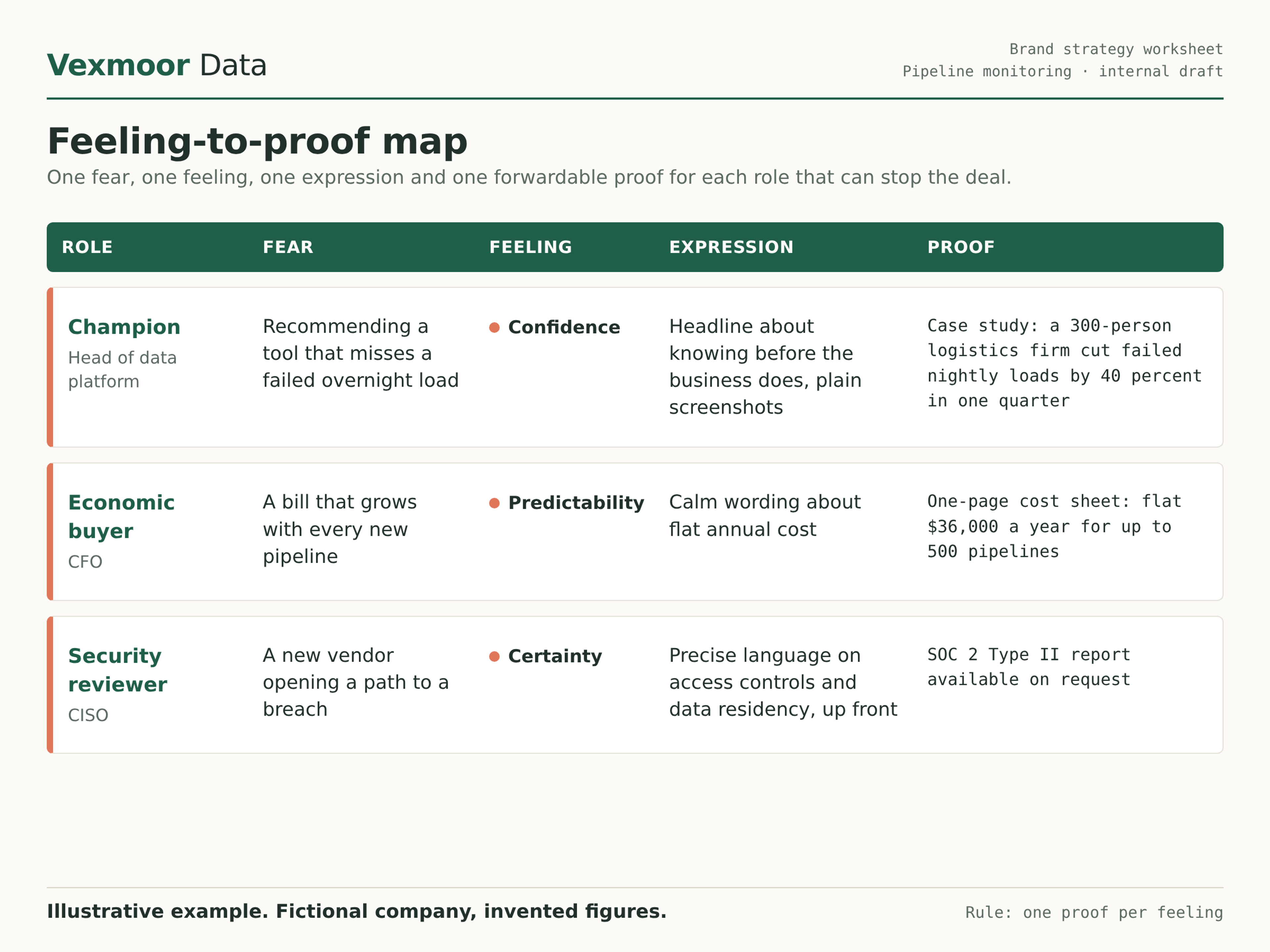
- Champion (head of data platform). Fear: recommending a tool that misses a failed overnight load. Feeling: confidence. Expression: a headline about knowing before the business does, with plain screenshots. Proof: a fictional case study in which a 300-person logistics firm cut failed nightly loads by 40 percent in one quarter.
- Economic buyer (CFO). Fear: a bill that grows with every new pipeline. Feeling: predictability. Expression: calm wording about flat annual cost. Proof: a one-page cost sheet showing a flat fee of $36,000 a year for up to 500 pipelines.
- Security reviewer (CISO). Fear: a new vendor opening a path to a breach. Feeling: certainty. Expression: precise language on access controls and data residency, stated up front. Proof: a SOC 2 Type II report available on request.
Each proof is something the buyer can forward to someone else. Nothing here asks for tears or hype. Each pairing is a calm answer to a specific fear.
Mistakes that make emotional B2B branding backfire
Emotional B2B branding backfires when it swaps professional reassurance for hype or consumer-style sentiment. Tech buyers are skeptical by habit, and these errors confirm the habit. These are my judgments, not measured results.
Hype in place of confidence. Words like revolutionary and magical raise doubt in a technical audience. Confidence sounds quiet and specific.
Consumer-style sentiment. A cinematic story about network latency feels off. Tech buyers want to look competent and sleep through the night.
Fear-mongering. Naming a risk helps. Threatening the reader makes them tune out and resent you.
Fake warmth. Stock photos of high-fiving teams signal nothing true. Warmth in this market looks like clear docs, straight answers and respect for the reader's time.
Emotion with no proof. A promise of relief without a view of how the product works reads as a pitch. Show the workflow.
One feeling for every role. A brand built only on pride in the interface may lose the security reviewer. A brand built only on compliance may lose the champion and the end user.
Conclusion
Emotional B2B branding works when a buyer feels safe choosing you and holds the proof to defend that choice. Neither half carries the sale alone.
A feature list leaves the buyer to translate your product into confidence. A big feeling with no evidence reads as a lightweight vendor. The map keeps both halves on the page, role by role.
I'd start with the one role that can stop your deal. Name its fear, pick a single proof, and check whether your homepage's first screen shows both. If you want a second pair of eyes, tell us which feeling your brand should answer first.
Questions
- What is an example of emotional branding?
- A B2B tech example is Retool's first screen on Nov 20, 2026. The H1 "Secure your vibe-coded apps" names a fear, and the lines below it, such as "Ship safely, with governance built in," offer safety. That is my reading of it, not Retool's stated intent.
- What is the rule of 7 in B2B?
- The rule of 7 is an informal rule of thumb that a buyer needs about seven exposures to a brand before acting. It has no single authoritative source. Use it as a reminder that familiarity builds slowly, not as a target to hit.
- What does B2B branding mean?
- B2B branding means shaping how a business is perceived by the organizations and people who buy from it. It covers positioning, name, identity, voice and the experience across touchpoints. In tech, it helps buyers judge a product they cannot easily see inside.
- What is the 3-7-27 rule in branding?
- The 3-7-27 rule is an informal rule of thumb, usually told as a count of touches (3, then 7, then 27) before a buyer acts or trusts you. Versions differ and I know of no authoritative source. I treat it as folklore that says trust takes repeated exposure.
- Is B2B buying emotional or rational?
- It is both. Buyers decide with feeling, such as safety and confidence, and then defend the choice with evidence. The Binet and Field principles summarized by the LinkedIn B2B Institute say emotional messaging is more effective long-term and rational messaging short-term.
- How do you add emotion to a B2B brand without hype?
- Name one specific fear or wish per buying role and answer it in plain words. Then put one piece of proof next to the claim. Avoid superlatives, stock-photo warmth and fear tactics. Calm, specific language reads as confidence.