Strategy
Building Brand Trust with B2B Buyers
B2B brand trust is the confidence a buyer has that you will deliver what you claim, and it is earned with evidence and delivery, not messaging. Here is the proof buying committees check and how to keep your claims and your delivery aligned.
Key takeaways
- B2B brand trust is the confidence a buyer has that you will deliver what you claim. It is earned with evidence and delivery, not messaging.
- In Forrester's 2023 buyer trust research, as reported by DigitalCommerce360, competency (18.5%), consistency (17%) and dependability (16.8%) led the traits that build trust in a supplier.
- Peers beat vendor messaging: TrustRadius found in 2024 that 56% of buyers spoke with a product user before buying, and Forrester found vendor sales reps trusted by 58%, seventh on the list.
- A badge is a claim. Reports, incident records and uptime history are the proof, so put them as close to the claim as you can.
- Use a claim-to-proof ledger: list your claims, write the proof a buyer can check alone, mark each as shown, on request or missing, and fix the gaps before adding new claims.
- Trust slips when proof requests come earlier and in more detail, when reps discount early, and when you lose late to the established incumbent.
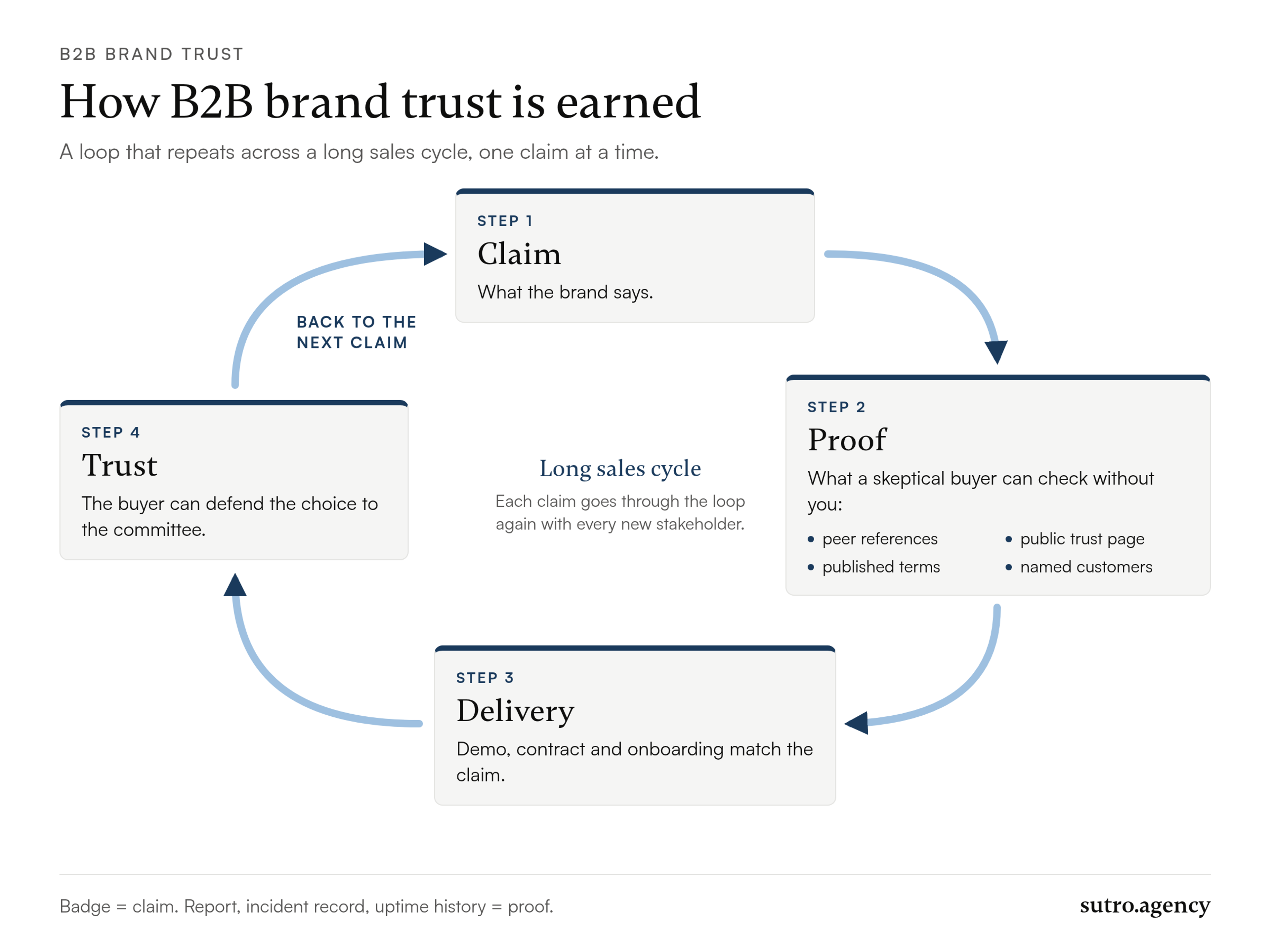
B2B brand trust is the confidence a buyer has that you will deliver what you claim. It is earned with evidence and delivery, not messaging.
Buyers do not take your word for it. They check, they ask peers, and they compare what you said in the first call with what they can verify in the last review. A brand that survives that comparison gets trusted. One that does not gets discounted, delayed or dropped.
Most B2B branding advice stops at voice, visuals and slogans. At Sutro, we work as a brand strategy studio for technical B2B teams, and we treat a brand as a set of claims. Every claim is a debt that proof has to pay.
This article covers what trust means to a B2B buyer, which proof moves a buying committee, how to keep claims and delivery aligned over a long sales cycle, and how to spot trust slipping. The figures come from public reports I read, and each is named with its source and year. Everything else is my judgment, and I say so.
What brand trust means for a B2B buyer
For a B2B buyer, brand trust is the belief that choosing you will not harm the business or the buyer's own standing. It is a risk judgment before it is a feeling.
Consumer trust can lean on taste, shared values and emotion. B2B trust is more practical. A buying committee asks whether the product will work, whether the vendor will keep its word once the contract is signed, and who gets blamed if it does not.
Different people ask different versions of that question. The engineer wants to know if the integration will hold. The security lead wants to know if the controls are real. Finance and procurement want terms that match what was promised. A brand earns trust when it gives each of them something checkable.
Forrester's State of Global Business Buyer Trust 2023 research, as reported by DigitalCommerce360 in January 2024, ranked the traits that build trust in a supplier. Competency came first at 18.5%, consistency second at 17% and dependability third at 16.8%. I read the write-up, not Forrester's own report, so I attribute the figures to the report as printed there.
Nothing on that list is a slogan. Competency, consistency and dependability are things a buyer observes over time, so trust follows delivery, not copy. The same Forrester 2023 research found that 74% of buyers who trust their supplier would keep buying additional products, against 43% of those who do not.
Inc. contributors from the Young Entrepreneur Council made the same point in a June 2023 piece: "Trust comes from showing competence, integrity, reliability, and empathy in all interactions with B2B buyers." The operative word is showing.
This article is about evidence and delivery. For how a buying committee perceives a brand at each decision point, read our guide to B2B brand image and buyer perception.
Proof that actually moves a committee
The proof that moves a committee is proof buyers can check without you: what peers say, what documents show and what public records confirm.
The TrustRadius 2024 B2B Buying Disconnect Report shows how often buyers go around the vendor. 56% of buyers spoke with a product user before buying, and 71% did at enterprise price points. Vendors guessed 34%. Half of buyers (50%) sought former colleagues or known peers. Only 27% used vendor-provided references, or 46% at enterprise price points.
In the same TrustRadius 2024 report, the top thing buyers wanted from those conversations was "the confidence to move forward," named by 68%. They are also wary of public praise: per TrustRadius in 2024, 73% believe they regularly or sometimes see fake reviews. And TrustRadius found in 2024 that 66% lean toward established, leading products, against 19% for niche products and 11% for new ones.
Forrester's data points the same way. Per the DigitalCommerce360 write-up of the 2023 Forrester research, 82% named co-workers and 82% named company management as most trusted information sources. In that 2023 data, vendor sales reps scored 58%, seventh on the list. The report's own words: "Salespeople don't innately command trust, barely scoring higher than government officials."
I read both and compared them. They agree: peers beat vendor messaging. My reading is that a brand cannot win this by speaking louder. It wins by making peer checks come back clean and by giving buyers evidence they can verify before and between those conversations. If you are newer or niche, the 66% figure from TrustRadius's 2024 report says the burden of proof is higher, not that you cannot win.
Public proof is the part you fully control. On Nov 19, 2026 I went through Cloudflare's Trust Hub and its public status history. The hub names ISO 27001, ISO 27701, PCI DSS and SOC 2 Type II "and others," with a customer logo strip and a "View case studies" link. On the page itself I saw no subprocessor list, SLA terms, audit dates or uptime numbers. Anything more is a click away. The status history is a live feed of incident and maintenance entries running through that day, including a resolved increased-errors incident for Durable Objects and D1 at 13:37 UTC, with filters by service and location. The text I read showed no uptime percentage.
A badge is a claim. The audit report, the incident record and the uptime history are the proof. The closer proof sits to the claim, the less work the buyer does to believe you.
If I were ordering proof for a technical committee, I'd start with this list:
- Named customers who will take a call, because buyers go to peers anyway.
- Case studies with specifics: what changed, how it was measured, who signed off.
- Public technical documentation that answers integration questions.
- Audit reports with dates, plus a clear way to request them.
- A public incident and status history.
How trust is built over a long sales cycle
Trust is built over a long sales cycle by keeping what you claimed early equal to what the buyer can verify late.
A long cycle gives buyers many chances to compare. The website says one thing, the first call another, the demo a third and the contract a fourth. Every mismatch is a small withdrawal from trust, and committees notice because different people check different pieces. Consistency and dependability, two of the three leading Forrester traits above, describe this exact quality: the same story holding up at every step.
Delivery counts inside the sale too. If the site promises automated reporting, the demo should run it live. If discovery scoped a deployment one way, the contract should describe it the same way. Buyers read how a vendor behaves during the sale as a preview of how it will behave afterward.
The tool I recommend for this is simple.
The claim-to-proof ledger
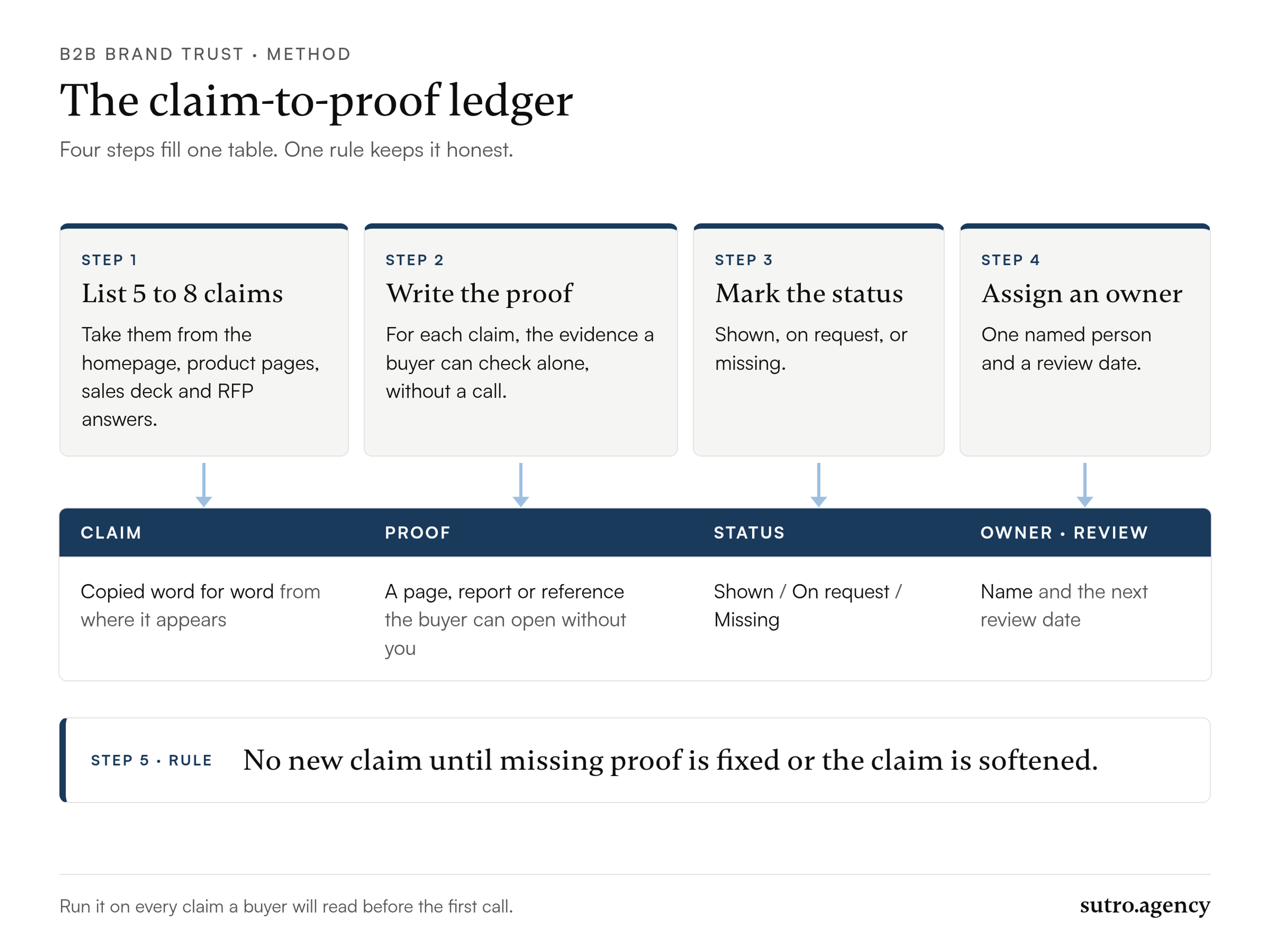
The claim-to-proof ledger is my recommendation, not a study. It is a one-page working document that ties every public claim to evidence a skeptical buyer can check without talking to sales.
- List the five to eight claims your brand makes most often, taken from the homepage, product pages, sales deck and RFP answers.
- Next to each claim, write the proof a skeptical buyer could check alone: a document, a public page, a named customer or a record.
- Mark each proof as shown, available on request or missing.
- Assign an owner and a review date to each row.
- Apply one rule: no new claim goes live until missing proof is fixed or the claim is softened to what you can prove.
Marketing, sales and product should all read it, because those three teams write the claims, repeat them and deliver on them. The brand side of keeping those voices aligned is covered in our guide to B2B brand consistency.
Illustrative example: a fictional ledger
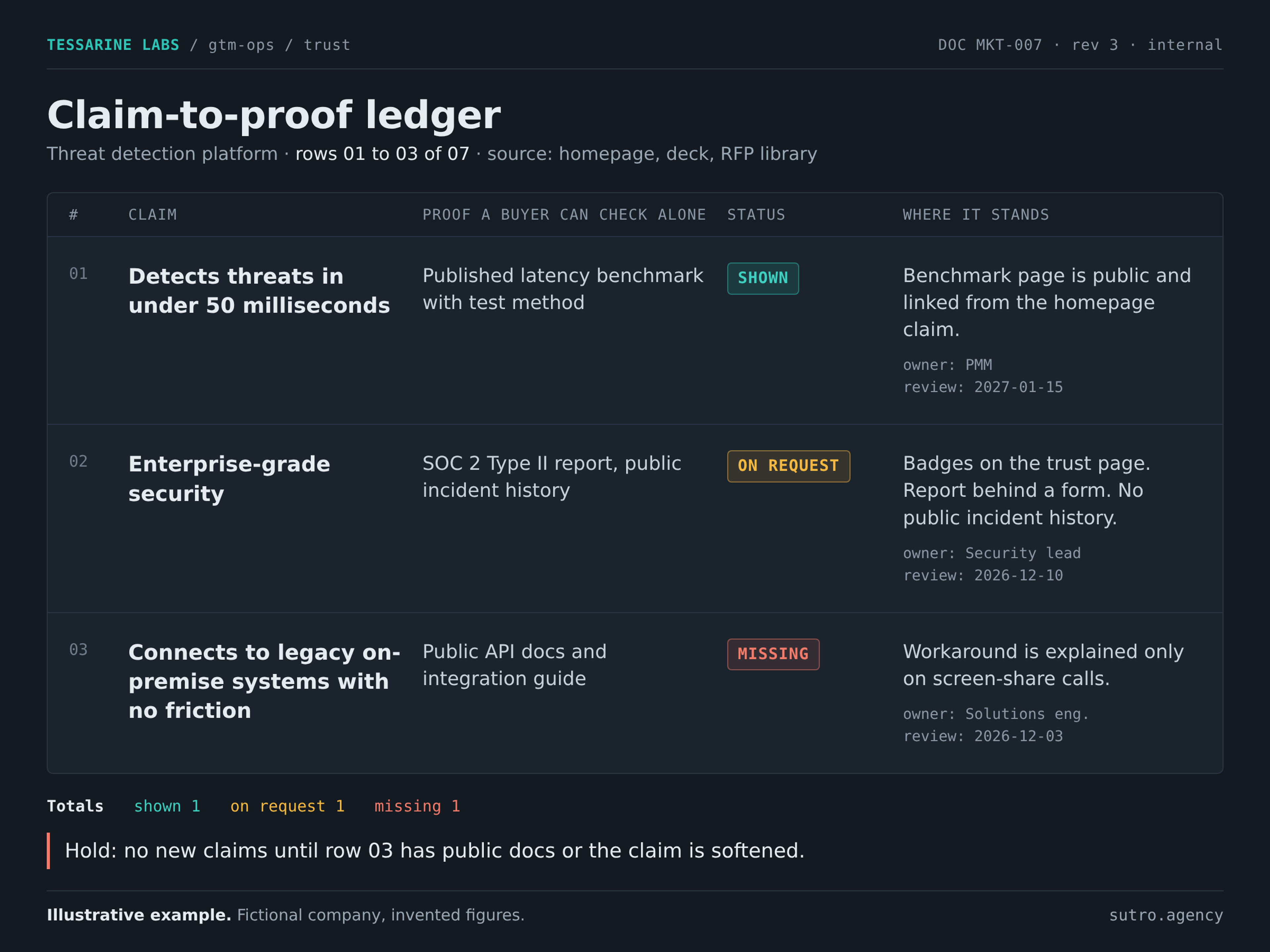
Illustrative example. Tessarine Labs is a fictional company that sells threat detection software to enterprise IT teams. The claims and figures below are invented.
- Claim: "Detects threats in under 50 milliseconds." Proof: a published latency benchmark with its test method. Status: shown.
- Claim: "Enterprise-grade security." Proof: a SOC 2 Type II report and a public incident history. Status: available on request. The badges sit on a trust page, the report is behind a form and no incident history is public.
- Claim: "Connects to legacy on-premise systems with no friction." Proof: public API documentation and an integration guide. Status: missing. Engineers explain a workaround on screen-share calls.
Tessarine's fix list is short. Publish the integration guide, or narrow the third claim to the three legacy systems it can document. Publish the incident history and state how fast the audit report is sent. Until then, the third claim is a liability. It will surface in a technical review and cast doubt on the other two.
How to tell if trust is slipping
Trust is slipping when buyers ask for proof earlier, more often and in more detail than they used to.
This is my judgment from how buying works, not a measured benchmark. Trust rarely drops in one deal. It wears down across several.
Signs I'd watch for:
- Proof requests arrive late and get specific. A buyer who asks for a custom benchmark just before signature does not believe your standard claims.
- Reference requests come right after the first call. Buyers already lean on peers, per TrustRadius. Asking you for names this early suggests they expect your own account to need checking.
- Security or legal review stalls on small points. Questionnaires come back long and customized.
- Reps discount before value is agreed. Price becomes the substitute for confidence.
- You lose late to the established incumbent. With 66% of buyers leaning toward established products in TrustRadius's 2024 data, this is the default result when risk feels unresolved.
- Sales spends demo time softening marketing claims. The gap between site and product is already visible.
- The ledger shows more missing rows than last quarter.
To check, I'd start with three sources you already have: lost-deal notes, the proof requests your sales team receives, and the ledger. If the same missing item appears in all three, fix that one first.
Mistakes that quietly burn trust
Trust burns quietly when a brand hides flaws, offers vague proof, lets claims outrun the product or makes the buyer ask sales for basic facts. Each one tells a buyer to check harder.
Polishing away the flaws
Buyers know software breaks. They do not expect perfection. They expect a visible record and a fast fix. A vendor that shows only a clean history, or hides incident history behind a login, invites the assumption that the history is bad. That is my opinion, not a measured result, but Cloudflare's public feed of resolved incidents shows the opposite approach. A visible record is more believable than a blank one.
Case studies without specifics
A case study saying a logistics business saw big gains gives a buyer nothing to check. With 73% of buyers saying they regularly or sometimes see fake reviews online, per TrustRadius in 2024, unverifiable praise is discounted by default. Name the customer where you can, say what was measured, and include what did not go to plan.
Claims that run ahead of the product
This happens when marketing adopts trending category language after a funding round or a pivot. If the site says platform and the evaluation reveals a point solution with a few integrations, buyers revise every other claim downward. The ledger catches this before a buyer does.
Making sales the only door
According to the 2023 Forrester research reported by DigitalCommerce360, 58% of buyers trust vendor reps as a source, seventh on the list, which suggests buyers prefer other sources. Requiring a sales call to see basic API documentation adds friction at the moment a buyer is trying to build confidence alone. I'd publish what an engineer would ask for first.
Badges with nothing behind them
Logos and certification marks without scope, dates or a path to the report look like decoration. On Cloudflare's Trust Hub, the certification list was easy to find and the detail was a click away. Make that next step obvious and fast, and say how long it takes.
Conclusion
Trust in B2B is not a tone of voice. It is the record of claims that held up when a buyer checked them. Competency, consistency and dependability lead the Forrester list because buyers can only see them in delivery, and peers confirm or contradict what you say long before you hear about it.
Start with the ledger. List your claims, find the missing proof, and close the gaps before you add anything new. If you want a second set of eyes on your claims and the proof behind them, you can get in touch with us.
Questions
- What is B2B brand trust?
- B2B brand trust is the confidence a buyer has that you will deliver what you claim. It is earned with evidence, such as peer references, documentation and public records, and with delivery that matches your claims at every step of the sale.
- How do you build trust with B2B buyers?
- Show proof the buyer can check without you, and keep your claims equal to your delivery. In practice that means named customers who take calls, specific case studies, public documentation, dated audit reports and a visible incident history. A claim-to-proof ledger helps you find the gaps.
- What is a B2B brand?
- A B2B brand is the reputation and promise of a business that sells to other businesses. For a buying committee it works as a shortcut for risk: how likely the vendor is to do what it says.
- How risky is B2B sales?
- B2B sales is risky for both sides. Sellers face long cycles, committee decisions and late losses to established incumbents. Buyers carry the risk of a wrong choice reflecting on them, which is why they look for proof and peer opinions before committing.
- What is the rule of 7 in B2B?
- The rule of 7 is an informal marketing rule of thumb that a prospect needs to see a message about seven times before acting. It has no authoritative source, and the real number varies by buyer and deal. Treat it as a reminder to stay consistent, not as a plan.
- Is B2B a legit company?
- B2B is not a company. It stands for business-to-business, a model where one business sells to another. To judge whether a specific B2B company is legitimate, check for customers who will take a reference call, public documentation, dated audit reports and a public status history.
Sources
- DigitalCommerce360, Forrester survey: how most trusted suppliers attract B2B buyers (Jan 12, 2024)
- TrustRadius, 2024 B2B Buying Disconnect Report
- Inc. (Young Entrepreneur Council), 4 Pillars of B2B Brand Trust (Jun 27, 2023)
- Cloudflare Trust Hub (read Nov 19, 2026)
- Cloudflare Status, incident history (read Nov 19, 2026)