Positioning
Digital B2B Branding: Website, Content, and Social as One System
Digital B2B branding is making your website, content, social and third-party profiles tell one story, so buyers, search engines and AI assistants describe you the same way. Here is what 14 B2B software homepages show and how to build the system.
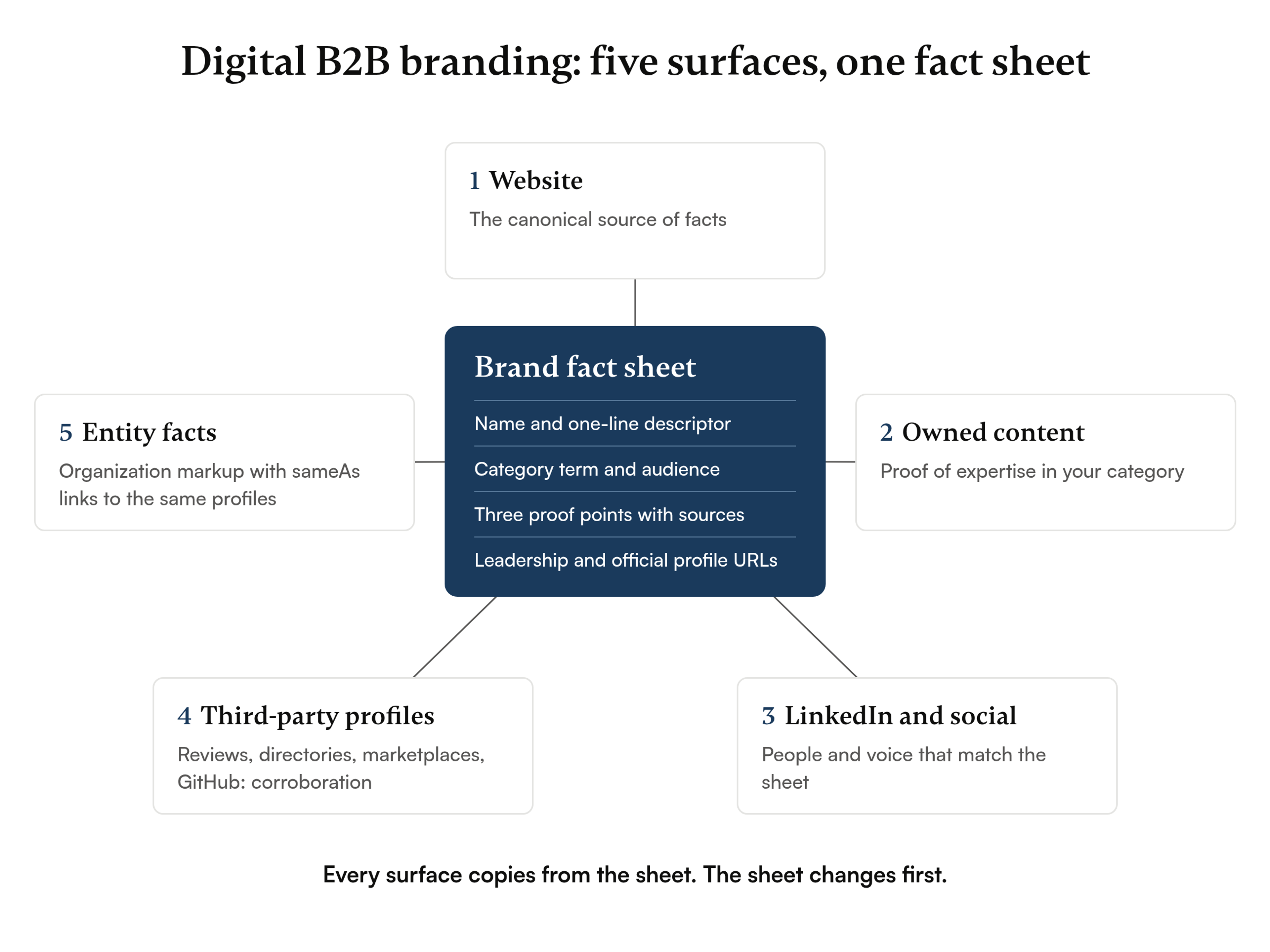
Key takeaways
- Digital B2B branding means one story across your website, content, social and third-party profiles, so buyers, search engines and AI assistants describe you the same way.
- In my November 22, 2026 check of 14 B2B software homepages, 12 served Organization markup, 5 linked Wikipedia or Wikidata, and 14 use AI or agent wording. It reads served HTML only and says nothing about rankings.
- Five surfaces each have one job: website, owned content, social, third-party profiles and entity facts.
- One internal brand fact sheet is my recommended method for keeping those surfaces aligned.
- Google says Organization structured data can help it understand and disambiguate your organization. It does not promise rankings or citations.
- Measure with branded impressions in Search Console, self-reported attribution, AI assistant answers compared to your fact sheet, and a profile parity check.
Digital B2B branding is making your site, content, social and third-party profiles tell one story, so buyers, search engines and AI describe you alike. It starts with positioning and ends with a check you can run this week.
Picture a hypothetical but common pattern: the website was rewritten last year, LinkedIn was last touched at a funding round, and a directory profile still describes a product you retired. Each piece looks fine alone. Together they tell three stories.
I checked 14 B2B software homepages on November 22, 2026. 12 of 14 served Organization markup, only 5 of 14 linked Wikipedia or Wikidata in it, and 14 of 14 use "AI" or agent wording in the title tag or meta description. Markup is common, the vocabulary is shared, and links to reference entries like Wikipedia are rare.
What digital B2B branding is, and why AI assistants raise the stakes
Digital B2B branding is keeping one account of who you are, in the same words, wherever a buyer or a machine looks. In my view, AI assistants raise the stakes because they summarize you from what they find, and buyers increasingly use them.
Sutro is a branding company for B2B software teams, so I come at this from positioning first and markup second. Positioning decides what the one story is. The digital work makes sure it survives every surface.
In a January 22, 2026 Forrester blog post, John Buten wrote: "While the proportion of buyers using AI only grew five percentage points, to 94%, twice as many buyers in Forrester’s Buyers’ Journey Survey, 2025, named generative AI or conversational search as a more meaningful or important source of information than any other source, far outpacing vendor websites, product experts, and sales."
Forrester reports in the same January 2026 post: "The majority of business buyers, 61%, report using private AI tools provided by their organization." The page gives no sample size, so I read both figures as direction, not precision.
My read: when an assistant is where a buyer first forms a view, your website no longer speaks for you alone. What the assistant finds on your profiles and in your markup can shape its summary. Forrester does not describe how these tools build answers, so that part is my reasoning, not its finding.
When I searched "digital b2b branding" on November 22, 2026, Google's AI Overview described the term as building trust, authority and recognition across the online channels where enterprise buyers decide. It listed the website, thought leadership content and LinkedIn among the touchpoints. I'd add third-party profiles and entity facts, because that is where drift hides.
What I found on 14 B2B software homepages
In my check of 14 public B2B software homepages, Organization markup was common, Wikipedia and Wikidata links were rare, and AI language was universal. The check shows what each server returned, not how any page ranks or gets cited.
On November 22, 2026, I pulled the public homepages of Airtable, Asana, Figma, Gong, Intercom, Linear, MongoDB, Notion, Okta, Postman, Retool, Twilio, Vercel and Zendesk. I requested each with a normal browser user agent and read the HTML the server returned: title tag, meta description, Open Graph title and description, and any JSON-LD with its sameAs links. I attempted 15; Snowflake returned a 403, so I dropped it.
Caveat: I read only server-delivered HTML. Markup injected later by JavaScript would not show up, so "none" means "none in the served HTML." Fourteen well-known homepages are a snapshot, not a sample of the market.
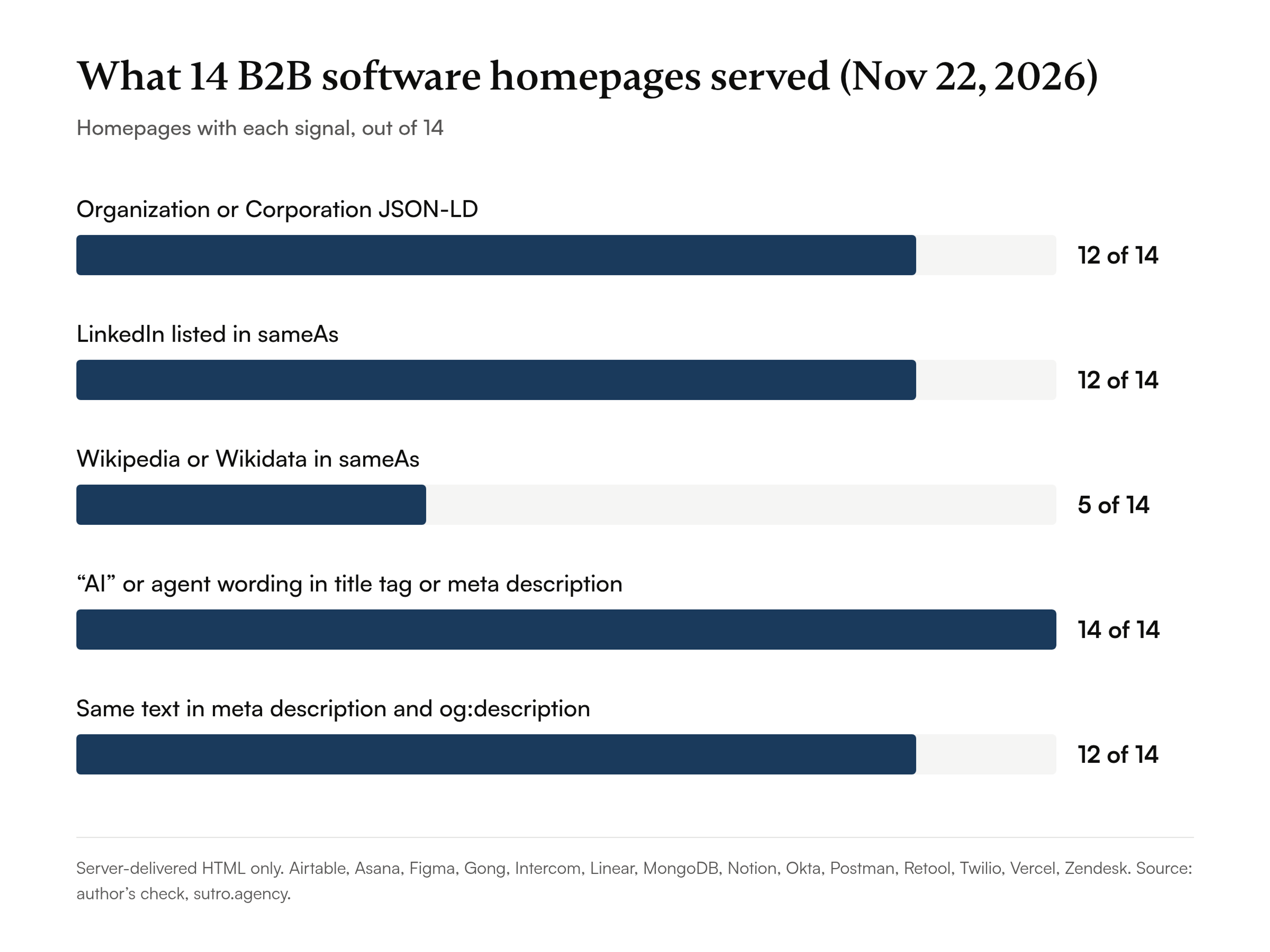
The results:
- 12 of 14 served Organization (or Corporation) JSON-LD on the homepage. Airtable and Linear had no JSON-LD in the served HTML.
- All 12 listed a LinkedIn URL in sameAs.
- 5 of 14 linked Wikipedia or Wikidata in sameAs: Intercom, Okta, Postman, Twilio and Vercel.
- Vercel listed the most distinct third-party profile domains, 10, including GitHub, npm, Reddit and Bluesky. (Zendesk lists more, but most are its own regional sites.)
- 14 of 14 use "AI" or agent wording (agent, agents, agentic) in the title tag or meta description, and 13 of 14 do so in the title tag. Linear is the exception, with only its description: "Purpose-built for planning and building products with AI agents."
- 12 of 14 use identical text for meta description and og:description.
Shared vocabulary
Title tags show the convergence. Postman: "API engineering for your agents". Vercel: "Agentic Infrastructure - Vercel". Gong: "Gong - Revenue AI". Notion: "The AI workspace that works for you. | Notion".
When every homepage reaches for the same trend word, the word stops separating anyone. My view: your one-line descriptor needs a concrete difference, such as who it is for and what it replaces.
Two descriptions of one company
Asana is the clear exception to matching descriptions (Okta differs only in one capital letter). Its meta description reads "Work management software for teams and AI agents. Plan, automate, and execute critical workflows together." Its og:description reads "Supercharge your team with AI that gets work done."
Depending on where a link is shared, a buyer can see a different one-line description of the same company.
Run the same check on your homepage
When I ran it on our own homepage, the Organization markup had name, url, logo, description, address, founder and knowsAbout, but no sameAs links. The founder's Person entity carried them instead. That is a gap worth closing.
To run it on yours:
- View source and search for application/ld+json.
- Confirm there is Organization markup and that it includes sameAs.
- Compare the title tag, meta description and og:description.
- Open each sameAs URL and compare its description with your homepage.
What to copy: list sameAs for profiles you officially run, add Wikipedia or Wikidata only where an accurate entry exists, and keep meta and og descriptions identical.
The five surfaces and the job of each
A digital B2B brand lives on five surfaces: website, owned content, social, third-party profiles and entity facts. Each has one job.
- Website. The canonical source of facts. Everything else points back to it. The website gets its own article, so I'll keep it to that.
- Owned content. Blog, docs and webinars. The job is proof that you know the category, using the same category term and facts instead of new framing per post.
- LinkedIn and social. People and voice. In my view, buyers use it to check leadership and momentum. The job here is not a posting plan: it is that your company page, about lines and executive bios match the fact sheet.
- Third-party profiles. Review sites, directories, marketplaces and developer spaces such as GitHub. The job is independent corroboration. You do not fully control them, which is why, in my view, buyers trust them and why they go stale.
- Entity facts. Organization markup that ties the other four together for machines.
Building the wider brand system is a separate job, covered in the brand toolkit behind every surface.
One brand fact sheet behind every surface
The simplest way to keep five surfaces in step is one internal page they all copy from. This is my recommended method, not a study, and I did not test it on the 14 homepages.
The sheet holds:
- Approved company name
- One-line descriptor
- Category term
- Primary audience
- Three proof points, each with a source
- Leadership names and titles
- Official profile URLs
Every surface copies from it. Every sameAs URL comes from its URL list. When something changes, the sheet changes first, and one named person owns it. Keeping every team inside the lines is a different question, covered in rules that keep every touchpoint on brand.
Illustrative example: Ivelmark, a fictional edge platform
Ivelmark is invented, and so is every detail below.
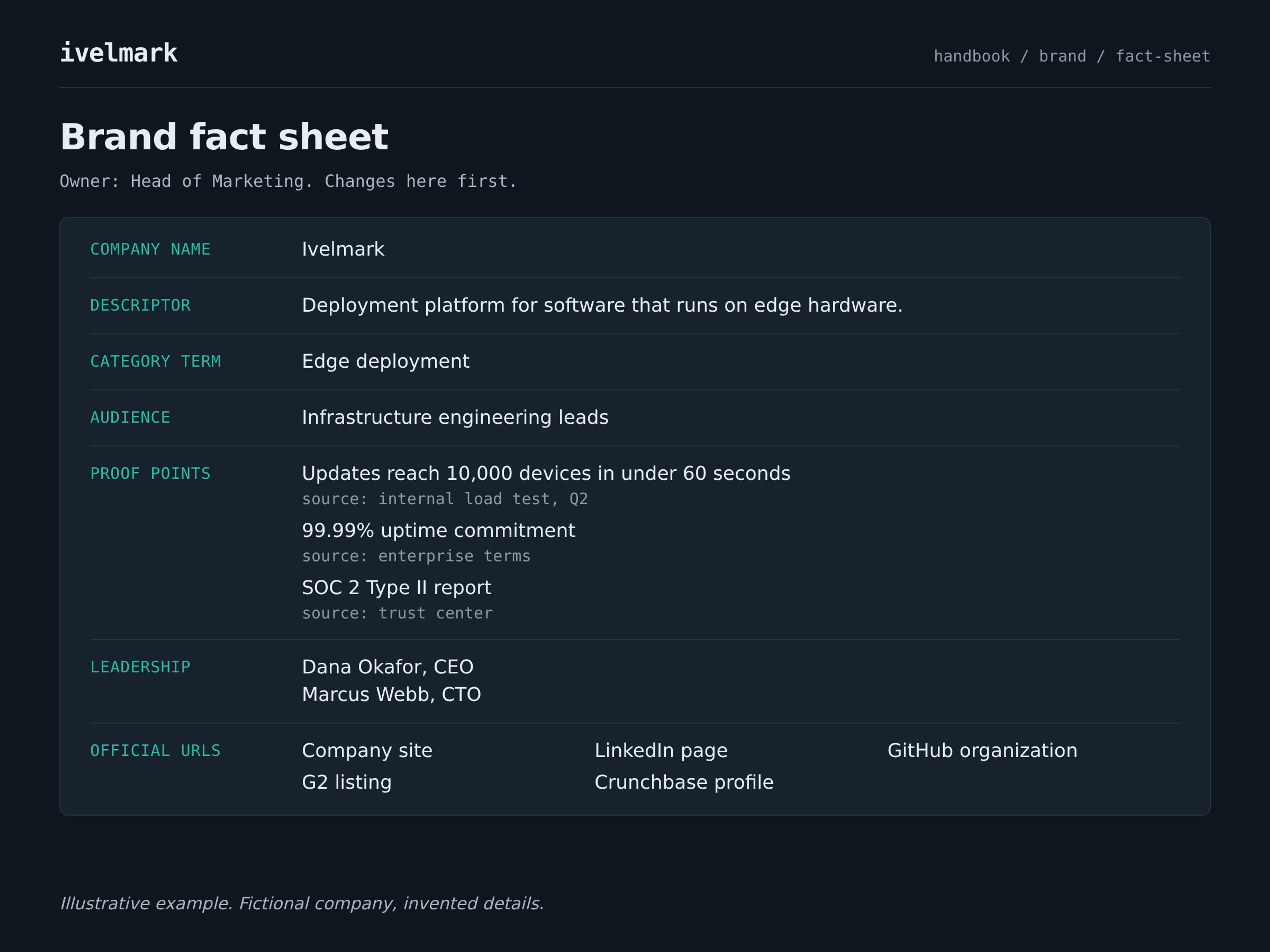
- Company name: Ivelmark
- Descriptor: Deployment platform for software that runs on edge hardware.
- Category term: Edge deployment
- Audience: Infrastructure engineering leads
- Proof points: An update reaches 10,000 devices in under 60 seconds (internal load test, Q2). A 99.99% uptime commitment (enterprise terms). A SOC 2 Type II report (trust center).
- Leadership: Dana Okafor, CEO. Marcus Webb, CTO.
- Official URLs: Company site, LinkedIn page, GitHub organization, G2 listing, Crunchbase profile.
Note what is missing: adjectives. Every line is a fact someone can verify or a term someone can reuse.
Entity facts for search and AI assistants
Entity facts are Organization markup on your homepage that states your name, description and official profiles in a form machines read directly. Google says this can help it understand you. Nothing here promises rankings or citations.
Google's Organization structured data documentation says: "Adding organization structured data to your home page can help Google better understand your organization's administrative details and disambiguate your organization in search results."
For sameAs, it asks for "The URL of a page on another website with additional information about your organization, if applicable. For example, a URL to your organization's profile page on a social media or review site."
schema.org defines sameAs as "URL of a reference Web page that unambiguously indicates the item's identity. E.g. the URL of the item's Wikipedia page, Wikidata entry, or official website."
In practice, write the name, url, logo and description in the markup from the fact sheet, and build sameAs from its URL list. Keep it to official profiles, not a link dump. In my check, all 12 pages with markup listed LinkedIn, and Vercel went to 10 domains. A Wikipedia or Wikidata link belongs only where an accurate entry exists.
I'd serve the markup in the initial HTML so a simple check like mine can see it. Markup labels a story. It cannot fix one that is inconsistent.
How to build the system, in order
Build from the inside out: facts first, then the website, then outside profiles, then markup. Each step hands the next one something fixed to copy.
- Inventory every surface. List profiles, directories, marketplaces, the GitHub organization, speaker bios and press boilerplate. Why: you cannot align what you have not listed.
- Write the fact sheet. Get the CEO and the marketing lead to sign off on the descriptor and category term. Why: the story is chosen once, not per channel.
- Fix the website. Why: every other surface points back to it, so it must be right first.
- Update outside profiles to match. Start with the ones buyers are most likely to open. Why: a stale profile contradicts the site for anyone who cross-checks.
- Align content. Fix the most-read posts and docs first, then let the rest follow as you touch them. Why: content that repeats the term and the proof reinforces the story.
- Add or fix the markup. Why: markup should describe a finished story, not a draft.
- Re-check on a schedule. I'd review quarterly. Why: drift returns with every hire, campaign and launch.
How to measure digital B2B branding
Measure whether the market describes you the way your fact sheet does. There is no single score, so use four directional signals and compare them over time.
- Branded search impressions. In Search Console, watch impressions for queries that include your company or product name. A rise suggests more people look for you by name, but it does not say why.
- Self-reported attribution. Add a free-text "How did you hear about us?" to the demo form. Read the buyers' own words. If they use your category term, the story is landing.
- Ask AI assistants. Prompt several assistants to describe your company and category. Compare each answer with the fact sheet: name, descriptor, category, audience, leadership. Save the answers with the date. Answers vary between runs, so look for patterns, not verdicts.
- Profile parity check. Open every URL on the sheet and compare descriptions line by line. Count mismatches. The target is zero.
Mistakes that break a digital B2B brand
Most breakage is quiet: an old profile, a tagline rewritten in one place, a trend word with nothing behind it. Each gives buyers and assistants a reason to doubt the rest.
- Old positioning on third-party profiles after a rebrand. Buyers cross-check, and the mismatch reads as carelessness.
- A slightly different descriptor on every surface. Asana's two descriptions show how easily it happens, even on one homepage.
- Chasing trend words. 14 of 14 homepages in my check use AI or agent wording, so the word alone separates no one.
- Markup without aligned profiles, or aligned profiles without markup. Each half is weaker alone.
- Treating sameAs as a link dump. Point it at profiles you officially run.
- Measuring follower counts. Measure how accurately the market describes you instead.
- No owner. A fact sheet that nobody owns goes stale.
Conclusion
Digital B2B branding comes down to one story, written once and copied everywhere. Write the fact sheet, update the surfaces in order, then check the markup and the profiles against it.
Start with the profile you suspect is stale. If you want a second opinion, tell us which profile still describes an older version of you.
Questions
- What is digital B2B branding?
- Digital B2B branding is making your website, content, social and third-party profiles tell one consistent story. The goal is that buyers, search engines and AI assistants describe you the same way.
- What are the key digital touchpoints for a B2B brand?
- Five: your website, owned content, LinkedIn and other social, third-party profiles such as review sites, directories and GitHub, and entity facts such as Organization markup. Each has one job. The website is the source of facts, content is proof, social is people and voice, profiles are corroboration, and markup ties them together for machines.
- How do you measure digital B2B branding?
- Use directional signals, not a single score. Track branded search impressions in Search Console, read self-reported attribution in your own buyers' words, ask AI assistants to describe you and compare the answers to your fact sheet, and check your profiles for mismatches.
- How does AI search change B2B branding?
- It raises the cost of inconsistency. In Forrester's Buyers' Journey Survey, 2025, twice as many buyers named generative AI or conversational search as a more meaningful or important source of information than any other source, far outpacing vendor websites. That is Forrester's finding. My view is that assistants summarize what they find about you, so conflicting profiles can produce a muddled summary.
- Do B2B companies need Organization structured data?
- It is optional, but I recommend it. Google says Organization structured data on your homepage can help it better understand your organization and disambiguate it in search results. It does not promise rankings or citations, and it works only if your profiles already agree.
- Who should own digital B2B branding?
- In my view, one named person in marketing, usually the head of marketing or brand, should own the fact sheet. Product marketing, web, sales and the founder contribute, but a single owner approves changes. Without an owner, profiles drift.