Positioning
B2B Taglines: Do You Need One and How to Write It
Most B2B companies don't need a clever tagline. See when a technical B2B company needs one, and how to write and test it.
Key takeaways
- A B2B tagline is a short, lasting line next to the company name; you need one only if you can use the same line consistently for years.
- BrandingBusiness's informal count found only 5 of 20 well-known B2B brands using a tagline with their logo, so skipping one is a normal choice.
- In our November 17, 2026 check of 22 B2B homepages, 18 title tags were plain descriptions of the category, 3 were slogan-style and 1 was the brand name alone.
- Write the plain descriptor first, draft ten or more options, then test the finalists in a title tag, a deck and a banner.
- Run each candidate through five checks: specific, clear in five seconds, short enough to repeat, provable, and free of empty words.
Most B2B companies don't need a clever tagline: in our November 17, 2026 check of 22 B2B homepage title tags, 18 were descriptive. A B2B tagline is a short line next to the company name that says what the company does or stands for. Whether you need one comes down to a plain question: will your team use the same line, in the same place, for years?
Founders often ask for a tagline when something big shifts: a move upmarket, a new category, a merger. That is also when a tagline is easiest to get wrong. Positioning has to be settled first, and that is the part of the work we do at Sutro, a B2B tech branding firm in San Francisco. A line written before the positioning is a guess. The framework is in our five-step guide to B2B brand positioning.
This guide covers the decision first, then the method. It also reports a small check we ran on 22 real B2B homepages on November 17, 2026, and gives you a five-question test for any candidate line.
Tagline, slogan, headline, descriptor and value proposition
These five terms get mixed up in workshops, and each has a different job.
Tagline: a short, lasting line attached to the brand name. It sits near the logo, in decks and on banners, and stays the same for years.
Slogan: a line tied to a campaign. It changes when the campaign does.
Headline: the main copy at the top of a page. It is tested and rewritten often.
Descriptor: a literal statement of the category, such as the title tag "Cloud Monitoring as a Service" on Datadog's homepage. It has no wordplay, but it is clear.
Value proposition: the full argument for why a buyer should choose you: who it is for, which problem, what you offer and why you are different. It is a paragraph or a framework, never four words.
For many technical companies a good descriptor does the tagline's job. Hold on to that thought, because our data below points the same way.
Do you need a B2B tagline?
No. A tagline is optional, and plenty of large B2B companies run without one.
BrandingBusiness, a branding firm, looked at 20 well-known B2B brands in its article on whether you need a tagline. Only five used a tagline with their logo: 3M, Accenture, Canon, GE and Siemens. Fifteen did not, including IBM, Cisco and Microsoft. That was a quick, informal count in an undated article, so read it as one data point about big brands, not as a rule for a Series B company with no name recognition.
The size of the company matters. A famous brand can skip the line because the name already carries the meaning. A company buyers have never heard of has to explain itself somewhere, and a descriptor or tagline next to the logo is one cheap place to do it.
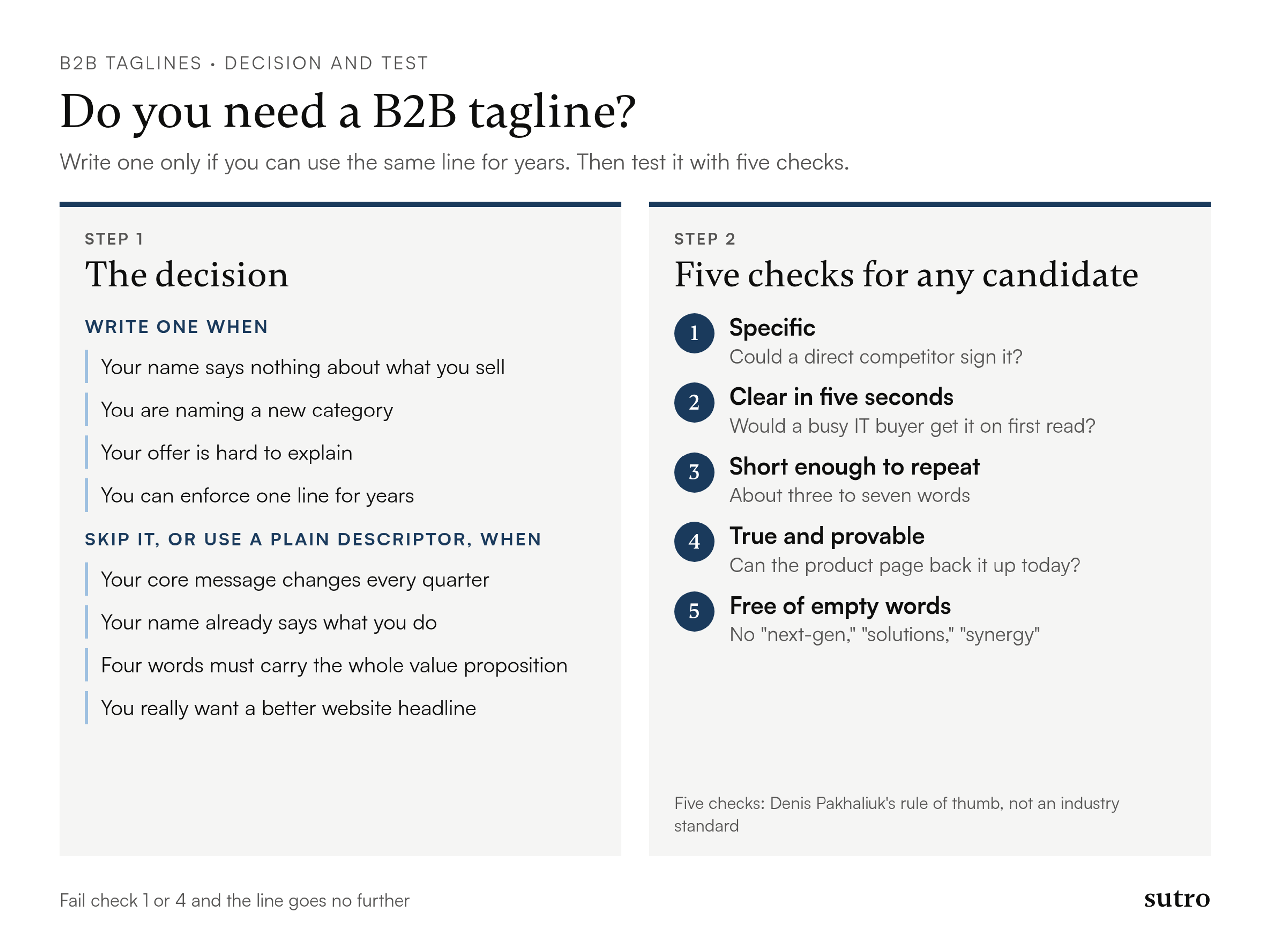
Write a tagline when most of these are true:
- Your name says nothing about what you sell. A buyer who meets a made-up word needs the category beside it.
- You are naming a new category, and the category name has to travel with your brand everywhere.
- Your offer is hard to explain, so a short anchor helps before the detail starts.
- You can enforce one line across the website, sales decks, conference banners and social profiles, for years.
Skip it, or use a plain descriptor, when any of these is true:
- Your core message changes every quarter. Use flexible headlines until positioning settles.
- Your name already says what you do.
- Stakeholders expect four words to carry the whole value proposition. They can't.
- What you really want is a stronger website headline. That is a copy test, not a brand asset.
The brand element guide lists the tagline and core message among the first five elements to lock. That line can be a plain descriptor. This article helps you decide whether it should be more than that. Where a tagline sits among all ten elements is in our guide to B2B brand elements.
What 22 B2B homepage title tags say
We checked what technical B2B companies actually put next to their name. On November 17, 2026 we fetched 29 company homepages with curl -L and a Chrome user agent and read the text of the HTML title tag. Seven would not return a readable title (Snowflake, Oracle, SAP, Cisco, Adobe, HashiCorp, ServiceNow). The other 22 are in the chart below. Where a title repeated the brand name at the end, we trimmed that repeat in the chart.
We sorted each title into one of three types. Descriptive means it says what the product is or does. Slogan-style means a promise with no category named. Brand name only means nothing else is there.
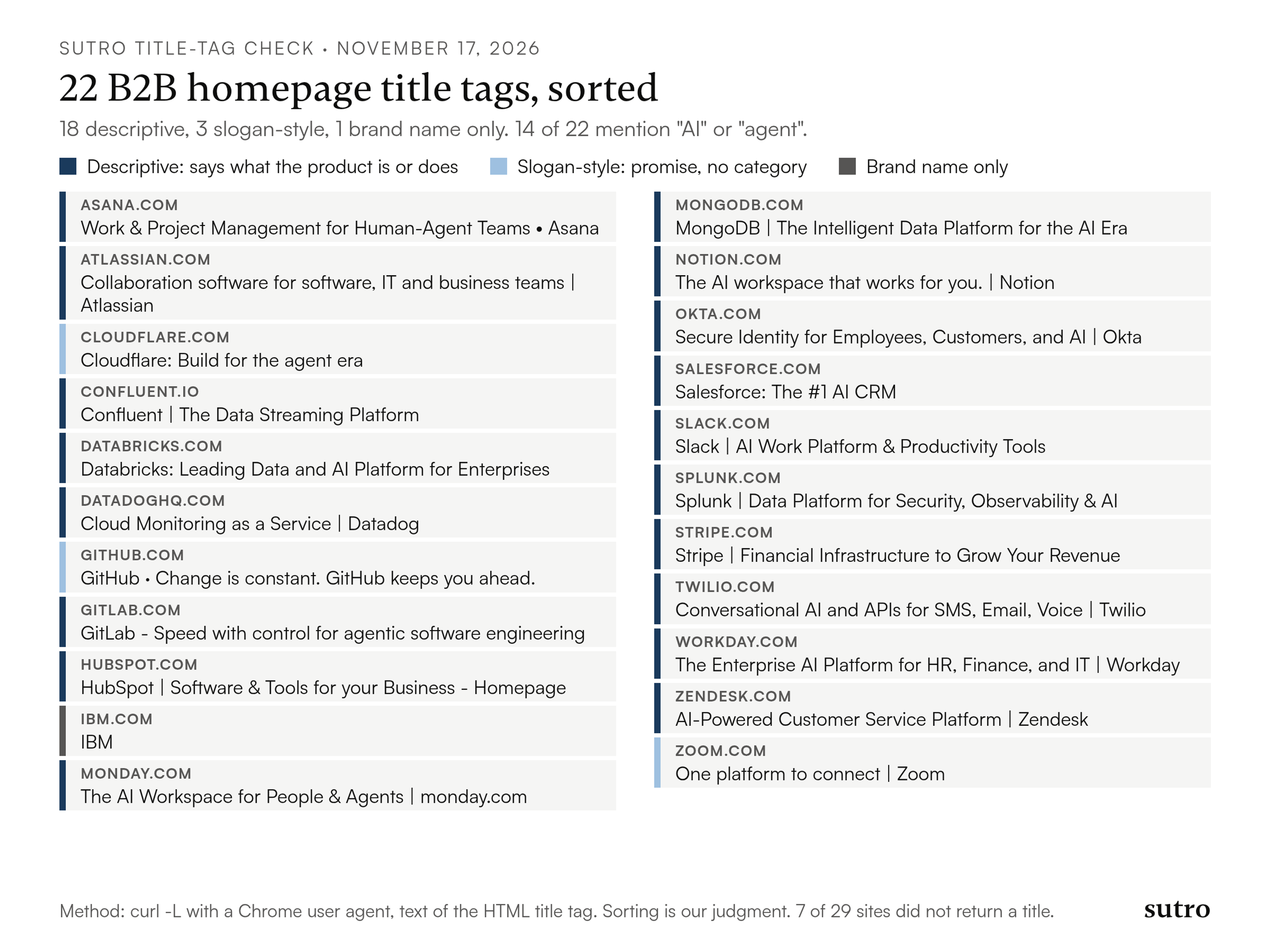
The result: 18 of the 22 titles were descriptive, 3 were slogan-style (Cloudflare, GitHub, Zoom) and 1 was brand name only (IBM). Fourteen of the 22 mention "AI" or "agent".
This is our own small check, not a study of B2B. It covers one list of well-known tech companies, one page each, on one day, and the sorting is our judgment. The title tag is not the same thing as a logo tagline. Still, it shows where companies in this space put their words: a plain statement of the category, next to the name.
The second number is a warning. When 14 of 22 titles lean on the same two words, a descriptor ages the moment the market's vocabulary moves, and your line starts to sound like everyone else's. That is the reason for check number one in the test below.
How to write a B2B tagline
Treat this as an editing job with a method. Start from facts, write many options, and cut hard.
Step 1. Start from positioning and the buyer's problem. Write down who you serve and which problem you solve for them. If that is not settled, stop and finish it first. Our messaging framework for sales teams is the step between positioning and a line like this.
Step 2. Write the plain descriptor first. One literal sentence about what the product is and does. It prevents drifting into abstraction, and it may turn out to be the answer.
Step 3. Draft ten or more options. Vary the angle: speed, risk, scale, integration, the cost of the problem. Volume pushes you past the first, most obvious phrases.
Step 4. Filter by what makes a B2B tagline work. DeSantis Breindel, a branding firm, names three attributes of an effective B2B tagline: it is inspired by the brand's essence, it expresses understanding of stakeholders, and it promises a differentiated experience. If an option can't pass all three, drop it.
Step 5. Cut the weasel words. Blue Seedling, in its piece on writing a B2B startup tagline, calls words like "empower" and "unleash" overused, and says a tagline does not have to be the website headline. It also says to start with something bolder and then rein it in. Your final line should survive without them.
Step 6. Test it in context, then lock it. Put it next to the real logo. Put it on a mock conference banner, in the footer of the sales deck and in a title tag. A line that reads well on a whiteboard and badly in these places is not finished. When it passes, write down where it appears and who owns it, so it stays the same.
The five-check test for a tagline
This is my own rule of thumb, not an industry standard. I use it to cut a list of candidates to the ones worth testing.
- Specific. Could a direct competitor sign it? If your biggest rival could put their logo beside it unchanged, discard it.
- Clear in five seconds. Would a busy IT buyer understand it on a first read, with no explanation?
- Short enough to repeat. Aim for about three to seven words, and prefer six or fewer. If a salesperson can't say it from memory, it is too long.
- True and provable. Can your product page back it up today? A claim your site can't support is a liability in a sales call.
- Free of empty words and jargon. Cut the words that fit any company: "next-gen," "solutions," "synergy," "journey." Drop category jargon a busy buyer would have to decode.
A line that fails check one or four should not go further, however good it sounds.
Real taglines and what they show
Real examples help only when they come from the company or a reliable source, so here is what we could verify.
DeSantis Breindel, in the article linked above, uses GE's "Imagination at work" and John Deere's "Nothing Runs Like a Deere" as examples of strong B2B taglines. It says the Deere line began as a temporary advertising slogan, was introduced in 1971, and became a permanent part of the brand. BrandingBusiness picks the same two lines as the ones that held up over time. These are lines from large, long-established companies with decades of repetition behind them.
Blue Seedling's article uses Dropbox as an example of a tagline ("All Yours") that is different from the website's headline, which makes the point that the two can live apart. The article is from 2023, so check Dropbox's current site before quoting it.
In software, the homepage title tags we read on November 17, 2026 are mostly plain statements:
- Stripe: "Financial Infrastructure to Grow Your Revenue"
- Datadog: "Cloud Monitoring as a Service"
- Confluent: "The Data Streaming Platform"
- Atlassian: "Collaboration software for software, IT and business teams"
- Zoom: "One platform to connect"
- GitHub: "Change is constant. GitHub keeps you ahead."
These are title tags, which pages can change at any time. They are examples of how companies phrase the line next to their name, not a claim that these are their official taglines. Zoom and GitHub lean toward promise; the other four state the category.
Illustrative rewrites
Here are three made-up companies with a weak line and a rewrite, run through the five checks. The companies, names and lines are fictional.
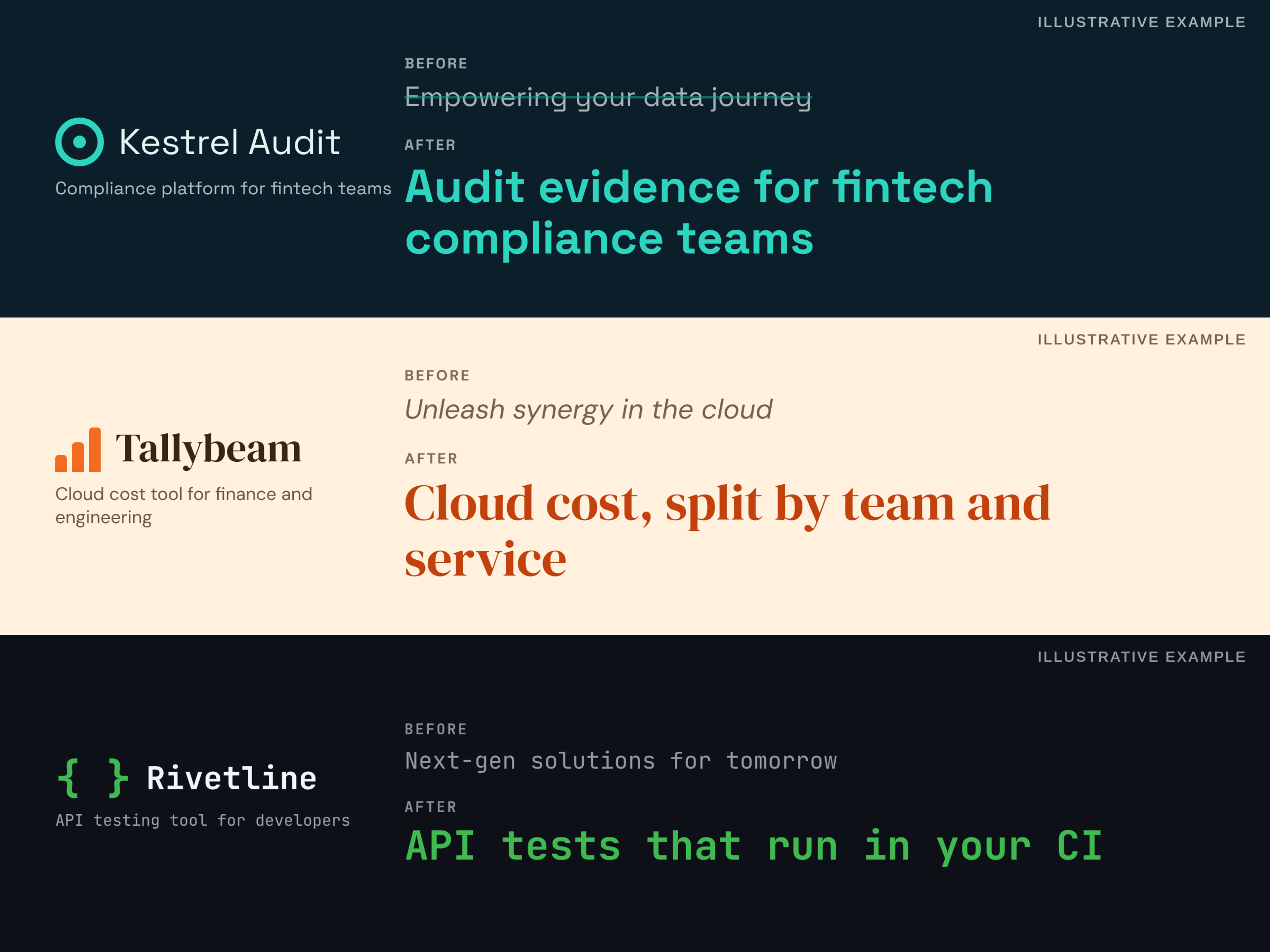
Kestrel Audit, a compliance platform for fintech teams. Weak: "Empowering your data journey." It fails checks one, two and five: any vendor could sign it, and "empowering" and "journey" say nothing. Rewrite: "Audit evidence for fintech compliance teams." It names the buyer and the job, in six words.
Tallybeam, a cloud cost tool. Weak: "Unleash synergy in the cloud." A finance lead can't tell what it does. Rewrite: "Cloud cost, split by team and service." It is specific, and the product page can prove it with a report.
Rivetline, an API testing tool for developers. Weak: "Next-gen solutions for tomorrow." It could belong to any software company. Rewrite: "API tests that run in your CI." A developer reads it once and knows whether it is for them.
Notice what the rewrites share: each states the buyer or the job, and none relies on a metaphor. A metaphor can work, but only once a company has the repetition and name recognition to give it meaning.
Common tagline mistakes
- Cramming everything into one line. A tagline is an introduction, not a feature list. When it says everything, nobody remembers it.
- Mixing up the tagline and the website headline. Headlines change when you test the page. A tagline has to stay put for long enough to be remembered.
- Choosing an abstract line before the name is known. The more unknown the company, the more literal the line should be.
- Skipping the context test. A line approved in a meeting but never tried in a title tag, a deck or a banner often fails there.
- Changing it every year. If the line changes with each campaign, it is a slogan, so treat it as one.
Conclusion
A B2B tagline is a commitment to say the same short thing for a long time. If your positioning is settled and you can enforce one line, write it with the six steps and run it through the five checks. If not, a clear descriptor beside your name does most of the work.
If you are weighing a tagline against a plain descriptor, or your team keeps rewriting the same line, book a call and tell us which line you can't settle.
Questions
- What is the difference between a B2B tagline and a website headline?
- A tagline is a short, lasting line beside your name, used in many places for years. A headline is the main copy on one page and gets tested and rewritten often.
- How long should a B2B tagline be?
- About three to seven words is my rule of thumb, not a standard. The real test is whether a salesperson can say it from memory without checking.
- Should a B2B tagline include our product category?
- Often yes, especially for a company buyers don't know. In our check of 22 homepage title tags, 18 named the category or the job. A well-known brand can afford a more abstract line.
- What are some famous B2B taglines?
- DeSantis Breindel uses GE's "Imagination at work" and John Deere's "Nothing Runs Like a Deere" as examples of B2B taglines that lasted. Both come from large companies with decades of repetition.
- Should a B2B tagline be catchy?
- Clear matters more than clever. A tagline has to be understood by a busy buyer in seconds, and Blue Seedling advises cutting overused words such as "empower" and "unleash." A catchy line that a competitor could also use fails the first check.
Sources
- BrandingBusiness: B2B Taglines. Do You Need One? (20 well-known B2B brands, five with taglines)
- DeSantis Breindel: B2B Taglines, The Hardest Working Words in Branding (three attributes; GE and John Deere)
- Blue Seedling: How I learned to stop worrying and love the tagline (weasel words; tagline vs headline; Dropbox)
- Stripe homepage (title tag read Nov 17, 2026)
- Datadog homepage (title tag read Nov 17, 2026)
- Confluent homepage (title tag read Nov 17, 2026)
- Atlassian homepage (title tag read Nov 17, 2026)
- Zoom homepage (title tag read Nov 17, 2026)
- GitHub homepage (title tag read Nov 17, 2026)