Strategy
Hiring Outside Help for B2B Branding: Scope, Questions, and Budget
How to decide whether to bring in outside help for B2B branding, what a sound scope includes, which questions to ask, and what drives the budget.
Key takeaways
- Bring in outside help at a commercial inflection point, such as moving upmarket, raising capital or preparing for an exit, not for routine collateral updates.
- A complete scope covers strategy and positioning, verbal identity, visual identity, website direction and sales enablement, in that order.
- Market data puts most agency minimums at $10,000 or more, but technical companies with several buyer roles and products usually need more than the median.
- Research depth, number of decision-makers, product complexity and rollout breadth drive the price more than the logo does.
- A phased engagement is usually the safest model for complex companies, and the CEO must take part in the strategy phase.
Bring in outside help for B2B branding when the business is at a commercial inflection point and the current brand can't carry the next stage of growth. Scope the work around a clear business event, plan for strategy, messaging, identity, website direction and sales enablement, and budget for the research and executive time the work needs, not only for the design files.
My experience has taught me that most B2B branding projects fail before a single design file is opened. They fail because the leadership team misunderstands the scope, underestimates the budget, or hires the wrong kind of partner for its stage.
I have run Ramotion since 2009, across more than 350 projects, and I built Sutro for technical companies at roughly $10M to $150M in revenue that are moving upmarket, raising capital, consolidating after an acquisition or preparing for an exit. This guide covers the decision in the order you will face it, from whether to hire at all to how to read a proposal. If you want to see how these engagements are structured in practice, Sutro's approach to B2B brand work is built around the same inflection points.
When to keep branding in-house and when to hire outside help
Keep branding in-house when you are still searching for product-market fit or only need updates to existing collateral. Hire outside help when the business has outgrown its story: you are shifting from founder-led sales to an enterprise sales team, raising a significant round, entering a new segment or preparing for an exit.
Product design is not brand design
Technical companies often hand a rebrand to the internal product design team. The assumption is that people who design good software interfaces can design a brand. These are different disciplines.
Product designers remove friction so a user can complete a task inside the application. Brand designers shape how the market perceives the company, so it stands apart in a crowded category and makes sense to the economic buyer who never logs in. Both skills matter, but they answer different questions.
Distance is part of what you pay for
Internal teams know the architecture intimately. They use internal acronyms and assume the market understands the product the way the engineers do. An outside partner has the distance to show you how buyers actually read your positioning. That distance also helps with internal politics: an outside facilitator can force the leadership team to agree on one narrative instead of four competing ones.
A useful test: if your executives describe the company differently in their first two sentences, you have an alignment problem that an internal team will find hard to solve on its own.
How to scope a B2B branding engagement
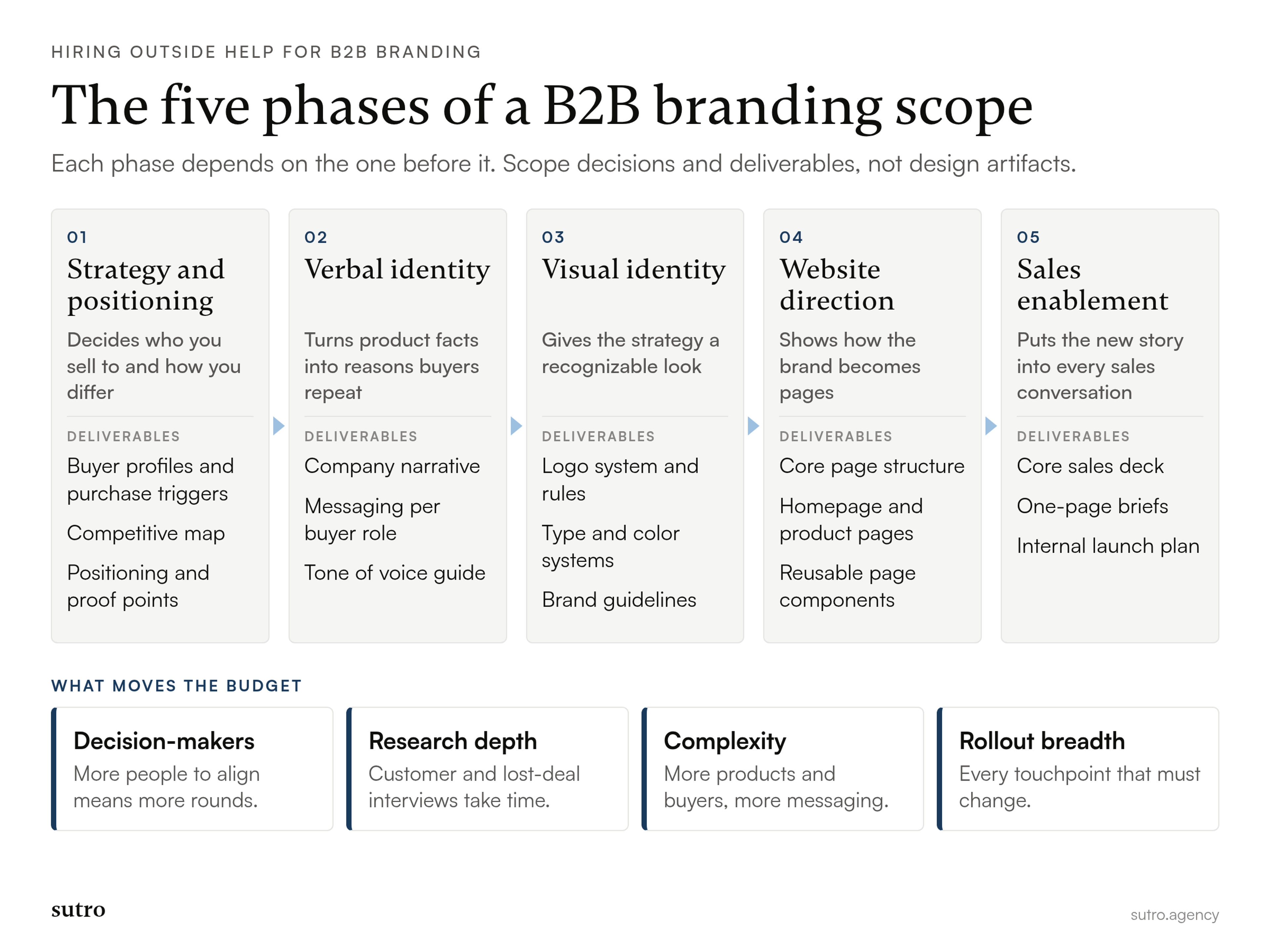
A complete B2B branding scope moves from research and strategy to verbal identity, visual identity, website direction and sales enablement. Each phase depends on the one before it, and skipping one leaves a gap the next phase can't fill.
Write the scope as a list of decisions and deliverables per phase, not as a list of design artifacts. For a stage-by-stage view of how these deliverables come together over time, see a step-by-step breakdown of brand development.
Strategy and positioning
Strategy decides who you sell to, what you promise and how you differ from the alternatives. Nothing else should start until it is agreed. A serious strategy phase includes stakeholder interviews, a competitive review and interviews with customers, ideally run by someone other than their account manager so the answers are candid.
Deliverables should include:
- Buyer profiles tied to the events that trigger a purchase
- A competitive map that shows where the open position is
- A positioning statement and the proof points behind it
- Brand principles that will guide verbal and visual choices
Verbal identity and messaging
Verbal identity turns what the product does into reasons a buyer can repeat. Technical companies struggle here most, because they default to features, infrastructure and API capabilities while economic buyers think in risk, cost and speed.
Deliverables should include:
- A core company narrative
- A messaging framework for each buyer role and, where needed, each vertical
- Tone of voice guidelines with examples of what to say and what not to say
- Boilerplates, short descriptions and, if useful, a tagline
Visual identity and the brand system
Visual identity translates strategy and messaging into a recognizable visual language. For a technical B2B company it has to signal stability to enterprise buyers while still reading as current.
Deliverables should include:
- A logo system with usage rules
- Typography and color systems checked for digital accessibility
- Guidelines for iconography, illustration, diagrams and product imagery
- A brand guidelines document that a new designer can work from without asking questions
Website direction
The website is where most buyers meet the new brand first, so the scope should cover how the identity and messaging become pages. That does not always mean a full build; often it means direction the in-house or web team can execute.
Deliverables should include:
- An information architecture for the core pages
- Designs for the homepage and key product or solution pages
- A component set that lets your team build new pages consistently
Sales enablement and rollout
Sales enablement is the phase most often cut, and it is the one that decides whether the investment pays back. A rebrand is an internal event first. If account executives can't explain the new positioning on a call, the market never hears it.
B2B purchases are made by groups, not individuals, and each person in that group asks a different question. Your sales team needs materials that answer each of them in the new language.
Deliverables should include:
- A rebuilt core sales deck
- One-page briefs for the main products or use cases
- Templates for the company and executive social profiles
- An internal launch plan that trains the team before the public launch
What drives the budget for B2B branding
B2B branding budgets vary widely because the same list of deliverables can hide very different amounts of research, senior time and stakeholder management. Market data gives a floor, and the complexity of your company sets where you land above it.
What the market data says
A review of 79 branding agencies on the30top in October 2026 found that 79% of the 62 that list a minimum project size set it at $10,000 or more, and 42% require $25,000 or more. In a 1,000-project sample of company rebrands, Sortlist found budgets from $10,000 to $60,000, with a median of $24,500. The same analysis notes that applying the brand across all touchpoints is often the largest cost, larger than the identity design itself.
Those figures describe the broad market, which includes small businesses and identity-only projects. A technical company at the inflection points I described above usually needs more than the median: primary research, a messaging framework for several buyer roles, a website direction and sales materials. Treat the market numbers as the starting point, not the answer.
The four factors that move the price
- Number of decision-makers. Aligning three founders takes days. Aligning a board, a CEO and several regional or product leaders takes weeks of presentations and iterations.
- Depth of research. Working from internal assumptions is cheap. Interviewing your most valuable customers and lost prospects takes trained interviewers and time.
- Product and audience complexity. One product for one buyer needs one narrative. A platform with several modules sold into different industries needs a messaging framework for each.
- Rollout breadth. The number of touchpoints that must change, from the website and decks to the product interface, documentation and events, often outweighs the cost of the identity itself.
When you compare budgets, ask what will be cut if the number goes down. If the answer is research or sales enablement, the lower quote is likely to cost more later.
How to compare engagement models
There are three common ways to structure the work. Compare proposals on how each one distributes risk, not only on the headline price.
Fixed-scope project
You pay a set price for a defined list of deliverables on a fixed timeline. Finance teams like the certainty. The downside is rigidity: if customer research shows you need a different website structure than planned, adding it becomes a change order.
Phased engagement
The strategy and research phase is quoted as its own project. Once the strategy is agreed and the real scope is visible, you get a firm quote for identity, messaging and website work. For complex technical companies this is usually the safest model, because you don't pay up front for risks that may never materialize.
Monthly retainer
You buy a fixed amount of capacity each month. Retainers work well after launch, for campaigns, new collateral and keeping the system consistent. They are a poor fit for foundational strategy, which needs a short, intense sprint rather than a few hours spread across many months.
The internal commitment the work requires
You can't outsource brand strategy and check back in three months. An outside partner brings the process, the objectivity and the design execution. Your company supplies the knowledge of customers, product and market, and the decisions.
The CEO has to take part. When a CEO delegates a rebrand entirely to a marketing manager, the project tends to stall at the end: the team spends weeks building a direction, presents it for final approval, and the CEO rejects it because they missed the decisions that shaped it.
Plan for the core leadership team to spend a few hours a week during the strategy phase, mostly in interviews, workshops and reviews. During design and rollout, the load drops to focused feedback sessions. Name one decision-maker with final approval before the project starts.
Questions to ask before you hire, and questions they should ask you
The right questions test method and fit, not portfolio polish. A good partner will also question you just as hard.
Ask the partner:
- How do you handle real disagreement among our executives during the strategy phase?
- Tell me about a technical B2B rebrand that did not work. What went wrong?
- Who will run the strategy day to day, and will that person be in our weekly meetings?
- What do you need from our sales team, and when?
- What exactly do we own at the end: source files, guidelines, templates?
Expect a strong partner to ask you:
- What business event is driving this work now?
- Who has final approval, and will they be in the strategy sessions?
- What happens if customer research contradicts what the team believes about why people buy?
- How will you measure whether the new brand is working in six and twelve months?
Red flags in branding proposals
Some proposals reveal early that the partner is not equipped for a technical B2B engagement. Read them for what they leave out as much as for what they include.
- Discovery shorter than a week. The partner plans to apply a template rather than learn your product and market.
- Pages on visuals, a line on messaging. If colors, type and logo variations dominate and verbal identity or sales enablement barely appear, you are looking at a graphic design proposal, not a brand engagement.
- Guaranteed revenue lifts. Brand perception changes over quarters. It shows up in win rate, sales-cycle length, pricing confidence and branded search, not in a spike of closed deals the week the new logo launches.
- No named senior people. If the proposal can't say who does the strategic work, assume it will be someone you haven't met.
- Vague ownership. If it is unclear who owns the files, fonts and templates afterward, you may pay again to use your own brand.
Conclusion
Hiring outside help for B2B branding is a commercial decision. It works when you tie it to a specific business event, scope every phase including sales enablement, budget for research and rollout instead of only design, and commit executive time from the start. Done well, the work moves the company from competing on features to being the vendor buyers already prefer when they start looking.
If your company is approaching one of those moments and you want a second opinion on scope and budget, send us your current scope and timeline.
Questions
- How long does a B2B branding project take?
- A full engagement that covers strategy, messaging, visual identity, website direction and sales materials usually runs several months. Strategy comes first and sets the pace, because identity and website work can't start until positioning is agreed. More decision-makers and products extend the timeline.
- Should we rebrand before or after a funding round?
- It is often easier after the round closes, because the budget is secured and the new brand can support the move upmarket that the capital is meant to fund. If the brand is actively hurting the raise, for example investors misread what the company does, positioning work before the round can pay off.
- Can our in-house team do part of the work?
- Yes. A common split is outside help for research, strategy, messaging and the core identity, with the in-house team handling website build, collateral and ongoing production from the guidelines. Agree on that split in the scope so nothing falls between the two teams.
- What is the difference between brand strategy and go-to-market strategy?
- Brand strategy defines who you are for, what you promise and how you sound and look. Go-to-market strategy defines the channels, segments and sales motions that capture demand. The two must agree, which is why sales enablement belongs in the branding scope.
- How do we know if a lower quote is a good deal?
- Compare what each quote includes line by line. If a lower price comes from less research, fewer stakeholder interviews or no sales enablement, the savings usually return later as rework or a brand the sales team doesn't use.